News · 8 August 2026 · 7 min read
'I spent $210,000 renovating and the valuation came back almost exactly what it was before. What did I do wrong?'
He did the kitchen, the bathrooms, the floors and the facade. The work was good. The valuation came back almost unchanged. The renovation wasn't the mistake — assuming the ceiling was a suburb number was.
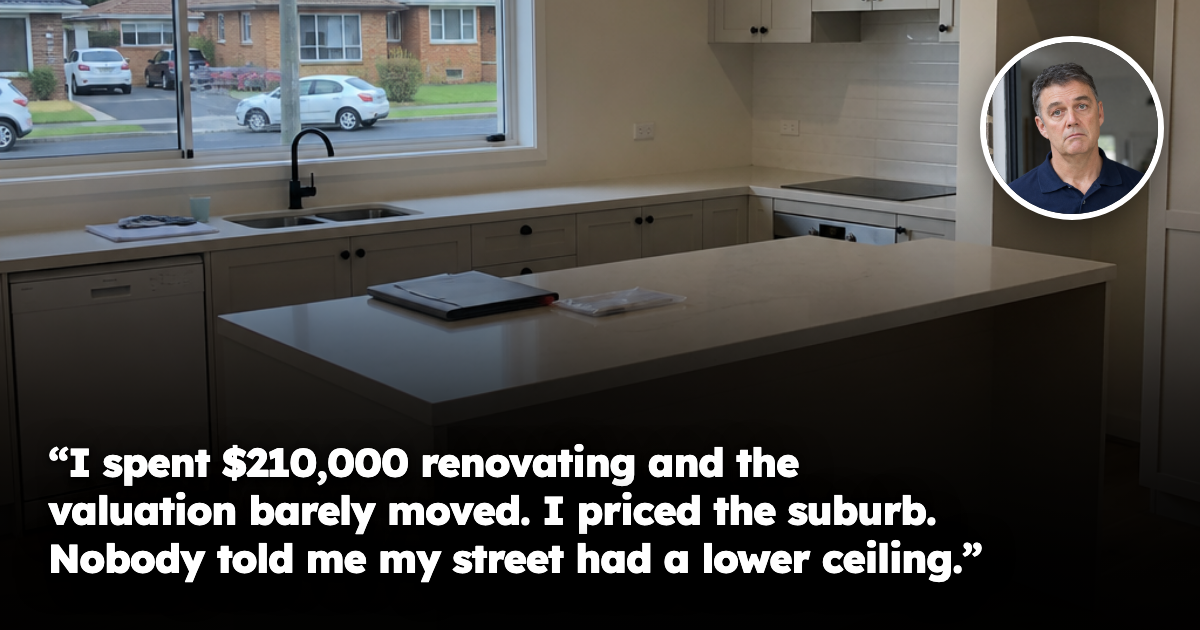
He sent us photographs before he sent us the question, which tells you how he was feeling about it.
The kitchen was genuinely good. Stone benchtops, decent cabinetry, a proper island. Two bathrooms redone to the same standard. Engineered oak through the living areas, new lighting, the facade rendered and repainted, landscaping at the front that someone had clearly thought about. Nothing gaudy. No purple feature wall, no cinema room, no swimming pool crammed into a courtyard. This was not a cautionary tale about taste.
The spend was $210,000 across about fourteen months. The valuation, when it came back, was almost exactly where the property had been sitting before he started.
His question was the one we get more than almost any other: what did I do wrong?
The uncomfortable answer is that he probably did the renovation right and the analysis wrong — and the analysis is the part nobody photographs.
The ceiling is real. Almost everyone puts it in the wrong place.
Ask any experienced selling agent about over-capitalising and you'll get a version of the same sentence: every suburb has a ceiling, and past a certain point buyers simply will not pay you back for the money you spent. Triple-glazed windows, commercial-grade appliances, imported tapware — buyers don't know what they cost and don't price them. You can spend past market expectations. You just can't get paid for it.
That advice is sound and it is repeated constantly. The problem is the word suburb.
A suburb ceiling is an average of a lot of very different streets. And the gap between the best and worst streets inside a single suburb is routinely larger than the gap between two suburbs on a map. We regularly see sale-price dispersion inside one postcode wide enough that the top street and the bottom street are effectively operating in different markets, with different buyers, different holding periods and different tolerance for a premium finish.
Here is how big these steps get, at a scale most owners never look at. In one Australian capital there are two suburbs that share a boundary — you can walk from one to the other in a few minutes — where the median house price differs by close to a million dollars. Not a different city. Not a different corridor. A shared boundary line.
If a ceiling can move by that much across one street corner, the idea that your renovation should be budgeted against a suburb-wide median stops making any sense at all.
He budgeted against the suburb. The suburb had room. His street did not.
What actually decides whether you get your money back
The honest version is that a renovation is not a value-adding act. It's a bet on a buyer pool. Whether the work helps or hurts depends almost entirely on what the buyers in that specific location want, and that's a demand question — which means it's a data question, not a taste question.
This is where street-level research earns its keep, and it's the core of what our research engine is built to answer. When we assess a property we're not looking at a suburb average, because a suburb average is a blend of the streets we'd fight for and the streets we'd avoid. We're looking at the street: the spread of sale prices along it over time, days on market compared with the suburb around it, the composition of the buyer pool — owner-occupier families versus investors versus downsizers — the stock profile, and how much of the housing on that run has already been upgraded.
That last one is the single most useful signal for anyone about to spend money, and it is invisible in a suburb report. If three-quarters of the homes on a street have already been renovated to a similar standard, a premium finish is table stakes and you'll be paid for it because you're matching the run. If yours would be the first, you are not setting a new benchmark — you are building the most expensive house on the street and asking the next buyer to pay a premium the surrounding sales don't support. Valuers are looking at those surrounding sales. So are lenders.
Days on market along a street tells you the same thing from the other direction. A street where good stock is transacting quickly has a competitive buyer pool that will bid for quality. A street where everything sits for months has buyers who are price-led, and price-led buyers do not pay for stone benchtops. They notice them, compliment them, and offer what the street offers.
There's a second-order effect worth knowing about too. Agents who sell in these streets consistently say a single visibly botched job — the one thing that was done cheaply or by an owner who shouldn't have — makes buyers doubt the quality of everything else in the house, including the work that was done properly. Value destruction isn't proportional. One weak element can discount the whole property.
Was his $210,000 wasted?
Not entirely, and we were careful not to tell him it was, because it wasn't true. We also didn't put a figure on the shortfall, because an honest answer is that nobody can tell you precisely what a renovation returned in isolation.
What we could tell him is what the money bought. The home is more liveable and he has a decade of use ahead of him. Well-executed work does shorten time on market and widens the pool of people willing to inspect. Presentation from the street — clean, maintained, cared-for — sets the tone before anyone walks in, and that is real. Some of the highest-return work is also the cheapest: a proper exterior wash instead of a repaint, a maintained front garden, decent lighting.
What the money did not buy was a new ceiling, because a renovation cannot lift a street. It can move you from the bottom of your street's range to the top of it. It cannot move the range. That distinction is the whole ball game, and it's the one that gets lost when someone reads a suburb median and mentally treats it as a target.
The scale of this is not small. Nationally, around $1.3 billion worth of residential alterations and additions is approved in a single month — very roughly $16 billion a year of Australians spending money on their own homes. Nothing in that approval process asks whether the street will pay it back. The council checks whether you're allowed to build it. Nobody checks whether it's worth building.
What this means for you
If you're weighing up a renovation, three things are worth doing before you commit:
Price the street, not the suburb. Find the highest genuine sale on your actual run in the last 18 months. That number is much closer to your real ceiling than any median. If your purchase price plus your renovation budget lands above it, you need a specific reason to believe you'll clear it.
Look at what's already been done around you. Renovating into a street of renovated homes is usually rewarded. Being the first is usually not. This isn't about being timid — it's about knowing which of the two situations you're in before you sign a builder's contract.
Separate lifestyle spend from investment spend, out loud. Plenty of renovations are worth doing purely because you'll enjoy living in the result. That's a completely legitimate reason. It only becomes a problem when it's quietly filed as an investment and the return never shows up.
For investors, the same logic runs in reverse and is arguably more useful. If a suburb median is an average of good and bad streets, then somewhere in every decent suburb there are streets performing well above the number everyone is quoting — and those are buyable. This is the part that gets missed in all the doom about renovation costs and softening conditions: the dispersion that punished this owner is exactly the thing that rewards a buyer who measures it. He bought a good property on an ordinary street and spent to a suburb number. Someone else, this month, will buy the same suburb on its best street and be paid for the same work.
Property remains one of the most reliable ways Australians build long-term wealth, and it hasn't stopped being that. But the returns are not evenly spread across a suburb, and they never were. They're concentrated on particular streets, in particular stock, at particular price points — and every one of those is measurable before you spend a dollar.
He asked what he did wrong. He researched a suburb and bought on a street. Almost everyone does.
If you want to see how street-level data changes the picture, our research on the difference a school catchment boundary makes to two identical houses shows the same effect from another angle, and our piece on why a block's physical characteristics decide what you can build on it covers the development side of the same question. For owners worried about how a property can be repriced by a document rather than by any physical change, our analysis of newly mapped flood designations is a useful companion read.
If there's a specific street you're weighing up right now, check its Street Score first — it's free, takes ten seconds, and tells you whether that street is pulling the suburb average up or riding on it.
Frequently asked questions
Why can a $210,000 renovation fail to increase a property's valuation in Australia?
Because the renovation may be better than the street's market will support. The article says the mistake was assuming a suburb-wide ceiling, when the real ceiling is often set by the specific street and its buyer pool.
What does the article mean by the 'ceiling' being on the street, not the suburb?
A suburb average blends very different streets, and sale prices can vary sharply within the same postcode. The article says the highest genuine sale on your actual street is often a better guide to value than the suburb median.
How do you tell whether a renovation will be paid back in your area?
The article says to look at street-level evidence, not just suburb data. Useful signals include sale prices on the street, days on market, who the likely buyers are, and how many homes nearby have already been renovated to a similar standard.
Does renovating at least make a home easier to sell?
Yes. The article says well-executed work can improve liveability, shorten time on market, and widen the pool of people willing to inspect. Good street presentation also helps buyers form a better impression before they walk inside.
What should an owner do before spending heavily on a renovation?
Price the street, not the suburb, and compare your purchase price plus renovation budget with the highest genuine sale on that street in the last 18 months. The article also says to be clear whether the spend is for lifestyle or as an investment.
General information only. It does not take your objectives, financial situation or needs into account, and nothing here is legal, financial, taxation or investment advice specific to your circumstances.