News · 12 August 2026 · 6 min read
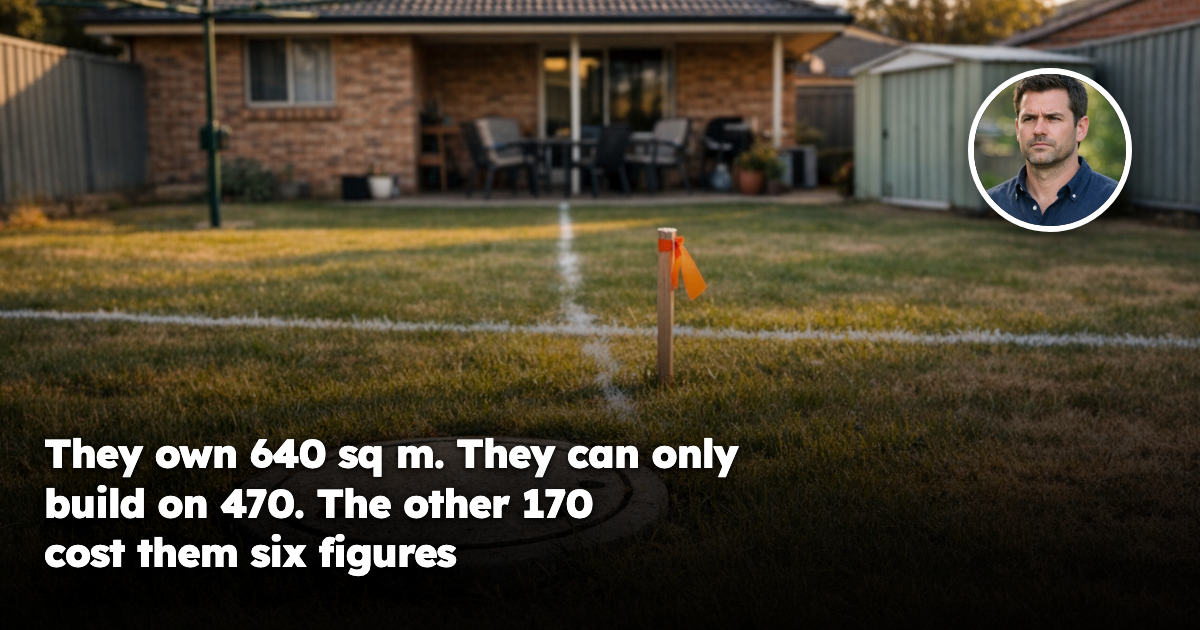
We paid for 640 square metres. The builder told us we own 640 and can build on 470
A sewer easement running through the back third of a block took 170 square metres out of a knock-down rebuild. The owners paid full price for that land and cannot build on it. With residential land now near $2,019 per square metre, easements are one of the most reliably mispriced features in Australian property — registered on the title, invisible from the street, and invisible to every suburb-level dataset.
A client asked us this a few weeks ago. It sounds like a technicality right up until you put a price on it.
He and his partner had bought an older house on a decent block in an established middle-ring suburb, with one plan: knock it down, build bigger, stay twenty years. They had checked the zoning, the lot size, and what the neighbours had been allowed to build.
Then the builder walked the block with the title in his hand and pointed at a round concrete lid sitting flush in the lawn.
A sewer main ran diagonally across the rear third of the yard, with an easement over it registered on the title. Roughly 170 square metres sat inside it. They owned that land. They paid for it. They pay rates on it.
They cannot build on it.
His question: is that land worth anything, and how did we not know?
The short answer
It was never hidden. It was on the title, and almost certainly on the plan attached to the contract — disclosed exactly as the system intends. What went wrong is more ordinary and more expensive than a disclosure failure: they read the words and never converted them into a number.
That is why easements are one of the most reliably mispriced features in Australian property. An easement is a line on a plan that most buyers glance at, file away as a legal formality, and never translate into square metres — and then into dollars.
What an easement actually does to a block
An easement is a right someone else holds over part of your land — usually a service authority (sewer, stormwater, water, sometimes power or a shared driveway) — so the asset underneath can be reached and replaced. The consequences are consistent nationally, though detail varies by state and by whichever authority owns the asset:
- You generally cannot build a permanent structure over or immediately beside the asset without the authority's approval, and that approval is not a formality.
- In most states the authority is an approval gate sitting underneath council. Council will not consent to a development application unless the asset owner has approved the plans first — and without that, no construction certificate.
- Published guidelines govern clearances: how close you may build, at what depth, with what footing design.
None of that is unreasonable — someone has to dig up the pipe, in the same way a road authority can remove anything built past a title boundary, as a Queensland owner learned when a wall and sign she had maintained for 22 years were removed and the cost billed back to her. But notice what it means: the easement does not reduce what you own. It reduces what you can do with what you own, which is the only thing that sets the price of land.
The number that makes this expensive
Here is why this stopped being a technicality.
Residential land in the major capitals is now priced at roughly $2,019 per square metre in new estates, up from about $1,000 in 2015. Over the same decade the average new block shrank by about 62 square metres. Since 2000, land prices have risen more than 500 per cent while construction costs rose around 150 per cent.
Now run our client's block through that arithmetic. About 170 square metres is encumbered. At the rates land transacts at, that is not a footnote on a title search. It is a six-figure line item he bought at full price and cannot use for the purpose he bought it for.
Look at the other end of the same logic. In one capital, a 110 square metre driveway sold for $1.25 million. A comparable sliver made $2.08 million. Narrow lots carrying live electricity substations sold at auction between $800,000 and roughly $1.8 million each.
Buyers pay seven figures for scraps because the scraps are buildable. Owners routinely pay full suburb rates for square metres that are not. The market prices buildable area precisely, and encumbrance barely at all.
This is a street-level problem, not a suburb-level one
Two houses on the same street can share every measurable field. Same postcode, same suburb median, same council, same zoning, same overlay, same catchment, same census profile. One has a sewer main running diagonally through the rear third of the block. The other has a clean run to the back fence.
They are not the same asset. One can take a knock-down rebuild with a decent footprint, a second dwelling, or a subdivision if the numbers work. The other cannot — and its owner finds out at the worst possible moment: after engaging a builder, or when a buyer's due diligence turns it up before settlement. Same street, opposite outcomes.
No suburb-level dataset can see that difference, because the difference is not a property of the suburb. It is a property of the title. A suburb median averages the encumbered blocks and the clean ones and reports a number that describes neither. It is the same shape as a single street tree worth $70,000 or a busy road 100 metres away — except an easement is invisible from the street. In our street-level work, development potential is one of the biggest single drivers of the 20–30 per cent effective-yield spread we routinely find between the best and worst streets inside a single suburb.
What to actually do
1. Get the title with the registered plan attached and find the easement on it. Not the description — the plan. Find the hatched strip and read its width.
2. Convert it to square metres, then to dollars. Width times length, multiplied by what land transacts at per square metre in that pocket. That one calculation tells you more than any building inspection.
3. Ask the asset owner what is possible. Some easements permit a great deal with the right footing design; others essentially nothing — and it is free to ask. The same discipline applies to any structure built without approval.
4. Price the property twice, with and without the encumbered area. If the deal only works when you count land you may never build on, the easement is not a detail. It is the investment.
The part that should encourage you
It is tempting to read this as another reason property is a minefield. It is closer to the opposite.
Land is the asset doing the work in Australian housing, and it gets scarcer and more expensive per square metre every year. That is precisely why a buyer paying attention can still find an edge: the market has become extremely good at pricing suburbs and remarkably poor at pricing individual titles. Every serious advantage in property comes from knowing something specific about a specific address that the people bidding against you have not looked up — and an easement is registered, public, cheap, and takes minutes to obtain.
Our client's block was fine. The main runs deep, the guidelines allowed more than he feared, and the rebuild footprint fits in front of it. He spent three weeks not knowing, because nobody had done the multiplication.
He researched a suburb, a zoning code and a price. He never measured the part of his own backyard he was not allowed to use. Almost everyone does it in that order — the same gap that let a historic contamination listing sit off one owner's title until a sale forced it into the open.
If there's a specific street you're weighing up right now, check its Street Score first — it's free, takes ten seconds, and tells you whether that street is pulling the suburb average up or riding on it.
Frequently asked questions
What is an easement on an Australian property title, and why does it matter for a knock-down rebuild?
An easement is a right another party holds over part of your land, often for sewer, stormwater, water or other services. It usually means you cannot build a permanent structure over or too close to that area without approval, so it can reduce your usable building area even though you still own the land.
How can a sewer easement affect the value of a block if the owner still pays for the land?
The article says the easement does not reduce ownership, but it does reduce what you can do with the land. If part of a block cannot be built on, that encumbered area should be priced differently because its development value is lower or sometimes effectively nil.
Why can two houses on the same street be worth very different amounts?
Because the difference may be on the title, not visible from the street or in suburb-level data. One block might have a service easement cutting through the usable yard, while the other has a clean build area, which can change its knock-down rebuild or subdivision potential.
What should a buyer check before relying on the full block size in a purchase?
They should get the title with the registered plan attached, locate any easement on the plan, and work out the square metres it covers. The article recommends converting that area into dollars and then asking the asset owner what can actually be built there.
Can you build over an easement if the land is already yours?
Sometimes, but not automatically. The article says approval from the asset owner is required and is not a formality, and council will usually not consent unless that approval is in place first.
General information only. It does not take your objectives, financial situation or needs into account, and nothing here is legal, financial, taxation or investment advice specific to your circumstances.