News · 6 August 2026 · 7 min read
‘We were three weeks from pouring the slab on a granny flat. Then my accountant read me one line and the whole thing stopped’
He had the plans, the quotes and a builder booked for a $180,000 granny flat. Then one line in the Budget papers stopped it: a granny flat next to an established property is not an eligible new build, but a duplex from a knock-down rebuild is. The tax question gets all the attention. The question that actually decides it — whether the block has the area, frontage, access and clear overlays to carry a second dwelling at all — is a lot-level fact no suburb average can answer.
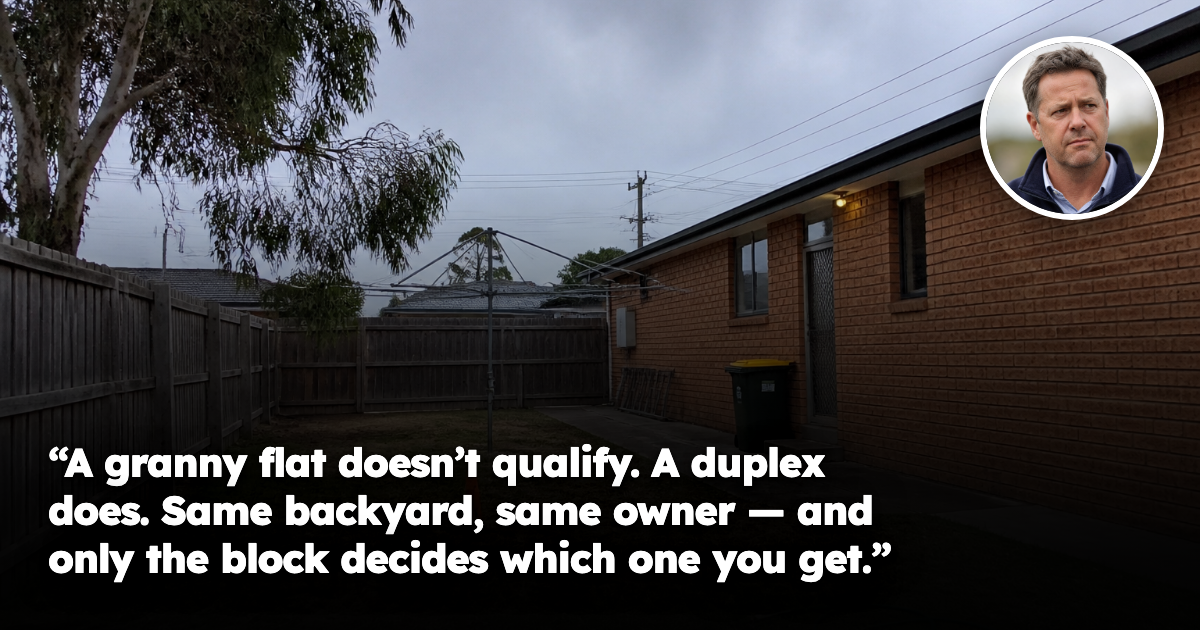
He had the quotes, the plans and a builder booked. A $180,000 two-bedroom unit at the back of an investment property he has owned for nine years, in a suburb where he already knew the rent.
Then his accountant read him one line out of the Budget papers and the whole thing stopped.
Under the negative gearing changes announced at 7.30pm on 12 May 2026, a granny flat built next to an established property is not a new build. A duplex built by knocking the old house down is. Same block. Same owner. Same backyard. In one version the tax system treats him as part of the housing solution. In the other, it doesn't.
"I'm not angry about paying tax," he told us. "I'm angry that nobody told me the shape of the building mattered more than the fact I was building one."
The question
"Is the granny flat dead? And if a duplex is the only thing that qualifies, does my block even fit one?"
We have had a version of this question almost every week since May. It is the second half that almost nobody asks first — and it is the half that decides the answer.
What the rule actually says
Take the emotion out and read the mechanics, because the detail is narrower than the headlines suggest.
From 1 July 2027, rental losses on residential investment properties purchased from 7.30pm on 12 May 2026 can only be offset against your other income if the property is a new build. Anything you already held at the announcement — including a contract signed but not yet settled — is grandfathered and keeps negative gearing until you sell.
That first point matters enormously and is routinely missed. If you owned it on Budget night, the rule as announced does not reach back and take negative gearing off you.
Losses that are caught aren't destroyed, either. They're quarantined: still deductible, but only against other residential property income — including a future capital gain — and carried forward until there's something to absorb them. For a lot of investors that's a timing cost, not a total loss. It only becomes permanent if you eventually sell for less than the accumulated losses.
There's a transitional window too: established properties bought after the announcement can still be negatively geared until 30 June 2027, with deductions denied from 1 July 2027.
And then there's the table. The Budget papers set out worked examples of what counts, and the pairings are unusually blunt:
- A newly constructed apartment bought off-the-plan — eligible
- A duplex from a knock-down rebuild replacing a free-standing house — eligible
- Any residential construction on previously vacant land — eligible
- A granny flat built next to an established property — not eligible
- An established house extended to add bedrooms — not eligible
- A single new house replacing an older, smaller house — not eligible
Read the second and sixth of those together. Knock the house down and build two dwellings, you qualify. Knock the same house down and build one, you don't. Leave the house standing and put a second dwelling behind it, you don't either.
The logic is coherent from a policy seat — the concession is aimed at net new supply at some scale. But it produces the outcome our reader ran into: two ways of adding one home to the same 700 square metres, treated completely differently.
Investors noticed fast. Enquiry for duplex builds reportedly jumped sharply within a fortnight of Budget night. Detail on the granny flat treatment was still being pressed months later.
The answer nobody gives him
Here is the part that actually determines his outcome, and it has nothing to do with tax.
A duplex is not a decision. It's a property characteristic. You cannot elect into it. Either the block can take two dwellings or it can't, and that is settled by a handful of physical and legal facts about that lot — not the suburb, not the postcode, not the market.
As a general rule of thumb you need around 600 square metres, a frontage wide enough to work with, and room for a driveway that gives both dwellings access. Then the site has to be big enough for what the local buyer pool actually wants — roughly 250sqm of building footprint for a four-bedroom townhouse, 175–200sqm for a three-bedroom, at least 150sqm for a two-bedroom unit.
Miss the frontage by a metre and a half and the entire tax question evaporates, because there is no duplex to have the argument about.
Then come the constraints that don't show up on any listing:
- Is dual occupancy even permitted under the planning controls on that lot? This is the first question, and most failed projects are lost right here.
- Overlays. Heritage is the big one. One state productivity review found that around a quarter of residential-zoned land within 10km of Sydney's CBD carries some form of heritage protection — the single biggest brake on backyard density in the country's most expensive market. Flood, bushfire and even aircraft noise contours do the same job elsewhere. These are lines on maps that stop at property boundaries, which is exactly why a suburb-level view can't see them. We made this same point about what a redrawn flood-risk line does to a house that has never flooded.
- Services. It is routine for an otherwise sound conversion to die on the cost of connecting power, sewer and water. Where the sewer main runs, and how deep, is a per-block fact.
- Fall of the land, easements, significant trees, battle-axe access. All lot-level. All capable of ending the project on their own.
This is the same problem we keep coming back to. Two houses on the same street, same median, same school catchment, can be entirely different assets — the $380,000 gap between two near-identical houses on different sides of a zone boundary was the same argument wearing different clothes. Development potential is the most extreme version of it, because the answer is binary. Your neighbour's block might be a duplex site. Yours might be worth exactly what it is worth today, forever, and the suburb average will never tell you which.
That's the work: reading the lot, not the label. Frontage, depth, area, fall, easements, overlays, service runs, and what the street's buyer pool will actually pay for a townhouse when it's finished. Street- and block-level data answers that question. A suburb median cannot even hear it.
What it means for you
Four practical things.
One — check your date before you panic. If you held the property before 7.30pm on 12 May 2026, you are grandfathered as announced. A large number of people currently worrying about this are not affected on that property at all.
Two — cost the quarantine, don't assume the worst. For a property that is caught, the loss isn't gone. Work out how many years it realistically takes to absorb, and what that's worth in today's money. Sometimes it's a rounding error. Sometimes it's the deal. You won't know until someone runs it.
Three — get the lot assessed before you get attached to a plan. Area, frontage, access, overlays, services. A few hundred dollars and a conversation with a town planner tells you whether you are in the duplex conversation or the granny flat conversation. Deciding which building you want before you know which one the block permits is how people end up where our reader ended up — three weeks out, fully committed, and asking the question in the wrong order.
Four — don't let the tax tail wag the asset. A granny flat still produces rent. It still houses someone. It can still be the right call on a block that can't take anything else — you just cost it as a cash-flow decision rather than a tax-deduction one. Be aware it usually can't be sold separately without strata title, and that adding a second dwelling can change your land tax and rates position, which is worth checking early rather than discovering later. That principle — that a tax change reprices an asset without changing what the asset does — is the same one we worked through when the negative gearing and CGT announcements first landed, and again when council land revaluations quietly moved investors into land tax.
The bigger picture
It is worth holding onto the scale of what's being argued over. Research put to policymakers late last year found that if just one in four standalone houses in our major cities became dual occupancies, it would unlock up to a million homes — without releasing a single new hectare of land. The backyards are already there. Hundreds of thousands of existing blocks are physically capable of carrying a second dwelling today.
That is the real story underneath the tax table: the most valuable undeveloped land in Australia is sitting behind houses people already own, and almost nobody knows whether their own block is part of it.
Our reader's block, as it turns out, is 640 square metres with a 17-metre frontage and the sewer running down the side boundary. It takes a duplex. He didn't know that three weeks ago, and he was about to spend $180,000 on the assumption that it didn't.
Tax rules change, and they will change again. What doesn't change is that the value in a property is set by the specific piece of ground it sits on — its size, its shape, its constraints, and what the street around it will pay. Headlines move sentiment. Blocks and streets move money. Investors who know precisely what they own, down to the frontage, keep finding opportunities in exactly the markets everyone else has decided are too hard.
If there's a specific street you're weighing up right now, check its Street Score first — it's free, takes ten seconds, and tells you whether that street is pulling the suburb average up or riding on it.
Market data & R-Scores for locations in this article
Drill Down Into the Markets Mentioned Above
Inspect live monthly R-Scores, median prices, rental yields, and street-by-street scores for the cities and council areas referenced in this article:
Frequently asked questions
If I already owned my investment property before 7.30pm on 12 May 2026, does the new negative gearing rule apply to me?
No, as announced, properties you already held at that time are grandfathered and keep negative gearing until you sell. The rule only applies from 1 July 2027 to residential investment properties purchased from 7.30pm on 12 May 2026.
What kinds of projects count as a “new build” under the Budget papers?
The article says a duplex built by knocking down an existing house can be eligible, as can a newly constructed off-the-plan apartment or residential construction on previously vacant land. A granny flat next to an established property is not eligible.
Why can’t I assume my block can become a duplex just because the suburb looks suitable?
Because duplex potential depends on lot-level facts, not suburb averages. The block needs enough area, frontage, driveway access and compliance with planning controls and overlays such as heritage, flood or bushfire restrictions.
What are the main things to check before planning a granny flat or duplex?
Check whether dual occupancy is permitted, then assess frontage, depth, area, access, overlays, services, fall of the land, easements and significant trees. The article says a town planner can help determine whether the block is in the duplex conversation at all.
If a granny flat is not eligible for the tax concession, is it still worth considering?
Yes, because it can still produce rent and suit a block that cannot take a duplex. The article says it should be treated as a cash-flow decision, while also checking land tax, rates and whether it can be sold separately.
General information only. It does not take your objectives, financial situation or needs into account, and nothing here is legal, financial, taxation or investment advice specific to your circumstances.