
News · 25 August 2026 · 5 min read
She bought the renovated home. Then the $42,000 defect became her legal problem
A downsizer discovers that building warranties can follow a property to a later owner — but the evidence behind a renovation may matter more than the fresh paint.
The question
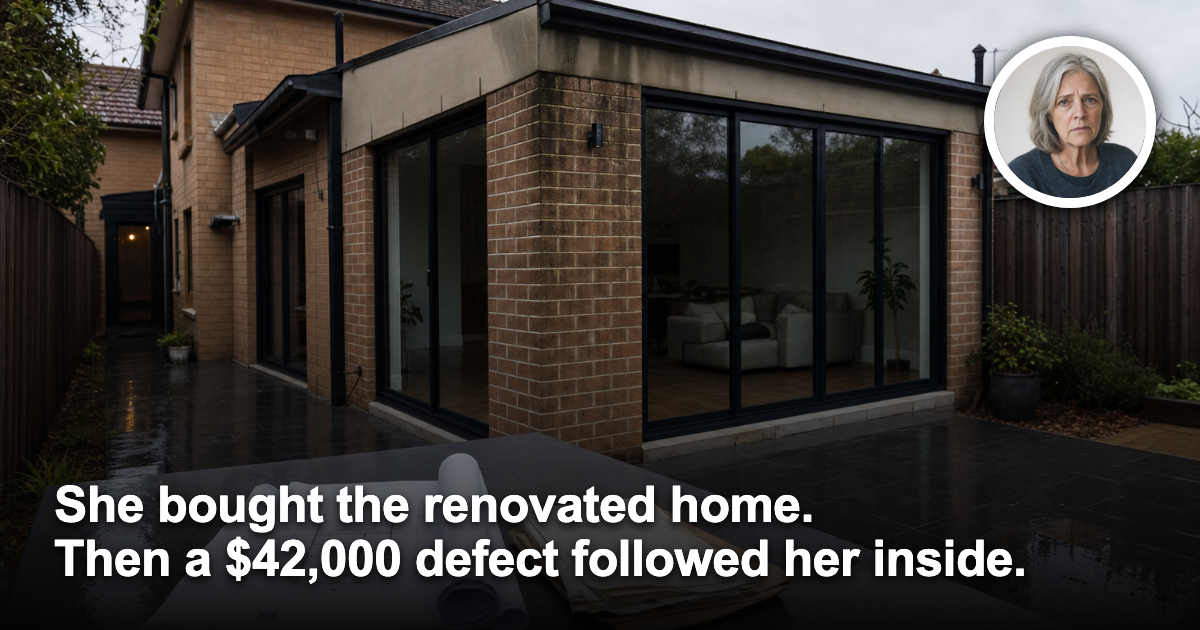
When a 69-year-old downsizer bought a renovated home, she thought the person who commissioned the work was the person who carried the risk. Nine months later, water began entering around a rear extension. The repair estimate was $42,000.
The sale contract contained a familiar-sounding warning: the buyer was accepting the property in its present condition, and the seller was not promising that any earlier renovation was perfect.
Her question to us was blunt: “If I did not sign the building contract, how can I claim anything from the builder? And if the contract says I accepted the house as it was, haven’t I already given that up?”
The answer is more useful — and more surprising — than many buyers realise.
The right may travel with the house
For certain domestic building work, the warranties are not simply a private promise between the original owner and the builder. They are implied into the building contract. They cover the way the work was carried out, the suitability and quality of materials, compliance with legal requirements, reasonable care and skill, completion within the agreed period, and whether a home or substantial renovation is suitable for occupation when completed.
The important part for a later buyer is that the current owner may be able to take proceedings for a breach as though they had been a party to the original contract.
That changes the usual mental picture. The buyer is not necessarily asking for a favour from the seller, and is not necessarily trapped outside a contract they never saw. The building itself can carry the benefit of the warranty to the owner for the time being.
This does not mean every cracked tile creates an automatic claim, or that every builder must pay whatever a later owner spends. The work, the defect, the contract, the timing and the available evidence still matter. But “I was not the original customer” is not always the end of the conversation.
Why the contract warning may not settle it
The next surprise is even more important during a purchase negotiation. An agreement or instrument that tries to remove or restrict a person’s right to take proceedings for a building warranty breach can be void to the extent that the breach was not known, or reasonably knowable, to that person when the document was signed.
That is not a licence to ignore a building report. It is a protection against a different problem: a buyer unknowingly signing away a right connected to a defect they had no reasonable way of identifying.
In this case, the rear extension looked dry on the day of the inspection. The staining was behind a finished wall. The seller disclosed that the extension had been completed several years earlier but did not have the original builder’s invoices. The buyer had no reason to know that the flashing had been installed incorrectly.
Her $42,000 estimate was not proof of liability. It was the number that forced the better question: what work was done, when was it completed, who carried it out, what did the original contract promise, and what was discoverable when she bought?
The evidence is usually worth more than the argument
The strongest next step is to build a chain rather than begin with outrage. Collect the sale contract, disclosure documents, building report, plans, permits or approvals, invoices, photographs, correspondence, dates of occupation and the engineer’s explanation of the failure. Ask whether the defect is consistent with a breach of a building warranty, ordinary maintenance, later damage or a combination.
The current owner may have rights, but rights still need a factual bridge. A builder’s name on an old invoice can be more valuable than ten pages of angry emails. So can a plan showing that the leaking section was part of the original renovation rather than an alteration made later.
The timing matters too. A warranty that runs with the building is not an unlimited insurance policy, and limitation rules can affect when a dispute must be started. A buyer who sees water entering should not wait for the next sale or assume the problem will become clearer by itself.
There is also a practical distinction between the legal right and the commercial outcome. The original builder may still be trading, may dispute the cause, may have insurance questions, or may be difficult to locate. The seller may have made a separate promise in the sale documents. A later owner can have a worthwhile claim without having a simple claim.
The street-level value question
This is where suburb averages become almost useless. Two renovated homes can sit four hundred metres apart, share the same suburb median and appear identical in an automated property report. One may have a clean chain of plans, certificates, invoices and completed defect rectification. The other may have an undocumented extension with no builder file and a $42,000 water problem hidden behind finished surfaces.
Ripehouse Advisory’s street- and property-level research is designed to expose that difference: the asset is not just the suburb, the bedroom count or the renovation photos. It is the evidence attached to the actual building. In the same suburb, the best and worst streets can show a 20–30 per cent effective-yield spread; a hidden construction risk can widen the gap again when it turns into a cash call.
Before buying a renovated investment, ask for the building story as carefully as the rental story. What was changed? Which contract covered it? Which approvals exist? Were defects identified and closed? Is there a warranty trail that a future owner can understand? The answers can affect price, insurance, finance and resale even when the house looks finished.
What it means for investors
The lesson is not to fear renovated property. Good renovation can create a better, more lettable and more durable asset. The lesson is to price the work, not merely admire it.
For this downsizer, the $42,000 problem changed the purchase from a lifestyle decision into an evidence exercise. The law may give a current owner a route into a warranty they never signed, but the route is strongest when the buyer can prove what was built, what failed and what was known at purchase.
The right property on the right street can still be an excellent investment. The edge is knowing whether the renovation is an asset — or an undocumented liability wearing fresh paint. Street-level data, building records and disciplined due diligence turn that uncertainty into a number you can negotiate before you exchange.
Read the related RHA analysis on why building warranties can run with the property, the renovation contract variation trap and what happens when a builder’s contract structure is unlawful.
If there's a specific street you're weighing up right now, check its Street Score first — it's free, takes ten seconds, and tells you whether that street is pulling the suburb average up or riding on it.
Frequently asked questions
Can a later buyer in Australia make a claim for defects in a renovated home if they never signed the original building contract?
Yes, for certain domestic building work the warranties can be implied into the building contract and may be available to the current owner as though they were a party to it. The article says “I was not the original customer” is not always the end of the matter.
Does a contract clause saying I accepted the property “as is” stop me from claiming for a hidden renovation defect?
Not necessarily. The article says a term that removes or restricts a person’s right to take proceedings for a warranty breach can be void to the extent the defect was not known, or reasonably knowable, when the document was signed.
What evidence should a buyer gather if water starts coming into a renovated extension?
The article suggests building a chain of evidence: the sale contract, disclosure documents, building report, plans, permits or approvals, invoices, photographs, correspondence, occupation dates and the engineer’s explanation. The key is to show what work was done, when, by whom, and what failed.
Why does the article say the builder’s invoice or plans can matter more than the fresh paint?
Because a later owner’s rights depend on proving what was actually built and whether the defect relates to that work. The article says a builder’s name on an old invoice or a plan showing the leaking section was part of the original renovation can be more valuable than appearance alone.
What is the main risk for buyers of renovated homes in Australia?
A renovated home can look complete while hiding an undocumented defect that becomes a real cost after settlement. The article warns that legal rights may exist, but the strongest position comes from knowing what was built, what failed and what was knowable at purchase.
General information only. It does not take your objectives, financial situation or needs into account, and nothing here is legal, financial, taxation or investment advice specific to your circumstances.