News · 25 August 2026 · 4 min read
“She owned the home. The park controlled the exit.”
A downsizer trying to sell a $420,000 manufactured home discovers that the site agreement, a six-month clock and a formal buyback process can shape the exit as much as the building itself.
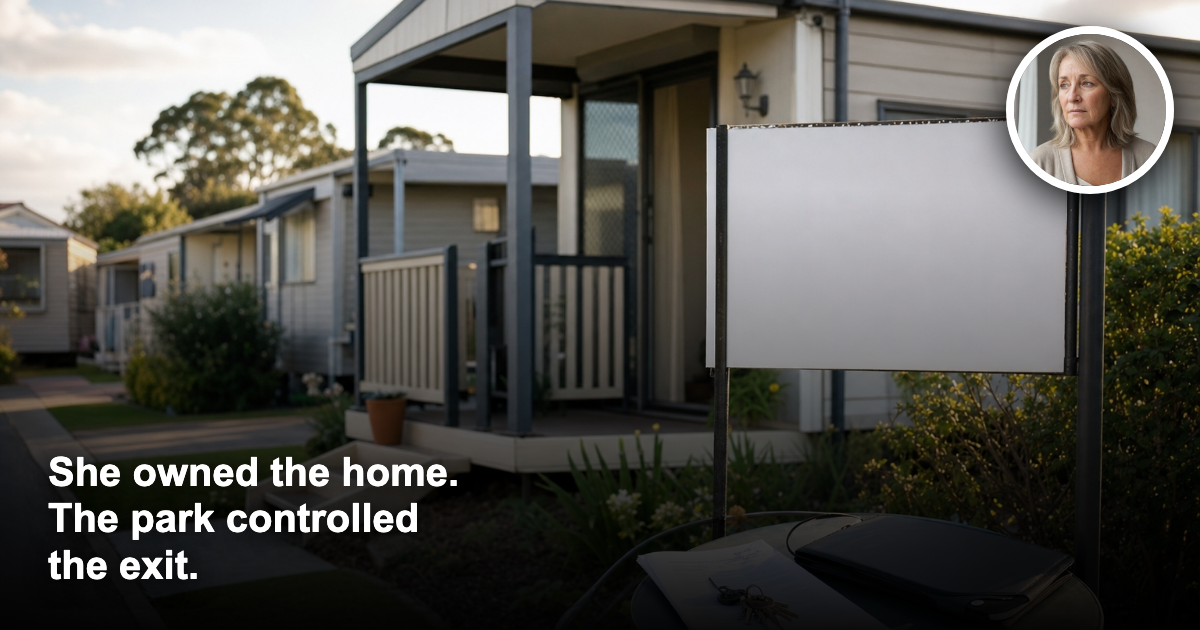
For 64-year-old Elaine, the plan looked simple: sell the three-bedroom manufactured home, move closer to her children and release the money tied up in it.
The home was advertised at $420,000. It sat in a well-kept residential park, had a renovated kitchen and a small garden she had spent years making manageable. She expected the buyer to care about the home itself. What she had underestimated was the second contract attached to the sale: the right to occupy the site beneath it.
After six months without a sale, Elaine was told there was another path. She could join a statutory buyback scheme. The phrase sounded like a guaranteed exit. It was not quite that simple.
The question
“If I own the home, why can’t I just sell it? And if the park has a buyback process, who decides what I get?”
It is a fair question because a manufactured home in a residential park is not the same asset as a detached house on its own title. The home can be privately owned while the land is controlled through a site agreement. That split can make the exit more complicated than the purchase.
The first protection is that the park owner must not hinder a home owner’s sale. That includes stopping potential buyers from inspecting the home. A park owner may offer selling services, but a fee is not automatically payable merely because a home changes hands. A selling authority needs to exist, and the park owner must be the effective cause of the sale before a sale fee can be charged.
That sounds like freedom. The buyback process introduces a timetable.
What happens after six months
For an eligible home — broadly, one that was already positioned in the park rather than brought there by its current or former owner — the home owner can give notice of an intention to sell. If the home remains unsold and unused for six months, the owner may opt into the buyback and rent-reduction scheme.
There are conditions. The owner must have stopped residing in, accessing or otherwise using the home. If the park offers seller services, the owner may also have to appoint the park as sole agent before opting in. Site rent does not stop simply because the owner has joined the scheme.
Once the scheme starts, the exit price is not whatever number feels fair on the day. The parties first have 14 days to agree in writing on the home’s resale value. If they cannot agree, they have a further seven days to jointly appoint a registered valuer.
If they cannot agree on the valuer either, the park owner must notify the chief executive. The home owner can do that if the park fails to act. A nominated registered valuer then becomes the required appointment.
The same valuation checkpoint can arise again at six months and nine months if no buyback agreement has been made and the home has not sold. The scheme is therefore a process with clocks inside clocks, not an instant cash-out.
The part many owners miss
If the park owner receives an offer at least equal to the buyback amount after being appointed to sell, the home owner must accept it. The scheme can protect an owner from being trapped indefinitely, but it can also narrow the room to keep negotiating once the statutory machinery is engaged.
That is the uncomfortable imbalance Elaine discovered. She owned the building, but the value of the building was inseparable from a site agreement, a park’s buyer process and the timing of a formal opt-in. A $420,000 asking price did not, by itself, create a $420,000 exit.
What it means for buyers and investors
The same suburb-level research that tells you where vacancy is falling will not answer the manufactured-home question. Two parks five minutes apart can have entirely different buyer depth, site-rent structures, resale rules and exit timelines. Even two homes in the same park can carry different risk if one has a longer site agreement, a different rent history or a buyer-facing condition that the other does not.
That is why Ripehouse Advisory looks below the suburb median. Street- and property-level checks can show the difference between a market that looks attractive in aggregate and an individual asset whose exit depends on a separate agreement. A suburb median has never sold a manufactured home; a buyer, a site agreement and a workable resale process do that.
Before buying, ask whether the home is eligible for any buyback scheme, when the six-month clock starts, whether the home must be unused, who can sell it, what fees may apply and what happens if the parties disagree about value. Ask for the complete site agreement and every disclosure document before treating the home price as the whole investment.
Elaine’s plan was not wrong. Her mistake was treating the building and the land arrangement as one uncomplicated asset. The better approach is to price the home, the site, the buyer pool and the exit rules together. Property investment still rewards people who do that work early: the right asset, on the right site, understood through the right data, can turn a complicated exit into a knowable one.
For a related look at how site arrangements can shape ownership outcomes, read when the home and the ground are owned separately, the $1,800 pet-bond deadline that changed a rental dispute, and the renovation variation that followed a hidden problem.
If there's a specific street you're weighing up right now, check its Street Score first — it's free, takes ten seconds, and tells you whether that street is pulling the suburb average up or riding on it.
Frequently asked questions
If I own a manufactured home in an Australian residential park, can I just sell it like a normal house?
Not always. The home may be privately owned, but the site beneath it is controlled by a site agreement, which can affect inspections, fees and the sale process. The park owner must not hinder the sale, but the exit is not the same as selling a detached house on its own title.
What happens if a manufactured home in a park doesn’t sell after six months?
For an eligible home, the owner can opt into a statutory buyback and rent-reduction scheme after the home has been unsold and unused for six months. The owner must have stopped living in, accessing or using the home, and site rent does not automatically stop when the scheme starts.
Who decides the price if the park buyback process is triggered?
The home owner and park owner first have 14 days to agree in writing on the home’s resale value. If they cannot agree, they have another seven days to jointly appoint a registered valuer, and if that still fails, the chief executive can be notified so a nominated registered valuer is appointed.
Can the park owner charge a sale fee when a manufactured home changes hands?
Not just because the home is sold. A fee is only payable if there is a selling authority and the park owner is the effective cause of the sale. The article also says the park owner must not stop potential buyers from inspecting the home.
What should a buyer check before purchasing a manufactured home in a residential park?
Ask whether the home is eligible for any buyback scheme, when the six-month clock starts, whether the home must be unused, who can sell it, what fees may apply and what happens if there is no agreement on value. The complete site agreement and disclosure documents are essential because they can shape the exit as much as the home itself.
General information only. It does not take your objectives, financial situation or needs into account, and nothing here is legal, financial, taxation or investment advice specific to your circumstances.