News · 6 August 2026 · 8 min read
‘I put the rent up $100 a week and my brother-in-law called me a parasite at a family lunch. Was I wrong?’
He owns one investment property. At renewal he put the rent up $100 a week, and his own family let him have it. The uncomfortable answer isn’t about greed — citywide rents rose about $50 a week last quarter while individual suburbs went up more than $150, and nobody in the argument had checked which number applied to his street.
He didn't ask us this in a meeting. He asked it in a car park afterwards, quietly, the way people ask questions they're embarrassed to have.
He's 44. He owns one investment property \u2014 a three-bedroom house in an outer-middle-ring suburb he bought in 2017. Not a portfolio. Not a trust structure. One house, bought because his parents told him property was how ordinary people got ahead, and he believed them.
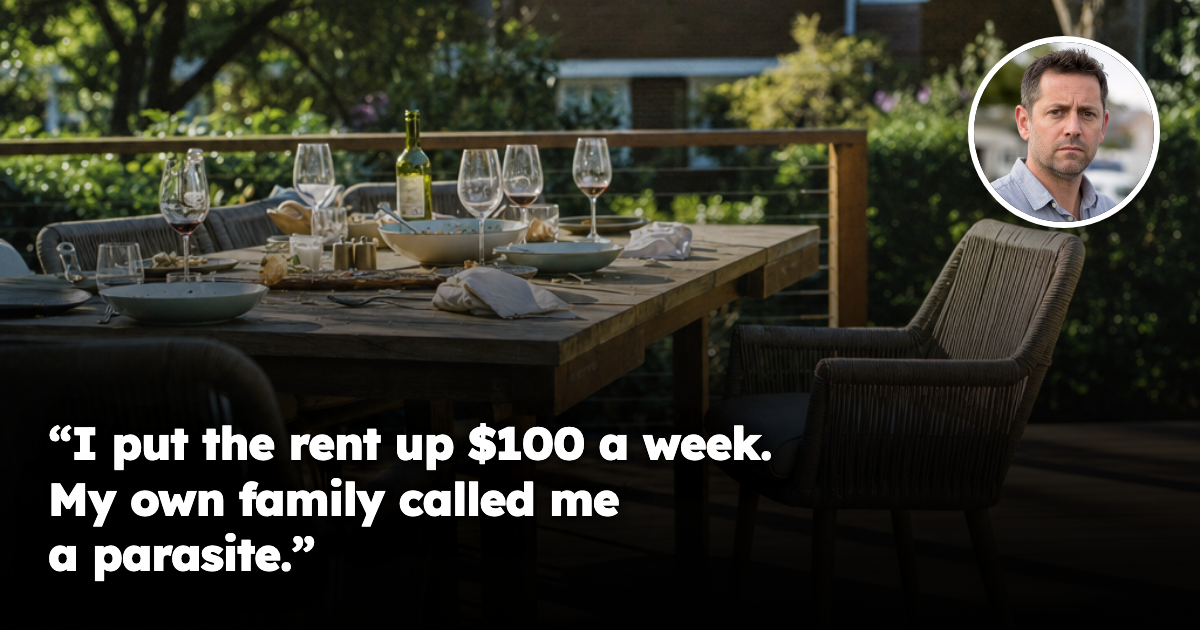
At renewal this year his property manager told him the place was letting well below what comparable homes were achieving, and recommended a $100 a week increase. He signed off on it. His tenant of four years \u2014 reliable, tidy, never late \u2014 pushed back hard. And at a family lunch a fortnight later, his brother-in-law said, in front of everyone, that putting the rent up $100 a week in the middle of a rental crisis was textbook parasite behaviour.
So he asked us the question he couldn't ask at the table.
Was I wrong?
The honest half of the answer
We're not going to pretend the tenant's side of this doesn't exist, because the numbers say it very clearly.
Rental affordability in Australia is at a record low. Tenant households are handing over a record share of their income just to keep a roof over their heads. The national median rent has climbed by more than $200 a week in five years. Advertised rents rose again in July, and the annual growth rate has now sat at 5.9 per cent for three consecutive months \u2014 around $40 a week added to the national median in a year.
Underneath that is a supply problem that nobody has solved. The national vacancy rate is 1.7 per cent. Anything under about 3 per cent is a market where tenants have no leverage; 1.7 per cent is a market where they have none at all. Rental listings have fallen over the past twelve months across every mainland capital. Dwelling completions are running roughly 27 per cent below the national housing target.
And the human consequence of that is not abstract. Close to half of Australian tenants reported struggling to pay rent in June. Around a third had already copped an increase in the previous six months. People are deferring medical and dental care to cover it.
So when his tenant reacted badly, she wasn't being unreasonable. She was being a person in a market with no exits. Any landlord who can't sit with that discomfort for a moment isn't thinking clearly about the asset they own \u2014 because tenant financial stress is not just a moral issue, it's the single largest driver of arrears, turnover and vacancy in your own portfolio.
That's the honest half. Here's the half his brother-in-law hasn't done.
The arithmetic half
His mortgage repayment on that property has risen substantially since he bought it. Council rates, insurance, water, management fees, maintenance and compliance costs have all moved in the same direction. The $100 a week doesn't make him wealthy. On his numbers it takes the property from bleeding cash every month to roughly breaking even.
That's the part that never survives the trip to a family lunch: most Australian landlords are not extracting a fortune. They own one property. Roughly half of property investors don't negatively gear at all \u2014 they're not running a tax strategy, they're running a small, thin, leveraged business with one customer.
But here's where we stopped agreeing with him.
Because the interesting question isn't "was the increase justified?" The interesting question is: why did this property need a $100 a week increase to stand up?
And that question has nothing to do with his tenant.
The part almost nobody checks
This is where the conversation usually turns, and it's the reason we think both sides of the argument are aiming at the wrong target.
Consider what actually happened in Sydney's rental market over one recent quarter. Citywide, house rents rose about 6.3 per cent \u2014 roughly $50 a week \u2014 to a record median. That's the number that makes the news. That's "the market".
Now look underneath it. Over a three-month window, individual suburbs in that same city recorded increases of more than $150 a week. Not 3 per cent \u2014 over 10 per cent, in a quarter. Other suburbs went up about $100. Unit markets in some pockets moved $75 to $150 while units citywide averaged about $30.
Same city. Same quarter. Same economy, same interest rates, same tax settings, same migration. Three times the average in some suburbs, and a fraction of it in others.
That spread is the whole story, and it doesn't stop at the suburb boundary. It keeps going down. Two streets inside one suburb \u2014 same postcode, same median, same school catchment, same train station \u2014 routinely produce materially different achieved rents, different vacancy periods and different days-on-market. One street lets in four days to a queue of applicants. The street behind it, on the same median, sits for five weeks and lets at a discount to a tenant who leaves in eleven months.
We measure that at street level: achieved rent rather than advertised rent, actual vacancy duration, days-on-market, tenant depth, and the supply pipeline that will compete with you at the next renewal. The gap between the strongest and weakest streets inside a single suburb regularly runs to 20\u201330 per cent on effective yield. It is not a rounding error. It is the difference between a property that funds itself and a property that needs a rent rise to survive.
Which brings us back to the car park.
The moral question and the data question are the same question
His property manager told him he was letting "below market". But which market?
If the honest street-level number for that specific house on that specific street was $100 a week higher, then he wasn't gouging \u2014 he was correcting a gap that had opened up over four years, and he'd effectively been subsidising the tenant without either of them realising it. That's a defensible position and he should stop apologising for it.
If the street-level number was, say, $40 a week higher and the $100 came off a suburb-wide median inflated by better streets, then he has just priced his house above what his actual location can hold. He'll likely get away with it once, because at 1.7 per cent vacancy tenants have nowhere to go. Then he'll get a vacancy, or an arrears run, or a tenant who stops reporting maintenance because she resents him \u2014 and every one of those costs more than the $5,200 a year he gained.
Nobody in that argument \u2014 not him, not his property manager, not his brother-in-law \u2014 knew which of those two situations he was in. They were all arguing about morality using a number none of them had checked.
The test is simple: is your rent increase tracking your street, or tracking your mortgage? One of those is a market position. The other is asking a tenant to fund a decision you made in 2017.
What this means if you own a rental
Three practical things.
Set rent off achieved data, not advertised data. Advertised rents tell you what owners are hoping for. Achieved rents, vacancy duration and days-on-market tell you what tenants actually paid, and how long the property sat before they did. Those are different numbers and only one of them pays your mortgage.
Get below suburb level. A suburb median rent is an average of streets that behave nothing alike. Using it to set the rent on one specific house is the same error as using a national average to value it \u2014 and we've written before about why suburb-level averages hide the real story at street level.
Price the relationship, not just the renewal. A good four-year tenant has a measurable dollar value: no vacancy, no re-letting fee, no advertising, no bond dispute, no three weeks of holding costs. That value belongs in the calculation. Sometimes the right answer is the full increase; sometimes it's a staged one; the point is that it should be a calculation and not a reflex.
The uncomfortable conclusion
The market is currently re-sorting itself, and it's re-sorting toward income. With the tax advantages of holding a loss-making property reduced, buyers who were purchasing a deduction are leaving, and buyers purchasing a rental income are replacing them. In Brisbane, gross yields in the strongest pockets are running between roughly 4.5 and 5.3 per cent, while the citywide price trend has turned negative for the first time in more than three years \u2014 which tells you, again, that the city-level number and the pocket-level number are answering different questions. It's the same divergence we saw when investor lending rose while auction volumes fell.
There's a warning in that for investors and an opportunity in it too. Fewer investors buying established homes, in suburbs with limited capacity for new development, means rental supply gets tighter, not looser \u2014 which is precisely why so many owners are now facing this conversation, and why we've argued that record rents make this a landlord's market with a catch.
But the catch is real. In a market where you can no longer rely on a tax outcome or a rising tide, the entire return comes from selection. You cannot buy almost anywhere and expect the same result any more. Rental demand, tenant depth, price discipline and street-level evidence now do the work that leverage and tax concessions used to do.
Which is the actual answer to his question.
He wasn't wrong to be a landlord, and he probably wasn't wrong to raise the rent. What he got wrong was much earlier and much quieter: he bought a house in 2017 on the strength of a suburb name and a general belief that property goes up, and nine years later he needed his tenant to close a gap that better research would have closed at purchase. The owners currently being called parasites are, overwhelmingly, the ones who bought an average. The ones who bought well are not in this fight \u2014 their properties hold good tenants at fair rents and still stack up, because the numbers worked before the rent rise, not because of it.
Property remains one of the most reliable wealth-building assets available to ordinary Australians, and a tight rental market with falling supply is, unsentimentally, a strong position for a well-selected asset to be in. But "well-selected" has stopped meaning the right city, and it stopped meaning the right suburb some time ago.
The mistake was never becoming a landlord. It was becoming one without ever finding out what his street could actually pay.
If there's a specific street you're weighing up right now, check its Street Score first — it's free, takes ten seconds, and tells you whether that street is pulling the suburb average up or riding on it.
Market data & R-Scores for locations in this article
Drill Down Into the Markets Mentioned Above
Inspect live monthly R-Scores, median prices, rental yields, and street-by-street scores for the cities and council areas referenced in this article:
Frequently asked questions
Was the landlord wrong to put the rent up by $100 a week on one investment property in Australia?
Not necessarily. The article says the real test is whether that rent matches the specific street-level market for that house, not just the suburb median or the landlord’s mortgage. If the increase reflects achieved rents nearby, it may be justified; if not, it may be pricing the property above what that location can support.
Why does the article say suburb averages are not enough when setting rent?
Because rental conditions can vary sharply even within the same suburb, and sometimes even between nearby streets. The article says one street can rent quickly at a premium while another sits vacant longer and leases at a discount, so suburb medians can hide the real market for a specific property.
What rental market conditions in Australia are making tenants and landlords feel the pressure?
The article points to record-low rental affordability, a national vacancy rate of 1.7 per cent, and rents rising strongly across Australia. It also says many tenants are struggling to pay rent, while landlords are facing higher mortgage, insurance, rates and compliance costs.
What should a property owner look at before deciding on a rent increase?
The article says owners should use achieved rents, vacancy duration and days-on-market, not just advertised asking rents. It also says they should go below suburb level and consider the value of keeping a good tenant, including avoided vacancy and re-letting costs.
What is the main risk of relying on a suburb-wide rent rise for one property?
If the property cannot actually achieve that higher rent on its street, the owner may end up with vacancy, arrears or a tenant who becomes unhappy and stops looking after the property as well. The article says those costs can outweigh the extra rent gained.
General information only. It does not take your objectives, financial situation or needs into account, and nothing here is legal, financial, taxation or investment advice specific to your circumstances.