News · 17 August 2026 · 5 min read
'There is no easement on my title. So how can a pipe I have never seen decide where my extension goes?'
She checked her title, found no easement, and designed the extension anyway. Then the certifier sent the plans to the water authority. Here is the provision almost nobody reads — and why the pipe next door can control your block.
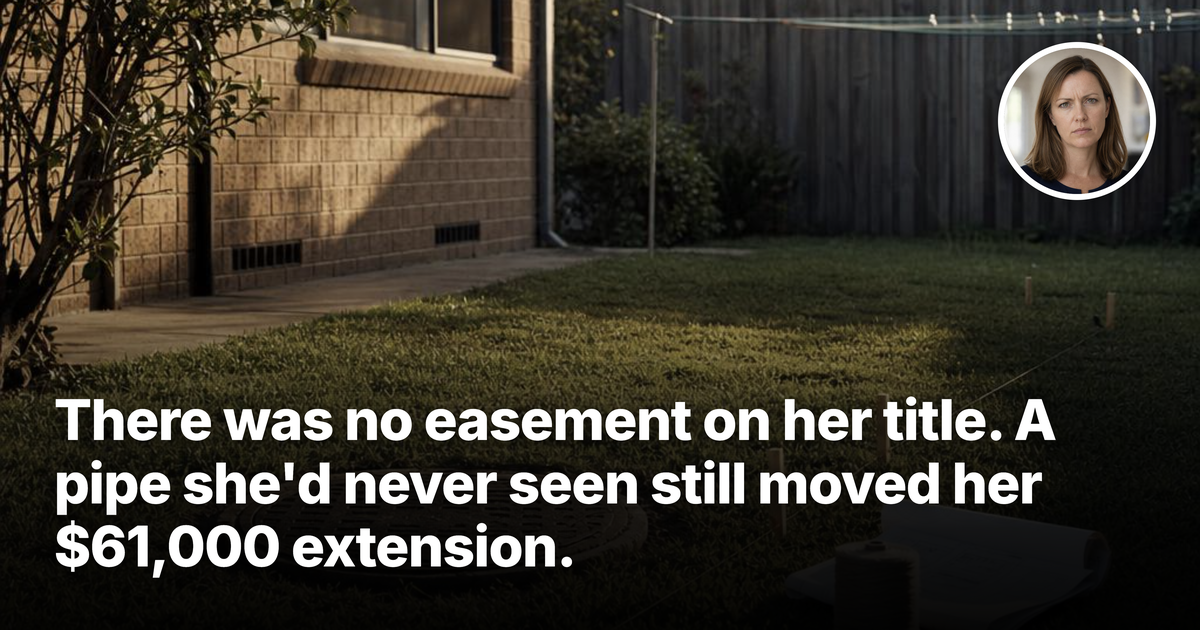
She did what everybody says to do. She ordered the title search, read it herself, then paid someone to read it again. No easement. No encumbrance. No caveat. Nothing over the back half of her block.
Eleven months later a rear extension she had already paid to design was sent away for someone else's approval — and it was not the council.
The situation
The owner is in her late thirties, an accountant, second property. A 1970s brick house on a 607 square metre block in a middle-ring suburb, bought partly because the backyard was deep enough to do something with later. Later arrived: a rear extension and covered deck, roughly $61,000. She knew what an easement was, and checked for one because a colleague had been caught by exactly that. There wasn't one, so she got on with it.
Then the private certifier told her the application had to be referred to the water authority before he could issue anything — and that the authority, not the council, would decide whether the deck could stay where it was drawn.
Her question, almost word for word:
"If there is no easement on my title, what is actually stopping me? And how does a pipe I have never seen get a vote on my own backyard?"
It catches out people who did their homework — because she had. She just checked the wrong document.
The short answer
An easement is a right recorded on your title. A build-over restriction is not. Two separate systems, and only one shows up in a search.
Sewers, water mains and stormwater drains are frequently laid across residential land with no easement registered at all — historically, through older estates, on the assumption nobody would ever build over the back of the block. The pipe is there. The title is silent. Both are true at once, and the second does not cancel the first. The version where the restriction is on the title, and you can at least measure it, is the easement case, where 640 square metres became 470 square metres of buildable land. This is the harder one: nothing to find.
Where the control actually sits
There is an offence provision saying a person must not, without the written consent of the service provider, build over, interfere with access to, increase or reduce the cover over, or change the surface of land in a way causing ponding over an access chamber for, that provider's infrastructure.
The very next subsection then says that despite all of that, a person does not require the written consent of the service provider if they are carrying out building work for a building or structure on a lot that contains — or is adjacent to a lot that contains — a sewer or water main.
Read that twice. The offence provision expressly steps aside for the most common situation on earth: someone building on a block with a sewer in it. So the control is not abolished. It moves — into the planning system, as a referral. The application goes to the service provider as a referral agency where the work is on a lot that contains, or is adjacent to a lot that contains, a sewer, water main or stormwater drain — and the design does not meet an acceptable solution in the relevant building code part, or is a class of structure that part states no acceptable solution for.
Nothing stopped her because of her title. She was referred because of where the pipe is and what she drew over it.
Three things that catch people
One: your neighbour's pipe binds your block. The trigger includes work on a lot adjacent to a lot containing the asset. A perfectly clear block can be pulled into the process by infrastructure that is not on it and not on its title.
Two: the asset owner assesses it, not the council. The referral agency is the service provider itself — for a stormwater drain, simply the owner of the drain. Their assessment is against performance criteria concerning that infrastructure. They are not weighing up whether your deck is nice. They are protecting a pipe.
Three: the manhole counts. In the definitions a sewer includes a maintenance cover — a cover, above, at or below ground level, through which a person, machine or device can access the pipe to inspect, maintain or replace it. That last word is why paving, decks and slabs over a cover cause trouble: access has to survive not just an inspection but an excavation, decades from now.
Why this is a street-level fact, not a suburb-level one
Two houses, same street, same zoning, same school catchment, same census profile. One has the main running down the side boundary where it belongs. The other has it cutting diagonally under the back third, at a depth nobody has measured since it was laid. On every metric an investor normally looks at — median price, days on market, vacancy rate, yield — those two properties are identical. In development capacity they are not remotely the same asset, and the market only finds out when someone tries to build.
That gap is the whole argument for street-level data. Across a single suburb we routinely see a 20 to 30% spread in effective yield between the best and worst streets — achieved rents, real vacancy duration, actual days on market. Underneath it sit per-lot facts like this one: what runs under the block, how deep, and whether the back yard is a future room or a permanent easement in everything but name. The same is true below the surface — two blocks on one street can carry different soil classifications and different footing costs for identical houses.
What she should have asked for
Not a title search. A sewerage service diagram — showing where the provider's assets actually run on and around the lot — obtained before the design was drawn. It costs very little and almost nobody buying an established house orders one. Her extension was not refused; it was moved, and the deck lost about a metre and a half. Far better than the version where the slab goes down first.
The part that should encourage you
None of this is hidden. The offence provision, the carve-out, the referral trigger and the definitions are all published, in force, and readable before you buy. Which means they are priceable — and almost nobody prices them, so the market prices the vague anxiety instead of the specific fact.
That is the opportunity, not the warning. Property remains one of the few asset classes where public information stays unpriced for years, and the buyer who reads one more document than everyone else gets paid for it. Rising costs punish the marginal deal — the one that only worked if nothing was under the lawn. Well-chosen land absorbs a surprise. A thin site bought on headline price does not.
She checked her title four times. She never once asked where the pipe was.
If there's a specific street you're weighing up right now, check its Street Score first — it's free, takes ten seconds, and tells you whether that street is pulling the suburb average up or riding on it.
Frequently asked questions
If my title search shows no easement, can a sewer or water pipe still affect where I build in Australia?
Yes. The article explains that a build-over restriction is separate from an easement, so a pipe can still affect your plans even when nothing appears on title. The control can come through the planning and referral process instead.
Why would a private certifier send my extension plans to the water authority instead of just approving them?
Because if your work is on a lot that contains, or is adjacent to, a sewer, water main or stormwater drain, the application may need referral to the service provider. The authority then assesses the design against its infrastructure-related criteria.
Can a neighbour’s pipe or drain still affect my backyard build if it is not on my lot?
Yes. The article says the trigger can apply to work on a lot adjacent to the lot containing the asset, so infrastructure next door can still bring your project into the referral process.
What information should I check before designing an extension to avoid this problem?
The article says to ask for a sewerage service diagram before the design is drawn. That shows where the provider’s assets actually run on and around the lot, which a title search will not tell you.
What part of a property is most likely to cause issues when building over pipes?
The article says the manhole or maintenance cover is a key issue because access must remain possible for inspection, maintenance or replacement. Paving, decks and slabs over a cover can create problems even if the title looks clear.
General information only. It does not take your objectives, financial situation or needs into account, and nothing here is legal, financial, taxation or investment advice specific to your circumstances.