News · 22 August 2026 · 5 min read
"My land tax tripled overnight. I objected — and they told me my objection never legally existed"
She objected to a land valuation that added $4,610 to her annual holding cost. The reply never mentioned value — it said her objection was never properly made, and was taken never to have existed at all.
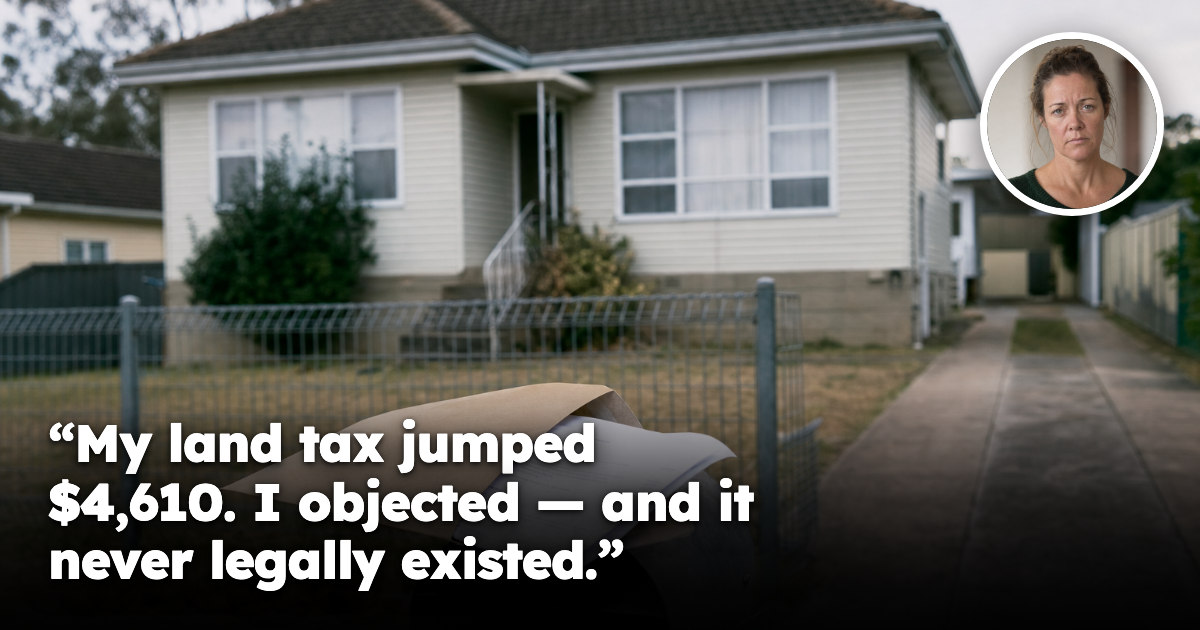
She is 45, single, and owns exactly one investment property. She bought it alone at 39 after eleven years of saving, and has never missed a payment. She is not a portfolio investor — one woman, one house, and a spreadsheet she keeps herself.
In the autumn a valuation notice arrived. The land under her property had been revalued upward by a margin she calls "not a rise, a reclassification." The building had not changed. The street had not changed. The land value had. Because that figure feeds her land tax and council rates, her annual holding cost moved by $4,610 — on a property whose rent had risen $1,040 in the same period.
So she did the thing everyone says to do. She objected. She wrote a careful letter explaining why the number was wrong, listed three nearby properties she believed were more comparable than whatever had been used, sent it well within the deadline, and waited.
What came back was not an argument about value. It was a notice saying her objection was defective, that she had 28 days to fix it, and — after she sent more of the same material — a decision that it was not properly made. Not rejected. Not lost. Deemed, in the words quoted back to her, never to have been made at all.
Her question to us was this: "How can they refuse to even look at whether the number is right, because of the way I filled in the form? And why am I still paying the bill while we argue about it?"
The answer nobody explains before the notice arrives
There are two separate questions in a valuation dispute, and almost every owner assumes there is only one. The first is whether your objection is admissible. The second is whether the valuation is correct.
The second is never reached unless the first is passed. The legislation is explicit: the decision-maker cannot consider or decide an objection that is not properly made. Not "may decline to." Cannot. The merits are not weighed and found wanting — they are not looked at.
What makes an objection "properly made" is a list, and every item is mandatory. Approved form. One valuation only. Signed by you, or by your agent with your written consent attached. Accompanied by the prescribed fee. And compliant with every content requirement — including the one that catches most people.
That requirement is not "state your grounds." It is: state your grounds, and state the information you rely on to establish each ground. Per ground. If you argue a nearby sale is comparable, you must give details of that sale, why you say it is comparable, and the basis of comparison. Miss that for one ground and it becomes a legislated "noncompliant ground." Miss it for all and the objection is not properly made at all.
The part that removes the safety net
When an objection is assessed as not properly made, the statute does not say it fails. It says it is taken not to be, and never to have been, properly made. It is erased backwards. It didn't lose — it never happened.
And because it never happened, the appeal right goes with it. The right to take the matter to court is expressly withheld where the objection is not a properly made objection. So the form defect is not reviewed by a court either. There is no forum in which anyone is ever required to ask whether the valuation was right.
Two further features deserve to be widely known.
You keep paying the disputed figure the entire time — the same trap as when a loan term quietly expires and the lender can call the balance up. Making an objection or appeal does not affect or interfere with the valuation, and it cannot be stayed in any proceeding — expressly overriding the court's own governing legislation. If you eventually win, an adjustment is made: overpayments refunded, underpayments recoverable as arrears. But you fund the disputed number throughout.
The number can move against you. The available decisions include disallowing the objection and changing the amount of the valuation. On appeal, the court may confirm, reduce or increase it. The onus of proof, in one flat sentence, sits entirely with you — with no matching obligation on anyone to justify the original figure. You bear your own costs.
Are the rules unreasonable? Not in design. Millions of parcels are valued annually and a challenge process without form requirements would be unworkable. There is a correction-notice stage, a late-objection pathway for incapacity or extreme circumstances, a conference process, and appeal tiers above the first court. Nobody behaved badly; every officer applied the law exactly as written — much like owners who discover a repair order attaches to the premises and transfers to the buyer, or unit owners outvoted on terminating their own scheme. Her problem is that the law was written for people who already knew what it required.
What this actually means for you as an investor
Two houses can sit four hundred metres apart on the same street, in the same postcode, with the same council, the same school catchment, the same median and the same growth rate — and carry entirely different land values, because land value tracks the land, not the suburb. One is on a larger parcel with a subdivision-capable frontage. One is on a battle-axe behind it. Their suburb reports are word-for-word identical. Their annual holding costs are not.
This is the whole argument for street-level data over suburb averages. A suburb median has never once read a valuation notice. What determines whether your investment works is measured at the street: achieved rents rather than asking rents, true days on market, real vacancy duration, genuine street-level supply and demand — where the gap between the best and worst street in one suburb routinely runs 20–30% in effective yield. Holding cost belongs in that column, and almost nobody puts it there.
She did not lose because the system is rigged. She lost because she treated a statutory process as a letter, and budgeted a property on rent and repayments without ever asking what the land underneath it was likely to be valued at, or how narrow the window to contest that would be.
All of it was published and readable years before her notice arrived. The sixty-day window. The fee. The per-ground information requirement. The retrospective nullity. The no-stay rule. None of it was hidden; it was simply never going to come and find her.
That is the real lesson, and it is a pro-investment one. Property remains one of the few assets where the rules governing your costs are written down, in public, in advance. A threat happens to you. A risk you can read is a line item — and a priced line item is an edge over every buyer at that inspection who never looked.
She is objecting again next cycle, properly this time. What she wishes someone had told her is that the hardest part of a valuation dispute was never the valuation.
If there's a specific street you're weighing up right now, check its Street Score first — it's free, takes ten seconds, and tells you whether that street is pulling the suburb average up or riding on it.
Frequently asked questions
Why can a land tax objection in Australia be treated as if it was never made?
The article says an objection must be “properly made” under the legislation. If it does not meet every required step, it is taken not to have been made at all, so the decision-maker cannot consider the valuation itself.
What does an owner have to include for a land valuation objection to be valid?
The objection must be in the approved form, relate to one valuation only, be signed correctly, include any prescribed fee, and state both the grounds and the information relied on for each ground. Missing those requirements can make the objection invalid.
Can you stop paying land tax or council rates while a valuation objection is being decided?
No. The article says making an objection or appeal does not affect the valuation, and the disputed amount still has to be paid while the process runs. If the owner later succeeds, overpayments can be refunded.
Can an incorrect land valuation be challenged in court if the objection form was defective?
Not according to the article. If the objection is not properly made, the right to take the matter to court is withheld, so the court does not review the defect or the valuation on that path.
What is the main practical lesson for Australian property investors from this story?
The article says investors should budget for land tax and holding costs using street-level data, not just suburb averages, because land values can differ sharply even within the same suburb. It also shows that valuation disputes have strict deadlines and form requirements that need to be understood in advance.
General information only. It does not take your objectives, financial situation or needs into account, and nothing here is legal, financial, taxation or investment advice specific to your circumstances.