News · 8 August 2026 · 9 min read
My home insurance renewal tripled. I have never made a claim, and nothing about the house has changed
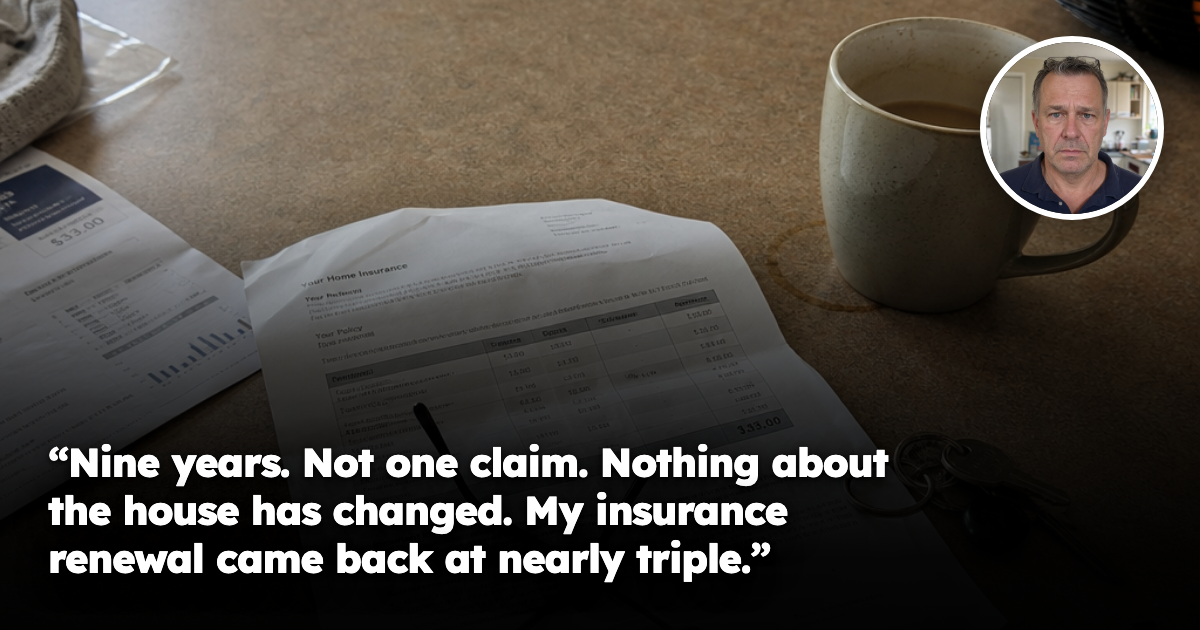
He has owned the house for nine years, never made a claim, and changed nothing about it. His renewal came back at almost three times last year's premium. Here is what the insurer is actually pricing — and why the most useful thing about that number is that it is the only genuinely honest second opinion anyone will ever give him about his property.
He is a careful owner. That is the first thing to say, because the story only works if you understand that he did nothing wrong.
He bought the house in 2017 — a three-bedroom brick place he rents out, bought with his wife as their one and only investment, chosen because it was near a train line, in a suburb they'd looked at for two years, at a price they could carry on one income if they had to. He has never missed a mortgage payment. He has never lodged an insurance claim on it. Not once in nine years. No storm damage, no burst pipes, no tenant incident, nothing.
In July his renewal notice arrived. The premium was almost three times what he paid the year before.
He rang the insurer, expecting to be told it was an error. It wasn't an error. He got a polite explanation about risk modelling and reinsurance costs, an offer to increase his excess, and a suggestion that he shop around. He did shop around. Two of the quotes were worse. One insurer wouldn't quote at all.
His question, and we now get some version of it several times a week, was this: "Nothing about my house has changed. Why has the price of owning it changed this much — and what is it telling me?"
Why the number moved when the house didn't
The instinct is to treat a premium rise as a billing problem — an annoyance to be solved by switching, raising the excess, or complaining. Sometimes it is. Often it isn't, and treating it that way is how owners miss the actual message.
Three things are happening at once, and only one of them is about him.
The first is that the cost of insuring the insurer went up. Insurers buy their own cover for large-scale events. When global catastrophe losses run high for several years, that wholesale cost rises, and it rises for the whole book at once — not for the properties that claimed. This is why a spotless claims history is far weaker protection than most owners assume. You are not being punished for your record. You are being repriced along with everyone who shares your hazard exposure.
The second is that risk models have become far more granular. Insurers have spent the past several years rebuilding how they assess an individual address — elevation, distance to a watercourse, slope, vegetation proximity, soil movement, construction era, roof type, and how similar structures nearby have actually behaved in real events. A property previously priced as part of a broad postcode band may now be priced closer to what it is. That can move a premium sharply in either direction without a single thing changing at the property. The house didn't change. The resolution of the assessment did. It is the same phenomenon we wrote about when a redrawn flood map repriced a house that had never flooded — arriving this time as a price rather than a line on a map.
The third is that a portion of the bill isn't insurance at all. In parts of the country, a meaningful slice of a home insurance premium is made up of taxes, duties and levies applied on top of the risk price. When the underlying premium rises, those charges rise with it, because several are calculated as a percentage. The compounding is not obvious on the notice.
So the honest answer to the first half of his question is: the market's estimate of what it would cost to rebuild his particular house, in his particular spot, after a bad event, moved — and part of the bill escalates automatically when that estimate does.
The part almost nobody takes seriously
Here is where it stops being a billing story.
The country's financial stability watchdog now lists home insurance affordability as a genuine risk to household resilience — not because insurers are in trouble, but because owners are. Insurers are profitable and well capitalised. The concern is the other side of the transaction: that as premiums climb, more households quietly respond by reducing cover, raising excesses beyond what they could actually fund, or dropping cover altogether — and that this builds up an underinsurance problem that only reveals itself after something happens.
That is the trap, and it is a dangerous one, because every step into it feels responsible at the time. Lifting an excess to $2,000 feels prudent. Trimming the sum insured to the figure you paid for the house feels like sensible economising — until you discover the sum insured needs to cover rebuilding, which is a construction cost, not a market value, and construction costs have risen far faster than most owners' sums insured have. Two properties can be identically "insured" and one of them is not.
There is also a mechanical point owners with a mortgage should check rather than assume. Most standard home loan contracts require the security property to be insured for the life of the loan. Letting cover lapse to save money may be a breach of the loan contract — a reason to read your own facility documents before making a decision that feels like it only affects you.
None of this is advice about your policy. Sum insured, excess levels and cover type are decisions for a broker or licensed adviser who can see the actual building. What we can be useful about is the other question — the one he asked second, and the one almost nobody asks at all.
What the premium is actually telling you about the asset
Here is the reframe that changed his thinking, and it is the most valuable thing in this article.
An insurance quote is the only genuinely honest second opinion anyone will ever give an owner about their property.
Consider who else offers you a number. An agent's appraisal is a pitch — produced by someone who wants the listing, free precisely because it costs them nothing to be optimistic. A bank valuation is a lending decision dressed as an opinion, conservative by design, existing to protect the lender rather than inform you. A neighbour's sale price is one transaction on one day. A suburb median is an average of a lot of properties that are not yours.
An underwriter is different. An underwriter is the only participant in the entire process who has to put their own money behind their opinion of your specific address, for a defined period, in writing. If they are wrong about your property, they pay. That is a fundamentally different kind of number, and it is priced at the level of the individual building — not the suburb, not the postcode, not the median.
Which is why the interesting comparison is never "my premium versus last year". It is your premium versus the premium on an equivalent house a few streets away.
This is where the thing we spend our working lives measuring shows up in an unfamiliar form. Our research is built on the observation that a suburb is not a unit of analysis — that within one suburb, sharing a median, a postcode, a council and a train station, the gap between the best and worst streets is routinely enormous. On the rental side we regularly see a 20–30% spread in effective yield between the strongest and weakest streets inside one suburb, using achieved rents, actual vacancy duration and real days-on-market rather than advertised figures. It is the same dispersion that explains why a $210,000 renovation can come back valued at almost exactly what the house was worth before: the range is set by the street, not the suburb.
Insurance pricing is that dispersion expressed as a cost instead of a return — by someone with money at stake. Two houses in one suburb, similar age, similar build, similar median, can attract materially different premiums because one sits eleven metres higher, or further from a creek line, or on a different soil profile, or backs a reserve rather than bushland. Nothing in the suburb-level story sees any of that. The underwriter sees all of it.
So the useful question is not "how do I get this number down". It is: is my premium normal for my area, or is my property being singled out inside it? Those two situations demand opposite responses. If the whole district has repriced, that is a market-wide cost of carry — it applies to every competing property including the ones a buyer might choose instead, and it is something to plan around. If your address specifically is priced worse than its neighbours, an insurer has just told you something about your asset that no agent, no valuer and no median will ever volunteer.
For his property the answer was mostly the former with a component of the latter — a familiar, slightly awkward result. It also gave him something he'd never had: a concrete forward-looking holding cost, the number that actually determines whether a long hold works, and which almost nobody models properly when they buy.
What this means for you
The practical sequence is short, and none of it requires you to do anything dramatic.
Get your sum insured checked against a rebuild cost, not a purchase price. These are different numbers and the gap between them has widened considerably. It is the single most common defect we see, and it costs nothing to correct.
Before you reduce cover, read your loan contract. The saving may not be yours to make.
Compare sideways, not backwards. Your premium against comparable properties nearby tells you far more than your premium against last year's.
And — the one almost nobody does — get an indicative quote before you buy, not after you settle. A premium is available to any prospective purchaser on any address, usually within minutes, at no cost, before contracts are signed. It is the cheapest and most candid piece of due diligence in Australian property, and it is almost universally skipped, because buyers treat insurance as an administrative task that follows the decision rather than information that should inform it.
The part that should make owners more confident, not less
It would be easy to read all of this as a reason to be nervous about property. It isn't, and the underlying numbers say otherwise fairly emphatically.
Australian household balance sheets are, in aggregate, in good shape. Housing values have risen substantially over the past four years despite a large increase in interest rates. The share of owners in negative equity is very small. Arrears remain low and have been improving. On modelling of a severe shock — a housing price fall of the order of 40% — the large majority of mortgage holders would still hold positive equity. This is not a fragile ownership base.
What is changing is not whether property works. It is that the cost of carrying a property is becoming a much sharper discriminator between assets than it used to be, and rising costs never fall evenly — the same pattern we traced through a land revaluation pushing owners over a tax threshold without them buying anything. Insurance is the clearest example yet, and the most informative, because unlike a statutory charge it is set by someone who has done detailed work on your specific address and has to live with the answer. It will barely register on a well-selected property and steadily grind down a marginal one. Over a decade that difference compounds into a materially different outcome for two owners who both believed they had "bought in a good suburb".
That is not an argument against owning property. It is an argument against owning an average one — and an argument for finding out, before you commit, which side of the average your particular address sits on. The information exists. Some of it, remarkably, is available for free in about four minutes, from an insurer, to anyone who thinks to ask before they buy instead of after.
He had owned the house for nine years before anyone gave him a properly priced opinion of it. Almost everyone does it in that order.
If there's a specific street you're weighing up right now, check its Street Score first — it's free, takes ten seconds, and tells you whether that street is pulling the suburb average up or riding on it.
Frequently asked questions
Why can a home insurance premium jump even if I’ve never made a claim and nothing about the property has changed?
Because insurers may be repricing the risk on the address, not punishing your claims history. The article says higher reinsurance costs, more granular risk modelling and taxes or levies can all push the premium up.
What is home insurance actually pricing in Australia?
It is pricing the expected cost of rebuilding that specific house in that specific location after a major event. The insurer may look at factors like elevation, flood exposure, slope, vegetation proximity, soil movement, roof type and construction era.
Should I compare this year’s premium with last year’s, or with other homes nearby?
The article says the more useful comparison is against equivalent houses a few streets away. A rise from last year may reflect a broader market repricing, while a much higher premium than nearby similar homes can signal your address is being singled out.
What is the biggest risk if I respond to a higher premium by cutting cover?
The main risk is underinsurance. The article warns that trimming the sum insured to a purchase price, or raising the excess beyond what you could actually pay, can leave you short when rebuilding costs are much higher than expected.
What should I check before reducing my home insurance or letting it lapse on a property with a mortgage?
Read your loan contract first. The article notes that most standard home loans require the security property to stay insured for the life of the loan, so letting cover lapse could breach the loan agreement.
General information only. It does not take your objectives, financial situation or needs into account, and nothing here is legal, financial, taxation or investment advice specific to your circumstances.