News · 5 August 2026 · 8 min read
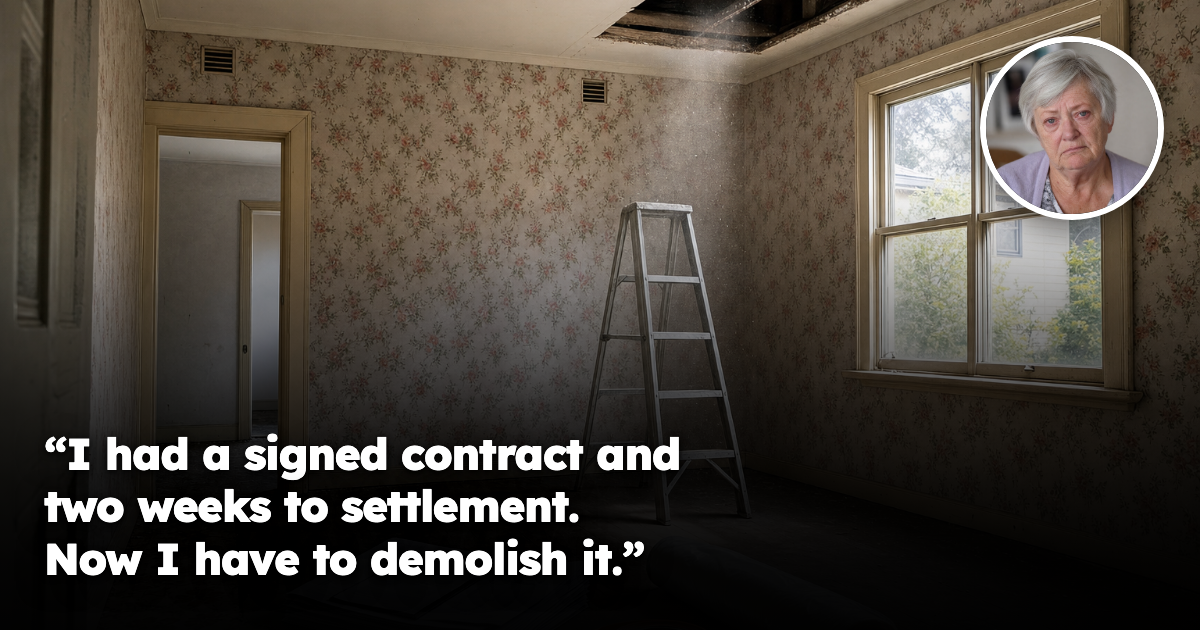
‘I had a buyer, a signed contract and two weeks to settlement. Then the council issued a work order and I had to demolish my own house’ — how did nobody find this?
She booked a tradesman to install an air-conditioner before selling the home she’d owned for 50 years. He found asbestos in the ceiling. Eight months later she was couch-surfing at her children’s houses and facing a $115,000 demolition bill her insurer refused to pay. One in three Australian homes built before 1990 contains asbestos — and the report most buyers rely on isn’t designed to find it.
It started with an air-conditioner.
A retired homeowner in Perth's northern suburbs had decided it was time. She was 76, widowed, and after more than fifty years in the same house she was ready to downsize and live on the proceeds. Before listing, she did what a sensible vendor does: she spent a bit of money making the place more saleable. A new air-conditioning unit seemed like an easy win.
The contractor opened up the ceiling and stopped work.
What followed was eight months most owners never contemplate when they picture selling the family home. Professional testing. Air monitoring. Council directions, all of which she followed and paid for. Eventually she was cleared to sell, went to market, and an offer came in and was accepted.
Two weeks before settlement, the local government issued a work order on the property.
Assessors had found asbestos through the ceiling, the wall cavities and the living areas \u2014 a concentration described as a scale rarely encountered even in industrial buildings. The sale was gone. Her options narrowed to two: a large-scale manual removal of loose asbestos, or demolition. She is now couch-surfing between her children's homes. The demolition quote is around $115,000, and her insurer will not cover it.
We get asked a version of this question constantly, and it always arrives in the same tone of disbelief: how did nobody find this? I had inspections. I had a contract. How is this my problem?
Here is the honest answer, and then the part that actually matters for anyone who owns or is about to buy an older Australian property.
Why nobody found it: the report you trusted wasn't looking for it
This is the single most misunderstood thing in Australian residential due diligence.
A standard pre-purchase building and pest inspection is not an asbestos assessment. It is not designed to be, it is not priced to be, and most reports say so explicitly. The typical outcome is a line noting materials that are "likely" to contain asbestos in the obvious places \u2014 a laundry ceiling, an outdoor toilet wall, an old garage \u2014 followed by a caveat that identification is outside the inspector's expertise and a licensed professional should be engaged to confirm.
That caveat is doing enormous work, and almost nobody acts on it.
Consider a first-home buyer couple who bought a 1965-built house in southern NSW this year after a two-year search. They were not naive. Their inspection had flagged "likely" asbestos in three obvious spots, and they bought anyway, then immediately brought in a licensed assessor \u2014 exactly the right sequence.
The assessor found it lining the entire bathroom floor to ceiling. The entire kitchen. The entire laundry. Both sunroom roofs. In the glue underneath the linoleum kitchen tiles. And in a layer between the bricks, because the house had originally been built as a fibro dwelling and later bricked over.
Three flagged locations became most of the house. Not because anyone was negligent, but because a visual inspection can only report what is visible, and the material was used in Australian building products from the 1940s through to the late 1980s in applications almost nobody thinks about \u2014 adhesives, backing sheets, fill, concrete. It wasn't banned outright here until 2003.
The scale is not niche. One in three Australian houses built before 1990 still contains asbestos, and it is linked to roughly 4,000 deaths a year. One Sydney renovator who spent north of $25,000 on removal \u2014 about 5 per cent of his build cost \u2014 later found more buried in his backyard and mixed through 2.5 tonnes of concrete around the house. His summary is the most useful sentence in this entire subject: if it's not in your home, it's in your neighbours'.
The financial mechanics owners get wrong
Three things compound in the case above, and they're worth separating.
Remediation cost is fixed in dollars, not as a percentage. A $115,000 demolition or a $25,000 removal costs the same whether it sits under a $600,000 house or a $2.4 million one. On the cheaper asset it can be a fifth of the value; on the dearer one it's rounding. Investors habitually assess risk in percentage terms and then buy the risk at the bottom of the market where the percentage is worst.
Insurance is not the backstop people assume. Standard home policies respond to insured events \u2014 a fire, a storm. Discovering that your building was constructed from a material that was legal at the time is not an event. It's a condition. There is generally nothing to claim.
Making it safe and making it saleable are different problems. In the Perth case, the manual removal option would have made the home safe \u2014 but experts noted it would restrict future owners from carrying out basic home improvements. Read that as a valuer would: you've spent six figures and handed the next buyer a property with a permanent constraint on renovation. That shows up in the price, in the size of the buyer pool, and in days on market. A remediated house and a clean house are not the same asset.
And the timing here is brutal. More than a third of older homeowners are already delaying sales \u2014 33.7 per cent, on recent survey data \u2014 with weekend auction clearance running at about 47.9 per cent against 71.9 per cent a year ago, and 62.2 per cent of over-55 owners saying they'd rather draw equity through a reverse mortgage than sell into this market. There are more than 5.5 million Australian homeowners over 55, a very large share of them sitting in exactly the pre-1990 stock in question. A six-figure remediation bill is far harder to absorb when the market itself is offering you less.
The part almost nobody measures: construction era is a street attribute
Here's where our own research work keeps landing, and it's the reason that renovator's line about neighbours matters so much.
Construction era is a street-level characteristic, not a suburb-level one. Suburbs weren't built at once. They were released and built out in distinct subdivision cohorts, street by street, sometimes decades apart. Which means you routinely find one street where nearly every dwelling is pre-1980 fibro-era stock, and a street four hundred metres away \u2014 same suburb name, same postcode, same median price, same school catchment, same census profile \u2014 where the housing is 1990s-and-later brick veneer.
Those two streets have almost nothing in common that matters to an owner:
- Remediation exposure. On one, the probability that any given renovation triggers a licensed removal job is high. On the other it's close to zero.
- Renovation economics. Identical cosmetic upgrades carry completely different contingency budgets.
- Redevelopment path. Original-cohort streets are the knock-down-rebuild streets. That can be the best thing about them \u2014 or the reason your "renovate and hold" plan quietly becomes a demolition.
- Buyer pool on exit. A remediated or partially-remediated house on an original-era street competes against neighbours with the same problem. On the newer street, it's the only compromised listing among clean stock.
The suburb median cannot see any of this. It's an average of streets that are not comparable, built in different decades, facing different capital risk \u2014 which is exactly the failure we spend most of our time correcting. It's the same problem we've written about when suburb-level data hides what the streets are actually doing, and the same reason Heidelberg's result only makes sense at suburb-and-street resolution.
Street-level resolution \u2014 dwelling-age concentration, original subdivision cohort, renovation and rebuild activity, days on market, achieved sale prices rather than asking prices \u2014 turns a hidden condition into a priced, visible variable before you commit. It doesn't tell you a house is clean. It tells you the probability that it isn't, on this street, and what that probability is worth in your offer.
What to actually do
If you own pre-1990 stock and intend to sell within a few years, get a licensed asbestos assessment before you list and before you spend a dollar on presentation. The worst possible sequence is the one above: discover it mid-campaign, or worse, after a contract is signed, when you have no leverage, a buyer with rights and a settlement clock.
If you're buying, read the caveat in your building and pest report as an instruction rather than boilerplate. On anything built before 1990, price a licensed assessment into the deal \u2014 it costs a fraction of one month's holding cost \u2014 and treat era as a negotiating input, not a nuisance.
If you're holding, know what's in the building. Not because it's dangerous when undisturbed \u2014 generally it isn't \u2014 but because your exit, your renovation and your refinance all depend on it, and you'd rather find out on your own timetable than two weeks from settlement.
The bigger picture
It would be easy to read this as an argument against older housing, and that would be exactly the wrong conclusion.
Original-era streets are frequently the best-located land in a suburb \u2014 closest to the station, the strip, the water, the parkland, because they were subdivided first. They carry the largest blocks. They hold the highest redevelopment upside. The reason they sometimes trade at a discount is that the market prices them as a category rather than individually, and that gap between category pricing and individual reality is precisely where returns come from. A buyer who knows the era profile of a street, has an assessment in hand and has priced remediation into the offer isn't taking a risk \u2014 they're being paid to solve a problem the next bidder hasn't looked at.
This story isn't a reason to avoid property. It's a reason to stop buying averages. Owners get hurt when the thing that determined their outcome \u2014 the decade their street was built \u2014 was never on the list of things they checked. It's the same lesson as an owner who couldn't escape a six-figure bill she never voted for, and the seller who discovered her options had closed before she knew she needed them. The asset was rarely the problem. The resolution was.
Good property, on the right street, bought with the condition of the building actually understood, remains one of the most reliable wealth-building assets in this country. The failure mode isn't owning property. It's owning it blind.
If there's a specific street you're weighing up right now, check its Street Score first — it's free, takes ten seconds, and tells you whether that street is pulling the suburb average up or riding on it.
Market data & R-Scores for locations in this article
Drill Down Into the Markets Mentioned Above
Inspect live monthly R-Scores, median prices, rental yields, and street-by-street scores for the cities and council areas referenced in this article:
Frequently asked questions
Why didn’t the building and pest inspection find the asbestos in this Perth house?
Because a standard pre-purchase building and pest inspection is not an asbestos assessment. It is mainly visual and may only note likely asbestos in obvious places, with a caveat that a licensed professional should confirm it.
What should a buyer do if a report says there is likely asbestos in an older Australian home?
Treat the caveat as a warning, not boilerplate. On anything built before 1990, the article says it is sensible to price in a licensed asbestos assessment before you commit.
Can asbestos be found in parts of a house buyers usually don’t think about?
Yes. The article says asbestos can be in adhesives, backing sheets, fill and concrete, not just obvious spots like old laundry walls or garage linings. A licensed assessor can find far more than a visual inspection can.
Will home insurance usually pay for asbestos demolition or removal in Australia?
Usually not. The article says standard home insurance responds to insured events like fire or storm, not to discovering that a building contains a material that was legal when it was built.
What is the main risk for someone selling a pre-1990 house with possible asbestos?
The biggest risk is discovering it late, after the property is listed or even after a contract is signed. That can wipe out the sale, trigger council action, and leave the owner facing large remediation or demolition costs on a very short timeline.
General information only. It does not take your objectives, financial situation or needs into account, and nothing here is legal, financial, taxation or investment advice specific to your circumstances.