News · 31 August 2026 · 5 min read
Her $46,000 apartment repair bill came after the warning signs. Who pays when the watchdog fails?
A homeowner faces a $46,000 apartment repair bill after defects and building-control questions collide. Street-level data helps test whether the exact address can absorb the risk.
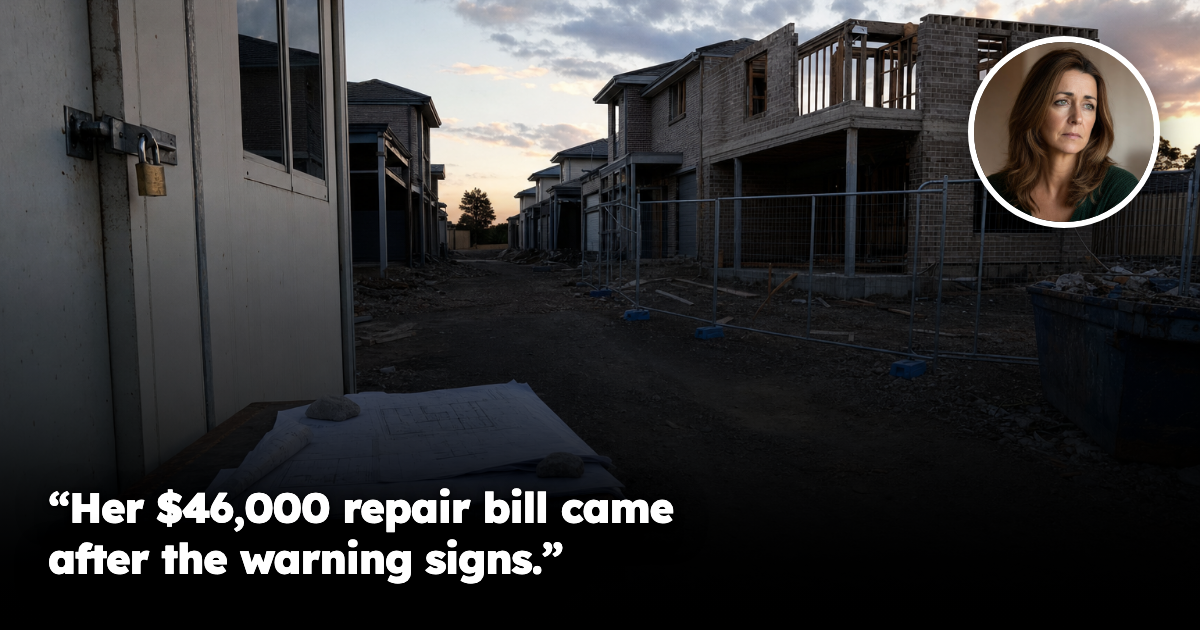
A 45-year-old homeowner was already rebuilding her finances after a separation when a letter arrived that changed the way she looked at her apartment. The building needed urgent work. Her share of the expected bill was $46,000.
The uncomfortable question was not only how she could fund it. It was why residents were being asked to carry the cost after warning signs had allegedly sat in front of the building-control system for so long.
The issue has become a live concern for apartment owners after reports that a Northern Territory building-control director was referred for investigation over an alleged failure to act on defects. The referral is not a finding of liability. But for owners, it raises a harder question: when the regulator, certifier, builder and owners’ corporation all sit in the chain, where does responsibility actually land?
The question: can an owner be trapped by a building problem she did not create?
Usually, yes — at least initially.
An apartment is not just the four walls inside the title. Waterproofing, balconies, cladding, fire systems, lifts, roofs, plant rooms and other shared elements can become the responsibility of the owners’ corporation. If urgent repairs are needed, owners may face a special levy or a borrowing arrangement even if they bought years after the original work was completed.
That is the part that feels unfair. A careful owner can inspect her kitchen, bathroom and living room, yet still inherit a defect hidden behind common property or buried in records she never saw before settlement.
The practical answer is that the cost question and the accountability question often move at different speeds. An owners’ corporation may need to make a building safe now. Any dispute with a builder, certifier, insurer or regulator can take much longer.
For the homeowner in this situation, the first step is to separate three issues: what work is genuinely urgent, what evidence supports the proposed scope, and which party may ultimately be responsible. Paying a levy does not necessarily answer the third question. It may simply keep the building functioning while the paper trail is assembled.
Why the paper trail matters more than the sales brochure
Apartment buyers often focus on the advertised view, floor plan, sinking-fund balance and quarterly strata fee. Those are useful, but they do not tell the complete building story.
The more revealing material can be found in meeting minutes, defect reports, engineering advice, fire-safety records, insurance correspondence, previous special-levy notices and motions that were deferred. A recurring reference to water entry, cracking, balcony access or “further investigation” can be more important than a freshly painted foyer.
The same principle applies to an investment unit. A low purchase price can be an illusion if the building is approaching a major repair cycle. A $46,000 levy is not merely an expense to subtract from a spreadsheet. It can affect borrowing capacity, cash flow, resale timing and the pool of buyers willing to take on the next unknown.
That is why hidden waterproofing failures can change renovation value, while a strata levy needs to be tested against the whole building’s disclosure history.
This is why a building inspection should be paired with a review of the scheme’s records. The inspector sees the physical clues available on the day. The records show whether those clues have been appearing for years.
The street-level test most buyers skip
Building risk is only half of the investment question. The other half is whether the exact address has enough demand and value support to absorb the risk.
Ripehouse Advisory’s research looks below the suburb headline. At street level, we compare achieved sales, rent, vacancy, days on market, buyer depth and competing supply. Two apartment buildings can share a postcode and a school catchment while attracting very different buyers.
A block on a quiet, walkable side street may have stronger tenant retention and a broader resale audience than a similar-looking building beside a congested connector road. A building with secure parking, usable outdoor space and a clean maintenance history may trade differently from one with the same bedroom count but an unresolved defect record. The suburb median cannot reveal those differences.
For an investor, that creates a disciplined decision point. If the building risk is high but the exact address has deep buyer and tenant demand, the issue may be price, timing and evidence. If the building risk is high and the address already struggles with vacancy, competing listings or long selling times, a discount may not be enough.
The mistake is treating every apartment defect story as proof that apartment investing is broken. The better conclusion is that the asset must be researched at building and street level, not selected from a suburb ranking or a glossy listing.
What should an owner or buyer do next?
An existing owner facing a large levy can ask for the engineering basis, staged options, insurance position, payment timing and a clear record of decisions. She should keep every notice, report, invoice and email in one file. If the building is unsafe, safety comes first; arguments about ultimate responsibility can follow the evidence.
A buyer considering an apartment should request the records early, before becoming emotionally committed. The key questions are simple: what defects have been recorded, what has been repaired, what remains open, what insurance claims exist, and what major capital works are expected?
Then test the apartment against the exact local market. How many comparable units are competing nearby? How long do they take to sell? Do tenants pay a premium for this particular position, or is the building relying on a cheap asking rent? Can the likely rent support the levy and normal ownership costs without assuming perfect occupancy?
The answers will not remove every surprise. They can, however, turn a frightening headline into a measurable risk.
The $46,000 bill is confronting because it shows how quickly a building problem can become a household problem. But it does not mean property investment should be abandoned. It means the right investment is the one whose construction record, exact street, demand profile and price have all been tested before the decision is made.
In property, better evidence beats louder headlines: the right building on the right street, bought with the right data, can still be a durable investment.
If there's a specific street you're weighing up right now, check its Street Score first — it's free, takes ten seconds, and tells you whether that street is pulling the suburb average up or riding on it.
Frequently asked questions
Can an apartment owner in Australia be hit with a big repair bill for defects they did not cause?
Yes, at least initially. Shared parts of an apartment building such as waterproofing, balconies, fire systems and roofs can become the responsibility of the owners’ corporation, which may need to raise a special levy or borrow to fund urgent repairs.
If a building has urgent defects, who decides what gets fixed first?
The owners’ corporation usually has to deal with the immediate safety issue first. Disputes about whether a builder, certifier, insurer or regulator is responsible can take much longer to sort out.
What records should a buyer check before purchasing an apartment with possible defect risk?
The article says buyers should look at meeting minutes, defect reports, engineering advice, fire-safety records, insurance correspondence, previous special-levy notices and deferred motions. These records can reveal problems that a standard inspection or sales brochure may not show.
Why is a strata levy a bigger issue than just a one-off cost?
A large levy can affect borrowing capacity, cash flow, resale timing and the number of buyers willing to take on the property. It may also signal that the building is moving into a major repair cycle.
How should a buyer judge whether an apartment can handle a defect or levy risk?
The article says to test the exact address, not just the suburb, by looking at achieved sales, rent, vacancy, days on market, buyer depth and competing supply. Strong local demand may help absorb risk, while a weak market may make even a discount less meaningful.
General information only. It does not take your objectives, financial situation or needs into account, and nothing here is legal, financial, taxation or investment advice specific to your circumstances.