News · 31 August 2026 · 4 min read
The $38,000 deposit that still left her short of a first home
A young couple saved $38,000 but a final lending check left her $21,700 short. The street-level question is how exact-address evidence changes financeability.
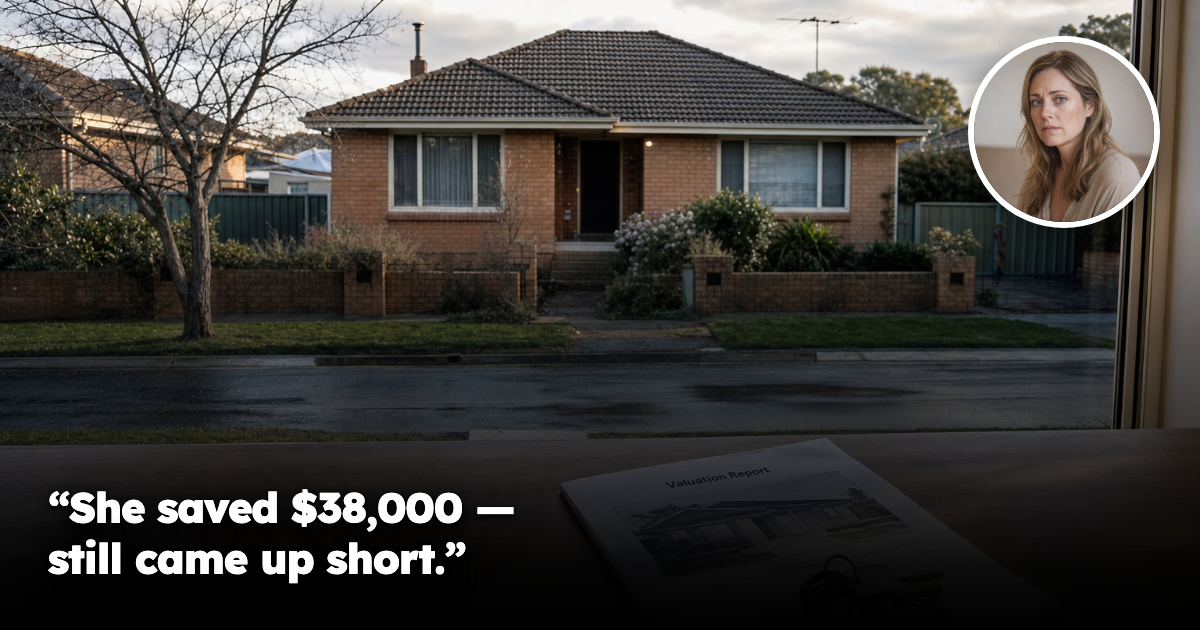
A 33-year-old woman thought she had done the hard part. She and her partner had saved $38,000, cut their spending and received a conditional borrowing figure from a lender. Then the full application exposed a different problem: the deposit was not the same thing as the cash required to complete.
The gap was $21,700.
It was not a dramatic change in the advertised interest rate. It came from the interaction between the purchase price, lender valuation, transfer costs, loan structure and the buffer the bank applied to the household’s income. In a market where new mortgage growth has slowed, that distinction is becoming more important. A conditional number can feel like permission to shop, while the final credit decision is a test of the exact property and the exact file.
Why did $38,000 not equal a $38,000 deposit?
The first answer is that a deposit is only one part of the cash position. A buyer may also need to cover transfer duty, conveyancing, inspections, lender fees, registration, moving costs and a reserve for the first repairs. Some buyers qualify for concessions or government-backed schemes, but eligibility and property limits matter. The headline percentage is never the whole calculation.
The second answer is valuation. A bank usually lends against the lower of the purchase price and its accepted value. If a couple agrees to pay $720,000 and the lender assesses the property at $700,000, the borrower may need to find the difference as well as the normal contribution. A $20,000 valuation gap can turn a carefully built plan into a last-minute scramble.
The third answer is serviceability. The lender tests whether the household can meet repayments at a higher rate than the one being offered. Existing credit limits, buy-now-pay-later accounts, dependants, irregular income and proposed rent from an investment property can all change the result. A household can be told it may borrow a certain amount, then discover that the final property does not fit the lender’s model.
The question she should have asked before inspecting homes
“What would make this particular address fail the bank’s test?”
That is a more useful question than asking only how much the household can borrow. A conditional approval is a starting boundary. It is not a guarantee that every property below that boundary will be accepted at the expected loan-to-value ratio.
The couple’s revised plan was to target a lower price, keep a genuine cash reserve and obtain evidence for comparable properties before making an offer. They also checked whether the property had features that could make a conservative valuation more likely: an unusual layout, limited parking, significant unapproved work or a small pool of genuinely comparable sales.
That work matters because two homes in the same suburb can produce very different lending outcomes. A suburb median does not tell a valuer whether the subject home competes with renovated stock, backs onto a busy road or sits on a street where buyers consistently pay a premium.
Where street-level data changes the decision
Ripehouse Advisory’s research starts below the suburb headline. It compares achieved sales, not just asking prices, then tests rent, vacancy, days on market, buyer depth and competing supply at the street and micro-location level.
Imagine two similar homes in the same postcode. One has three recent comparable sales within walking distance and attracts multiple buyer groups. The other is surrounded by near-identical listings and has fewer recent transactions to support the contract price. Their suburb statistic may be identical, but the second address can carry more valuation uncertainty.
The same analysis helps an investor assess the opportunity after the lending shock. A lower purchase price is not automatically safer if the property has weak tenant demand, long marketing periods or heavy competing supply. Conversely, a well-located asset with repeatable tenant demand and clear comparable evidence may remain financeable even when the national lending mood is cautious.
For buyers, the practical checklist is simple:
1. Calculate the complete cash-to-complete figure, including costs and a reserve. 2. Ask what happens if the valuation is below the contract price. 3. Reduce unused credit limits and document income before the final application. 4. Compare the property with recent, genuinely similar sales near the address. 5. Stress-test the plan against a slower sale, a vacancy period or an unexpected repair.
The goal is not to avoid borrowing. It is to avoid treating a broad approval as certainty. A disciplined buyer can use the gap between the first estimate and the final answer to negotiate, change the target property or wait until the numbers are robust.
What does this mean for property investors?
Slower mortgage growth can be read as a warning, but it also creates a sharper market. Borrowers and investors who rely on headlines may retreat from every opportunity. Those who can prove the address, the cash flow and the comparable evidence have more room to act.
The best property investment decisions are built around the right asset in the right street, not the biggest loan a calculator will display. Measure the local demand, the actual competition and the financing margin before committing. When the data is precise, lending caution becomes a filter rather than a dead end.
For a related look at how lenders can create a funding gap after conditional approval, read the bank valuation gap that changed one buyer’s plan. Our guide to the $55,000 gap faced by a downsizer shows why exact-address comparables matter even when the wider market looks healthy.
The opportunity remains real: buy the right property, on the right street, with the right data and enough margin to survive the lender’s final question.
If there's a specific street you're weighing up right now, check its Street Score first — it's free, takes ten seconds, and tells you whether that street is pulling the suburb average up or riding on it.
Frequently asked questions
Why can a $38,000 deposit still leave a first-home buyer short at final approval in Australia?
Because the deposit is only part of the cash needed to complete the purchase. Buyers may also need to cover transfer duty, conveyancing, inspections, lender fees, registration, moving costs and a repair reserve, and the bank may still require more if the valuation or servicing check comes in lower than expected.
What is the difference between a conditional borrowing figure and final loan approval?
A conditional figure is only a starting boundary and can feel like permission to search. The final credit decision tests the exact property and the exact file, including the lender’s valuation and serviceability assessment.
How can a bank valuation create a funding gap after a buyer signs a contract?
A bank usually lends against the lower of the purchase price and its accepted value. If the valuation comes in below the contract price, the buyer may need to cover the shortfall as well as their normal deposit and other costs.
What does the lender look at in serviceability beyond the listed interest rate?
The lender tests whether the household can meet repayments at a higher rate than the advertised one. Existing credit limits, buy-now-pay-later accounts, dependants, irregular income and expected rent can all affect the result.
What should a buyer check before making an offer on a property?
They should ask what would make that particular address fail the bank’s test, then compare it with recent, genuinely similar sales near the property. It also helps to keep a cash reserve and stress-test the plan for a lower valuation, vacancy or unexpected repair.
General information only. It does not take your objectives, financial situation or needs into account, and nothing here is legal, financial, taxation or investment advice specific to your circumstances.