News · 28 August 2026 · 5 min read
The $38,400 strata levy question: why the cheapest apartment can be the most expensive buy
A 64-year-old apartment owner faces a $38,400 strata levy and asks whether the apparent bargain was ever cheaper.
She thought she had found a bargain
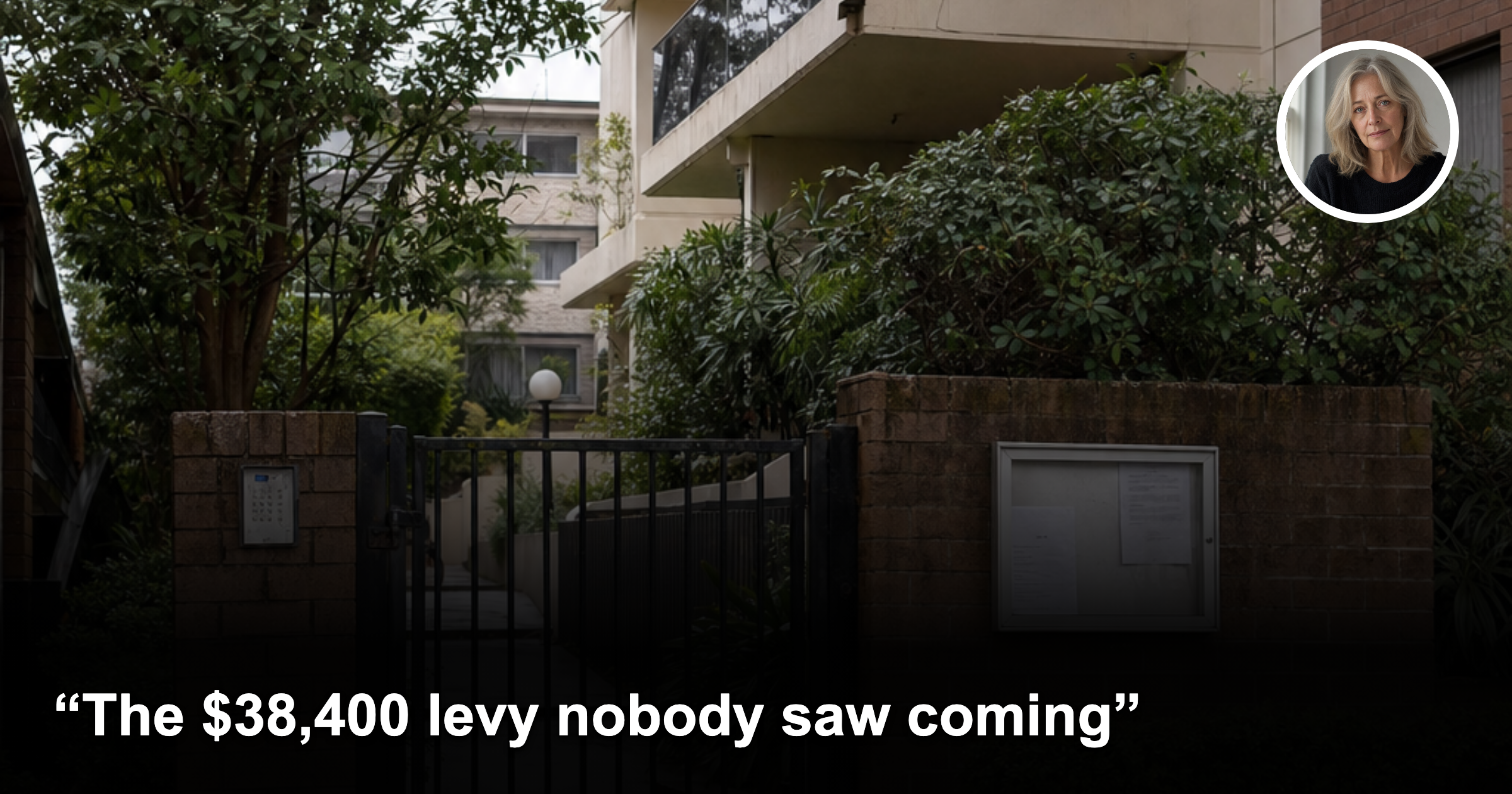
When a 64-year-old woman bought a two-bedroom apartment, the price looked like the sensible part of the decision. It was $38,400 below a comparable apartment in the same suburb. The building was tidy, the street was popular and the weekly rent appeared to leave room for a useful buffer.
Four months later, the owners corporation approved a $38,400 special levy for waterproofing, concrete repairs and related works. Her share was large enough to erase the apparent discount. The question she brought to us was blunt: “If the building can ask for that much after settlement, was the cheaper apartment ever cheaper?”
The uncomfortable answer is that an apartment is not just the lot shown in the listing. It is also a share of a building, a maintenance plan, a set of meeting decisions and a financial history. A low purchase price can be compensation for risk that has not yet appeared in the advertising.
Why the policy debate matters
A recent housing-policy proposal has put a familiar strata frustration back in the spotlight: buyers should see long-term maintenance costs more clearly before committing, while owners corporations and managers should face tighter governance expectations.
That is not the same as a new national rule already applying to every apartment. State and territory strata systems differ, and the detail of any reform matters. But the underlying problem is real. A buyer can often compare the advertised price and current quarterly levy quickly, yet struggle to see whether the roof, façade, lifts, fire systems, balconies or waterproofing are approaching expensive renewal.
The result feels unfair because the bill is not always caused by the person receiving it. A previous committee may have deferred work. A developer may have left defects unresolved. A manager may have produced records that are technically available but difficult to understand. Or a building may simply have reached the age at which major components need attention.
The buyer still inherits the exposure.
The levy is not the whole risk
The first mistake is treating the quarterly body-corporate payment as a complete cost measure. It is only the visible, recurring part.
An apartment’s ownership cost has at least four layers:
1. The regular administrative and capital-works levies. 2. Special levies already proposed, discussed or foreshadowed. 3. The likely timing of major building components reaching renewal. 4. The effect of those costs on rent, resale demand and financeability.
A building with a $1,100 quarterly levy is not automatically safer than one with a $750 levy. The first may be collecting properly for known works; the second may be postponing them. Conversely, a high levy can reflect inefficient management rather than genuine long-term protection.
The useful question is not “Which building has the lowest levy?” It is “What work is the levy funding, and what is still unfunded?”
What an investor should ask before signing
Start with the last several years of owners-corporation minutes, budgets, financial statements, maintenance plans, defect reports and insurance claims. Look for repeated references to the same problem. “Under review” appearing year after year can be more important than one dramatic line in a current report.
Then separate confirmed obligations from speculation. A motion to investigate balcony repairs is not the same as an approved levy. A sinking-fund forecast is not a bill. A committee discussion about litigation is not proof that the owners corporation will win. The distinction protects a buyer from both complacency and exaggerated fear.
Ask how many lots are contributing, whether levies are being paid on time and whether the building has borrowed for capital works. Check the building’s insurance, exclusions and claims history. For a property intended to be rented, test whether the expected rent survives a levy increase, vacancy period and a one-off contribution without relying on optimistic growth.
The contract and disclosure process also deserve independent review. A building file can contain technical language that is easy to skim and expensive to misunderstand. A property lawyer or qualified strata professional can help identify what must be disclosed in the relevant state and what remains a commercial risk for the buyer.
The exact building matters more than the suburb average
This is where broad suburb research is not enough. Two apartment buildings can share the same postcode and have completely different investment profiles.
Ripehouse Advisory’s street- and address-level approach tests the building against its immediate market: achieved rents rather than advertised rents, vacancy and days on market, depth of tenant and buyer enquiry, prior sales in the same complex, and the nearby supply pipeline. We also treat body-corporate cost trends as part of the address rather than a footnote.
For example, a building with a $38,400 levy shock may still be investable if its location has durable tenant demand, scarce competing stock and a credible repair plan. Another building with no current levy may be weaker if records show repeated deferrals, rising vacancy and a large wave of comparable apartments due to complete nearby.
The comparison should be building against building, not suburb against suburb. A street-level heatmap can reveal that one pocket consistently attracts faster leasing and deeper buyer enquiry, while another has more discounting and longer selling periods. That evidence does not remove the levy risk. It tells you whether the underlying asset has enough demand to recover from it.
Our guide to reading property supply before you buy is useful for the same reason: the market does not price every nearby address as identical. Building condition and building-level supply belong in that analysis too.
Was her apartment a bad investment?
Not necessarily. It was an under-researched investment decision if the levy exposure was not understood before settlement.
The $38,400 number is emotionally powerful because it converts a vague “old building” concern into a real loss of flexibility. It can consume renovation money, reduce the emergency buffer or force a sale at an inconvenient time. But the levy may also fund work that protects the building’s long-term value. Paying for necessary repairs is different from paying for avoidable mismanagement.
The practical test is forward-looking. After the contribution, does the building have a credible plan? Are the works scoped, funded and independently supervised? Does the complex remain attractive to renters and future buyers? Are the building’s costs proportionate to its services and age? And does the purchase still make sense when every known and likely cost is included?
The answer
The fairer disclosure debate is welcome, but buyers cannot wait for a perfect national system to make an apartment decision. The safest bargain is not the lowest advertised price. It is the property whose building risk has been priced, documented and matched to real demand.
Property remains a powerful long-term wealth-building asset when the right property is selected with the right evidence. Check the building, the street and the suburb together. A $38,400 surprise is a warning to improve the research process, not a reason to abandon property investment. The better opportunity is the address where the numbers, maintenance plan and local demand all support the decision.
If there's a specific street you're weighing up right now, check its Street Score first — it's free, takes ten seconds, and tells you whether that street is pulling the suburb average up or riding on it.
Frequently asked questions
Why can a cheaper apartment end up costing more after you buy it?
Because the purchase price is only part of the cost. In strata, you also inherit exposure to levies, maintenance, defects and future major works, which can erase the initial discount.
What should a buyer check before committing to a strata apartment in Australia?
Review recent owners-corporation minutes, budgets, financial statements, maintenance plans, defect reports and insurance claims. These records can show whether work is being deferred or whether a special levy may be coming.
Is the quarterly strata levy enough to judge whether an apartment is expensive to hold?
No. The regular levy is only one layer of cost, alongside special levies, future building renewal and the impact on rent, resale demand and financeability. A lower levy does not always mean a safer building.
How do you tell the difference between a real levy risk and a possible one?
Separate confirmed obligations from speculation. An approved special levy is real, while a motion to investigate repairs or a sinking-fund forecast is not yet a bill.
What is the main lesson from the $38,400 levy surprise?
A low advertised price is not automatically a bargain if the building has hidden maintenance risk. The better test is whether the building’s costs, repair plan and local demand all support the purchase.
General information only. It does not take your objectives, financial situation or needs into account, and nothing here is legal, financial, taxation or investment advice specific to your circumstances.