News · 31 August 2026 · 5 min read
He put up $145,000 to help the next generation buy. Why is Australia still short of 204,000 homes?
A grandfather puts $145,000 behind a new home while Australia’s housing target slips to 2030. The street-level data tells him whether the project can survive the uncertainty.
The question
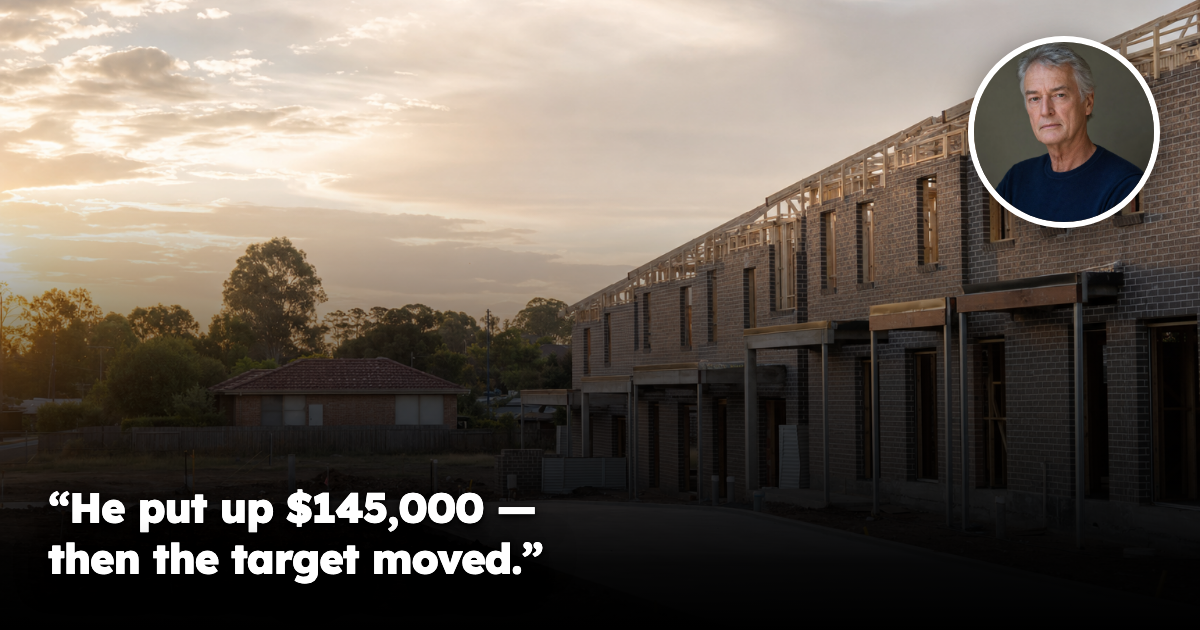
When a 67-year-old man agreed to put $145,000 behind his granddaughter’s first home, he thought the hard part would be finding a property she could afford.
Instead, the family ended up asking a much larger question: if Australia keeps changing the rules around property investment while missing its construction target, who is actually meant to finance the homes everyone says the country needs?
He had not promised to buy an old investment unit. The plan was a modest new townhouse on the edge of an established regional centre. His granddaughter would live in it. The $145,000 was there to make the deposit, costs and construction-stage buffer work without forcing her into the most expensive part of the market.
The project looked sensible on paper. Then the federal budget changed the treatment of property investment, interest rates rose again and the builder’s preliminary price moved. The family did not lose the deposit. They lost certainty. The question became whether waiting for a better policy environment was safer than proceeding with a property that could still be built.
The answer is uncomfortable
Australia’s headline housing promise has moved further away. The national target of 1.2 million homes was originally expected to be reached by June 2029. It was later pushed to September 2030 and is now expected to land at the end of 2030. Industry forecasts put the likely gap at about 204,000 homes.
That does not mean no homes are being built. More than 300,000 have been completed since the accord began, approvals are higher than they were a year earlier and commencements have increased. The problem is the distance between activity and the promise. A rising pipeline can still be too slow for the people who need a home now.
The tax changes add a second layer. For eligible purchases made after budget night, the old investment-property treatment is being narrowed for existing dwellings and the capital-gains-tax discount is being tightened. New dwellings retain more favourable treatment, deliberately pushing capital toward construction rather than another purchase of an established home.
That direction makes sense if the goal is additional supply. But a policy can be logically aimed at new housing and still feel punishing to the person standing in front of a delayed build, a changed borrowing limit or a price that no longer works. The grandparent in this story is not asking for a free pass. He is asking whether the rules reward the behaviour the country says it wants.
The answer is: only if the project survives the numbers at its exact address.
Why the suburb headline is not enough
A national shortfall is politically powerful, but it cannot tell this family whether one townhouse site is investable. The suburb median does not reveal the actual achieved rent of the finished dwelling, how many comparable homes will be delivered nearby, how quickly the best streets attract tenants or whether buyers will still be active when the build completes.
Ripehouse Advisory’s street-level work is designed for that gap. Two streets can share a postcode, school catchment and broad suburb growth story while producing different vacancy, days-on-market, buyer-depth and competing-supply results. A new project beside a transport stop may have a deeper tenant pool than one 700 metres away, even when both are marketed as the same suburb. A pocket with five similar townhouses arriving together can behave very differently from a pocket where the next comparable listing is scarce.
For the family, that means testing more than “will property prices rise?” The useful questions are narrower:
- What has the finished product actually rented for, rather than what is being advertised? - How long did comparable properties take to lease or sell? - How many competing dwellings are approved, under construction or likely to arrive before settlement? - Is the site’s walk, slope, orientation and street noise helping or hurting demand? - Does the completed property still work if the first-year rent is below the optimistic estimate?
The policy story matters because it changes the flow of money. The street story matters because it decides which assets can absorb uncertainty.
What should an investor do with the contradiction?
Do not treat a delayed national target as proof that every new dwelling is a good investment. It is evidence that supply remains structurally valuable. The investment question is where that value will be captured and whether the asset can withstand the period between contract and completion.
For a guarantor, that means setting a hard ceiling before emotions enter the room. The $145,000 should not become an excuse to stretch into a project whose only defence is a future headline. Construction contingencies, holding costs, lending changes and a realistic exit or rental scenario belong in the first spreadsheet, not the rescue plan.
It also means separating political frustration from asset selection. A government can miss a target, revise a tax rule and still leave a disciplined investor with an opportunity. Scarcity tends to support well-located, usable homes, but scarcity is not evenly distributed. The best evidence is often local: one street’s achieved rents, one pocket’s vacancy, one project’s competing supply and one address’s buyer depth.
The grandparent’s $145,000 was ultimately not a vote for a policy. It was a test of whether a particular dwelling could serve a particular household in a particular place. That is the level at which investment decisions become real.
Australia may be 204,000 homes short of its promise. That is a national failure worth debating. It is also a signal: the right new dwelling, on the right street, measured with the right data, can become more valuable as supply falls behind. Property investment still rewards patience — but only when patience is attached to an address, not a slogan.
Explore the practical signals that separate a resilient address from a headline suburb.
See how a failed development can expose the risk between deposit and settlement.
Download the Top Five Investment Markets report or book a Ripehouse Advisory discovery call.
If there's a specific street you're weighing up right now, check its Street Score first — it's free, takes ten seconds, and tells you whether that street is pulling the suburb average up or riding on it.
Frequently asked questions
Why does Australia being short of 204,000 homes matter for someone deciding whether to build a new property now?
It shows supply is still structurally valuable, especially for well-located new dwellings. But the article says the real decision comes down to whether a specific project can survive the numbers between contract and completion.
What changed in the property tax rules after the budget, according to the article?
For eligible purchases made after budget night, the old investment-property treatment is being narrowed for existing dwellings and the capital-gains-tax discount is being tightened. New dwellings keep more favourable treatment, which is meant to direct capital toward construction.
Why isn’t a suburb median enough to judge whether a new townhouse will be a good investment?
The article says two streets in the same suburb can have very different vacancy, days-on-market, buyer depth and competing supply. You need street-level data to see what the finished home may actually rent or sell for.
What local factors should be checked before backing a new build with family money or a deposit?
The article says to check achieved rent for comparable finished homes, lease or sale times, nearby competing dwellings, and whether the site’s walk, slope, orientation and street noise help or hurt demand. It also matters whether the project still works if first-year rent is below estimates.
What is the main risk in waiting for a better policy environment instead of proceeding with a build?
The family in the article did not lose the deposit; they lost certainty. Waiting may avoid a difficult build, but it can also mean missing a property that still works if the address, costs and demand stack up.
General information only. It does not take your objectives, financial situation or needs into account, and nothing here is legal, financial, taxation or investment advice specific to your circumstances.