News · 29 August 2026 · 5 min read
He was quoted $48,000 for a bathroom. Then the waterproofing bill doubled it.
A homeowner discovered that a $48,000 bathroom quote could become a $96,000 waterproofing and rectification bill. The real question was whether the exact street could support the finished investment.
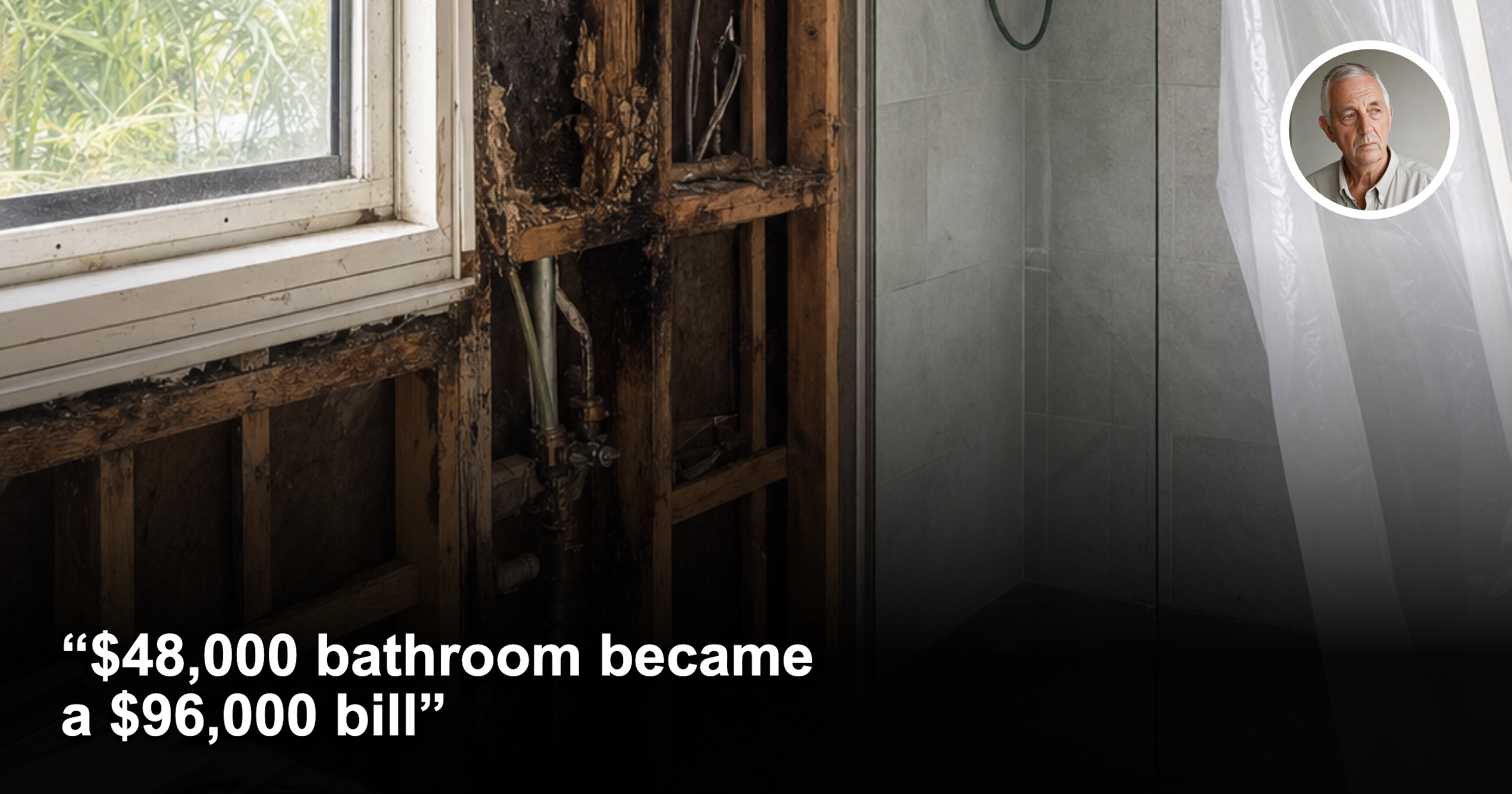
When a 73-year-old homeowner in Brisbane agreed to a $48,000 bathroom renovation, he thought the expensive part was over.
The quote covered demolition, new plumbing, a walk-in shower, wall tiling and a better layout. He had kept a contingency aside, but the project looked straightforward. The home was in a popular suburb, the bathroom was dated rather than obviously damaged, and the renovation was meant to make the property easier to hold and eventually easier to sell.
Six weeks later, the builder opened the wall beside the shower.
The old waterproofing had failed. Moisture had travelled into the adjoining room and under part of the floor. The original $48,000 scope became a $71,000 variation, then a $96,000 rectification and renovation bill after damaged plaster, flooring and cabinetry were included.
His question was simple: how can a bathroom quote nearly double when the tiles and fittings have barely changed?
The answer is usually hidden behind the tiles
The visible products are rarely the whole cost of a wet-area renovation. The risk sits in what must be removed, tested, repaired and certified before the new finishes can be installed.
A quote can be accurate for the work the builder can see and still be incomplete for the work revealed by demolition. That is why a homeowner needs to separate three things before signing: the defined base scope, the allowances for uncertain items, and the process for approving a variation.
Prime-cost items are allowances for products that have not been selected. A provisional sum is an allowance for work whose extent or cost cannot yet be fully determined. Neither is automatically unfair, but both can make the headline price look safer than it is. If the provisional sum for floor preparation is $2,000 and the actual repair is $11,000, the difference is not a minor tile choice.
Waterproofing creates another trap. It is not just a layer of paint beneath the tiles. Falls, penetrations, junctions, shower screens, puddling and curing all matter. If a defect is found, the sensible job may involve removing more finishes, drying the structure, repairing the substrate and bringing the wet area back to a compliant standard. A cheap patch can be more expensive than a properly documented repair when the property is sold.
The first practical defence is a written scope that describes what happens when concealed damage is found. It should say who investigates it, what evidence is provided, how the price is calculated, whether work stops until approval, and what happens if the owner rejects the variation. A verbal “we’ll sort it out” is not a budget.
The second defence is staged decision-making. Demolition, inspection and drying should be treated as a separate stage from the final finishes where the building condition is uncertain. The owner can then make an informed decision about whether to continue, redesign or stop before another large commitment is made.
Why the exact address changes the renovation decision
The obvious response to a $96,000 bill is to ask whether the bathroom is worth it. That question cannot be answered by looking at the suburb median alone.
Two homes in the same suburb can have very different renovation ceilings. One street may have deeper buyer competition for renovated character homes, while a nearby pocket may be dominated by investors and price-sensitive purchasers. One address may support a higher rent after a functional upgrade; another may never recover the spend because buyers value land, parking or school-zone position more than designer finishes.
That is where street-level analysis matters. Ripehouse Advisory compares achieved sales, not just asking prices, alongside days on market, buyer depth, achieved rent, vacancy and competing supply. For a renovation, the useful question is not “is this a good suburb?” It is “what have comparable renovated homes on this street actually achieved, and how long did they take?”
The same analysis can expose a renovation that is too modest. If the best nearby homes are attracting multiple buyers and a tired property is taking a discount well beyond the likely works, doing nothing may also carry a cost. The right project is not always the cheapest project; it is the one that fits the demand profile of the precise pocket.
Our guide to testing a renovation against the finished value of the property sets out the same principle: the budget must be judged against the value the street can support, not the owner’s emotional attachment to the plan.
What should a homeowner do before signing?
Ask for the plans, inclusions, exclusions and allowances in one document. Check whether demolition, waste removal, waterproofing certification, electrical upgrades, ventilation, floor levelling and patching outside the bathroom are included. Ask which items are fixed-price and which are provisional.
Then ask for the variation pathway in writing. A variation should describe the reason, the extra work, the revised price and any change to the completion date. Keep photographs, reports, invoices and approvals. If the dispute becomes serious, those records are more useful than a sequence of phone calls.
For an investment property, calculate the holding cost of delay as well as the construction cost. A bathroom that takes four extra weeks can mean lost rent, storage, temporary accommodation or a delayed sale. The return calculation should include those costs and a realistic allowance for maintenance, not just the promised uplift in the listing photos.
The 73-year-old homeowner eventually reduced the specification, retained the layout and paid to fix the wet-area problem properly. The renovation was no longer the glamorous upgrade he first imagined, but it became a defensible investment in the asset rather than a gamble behind fresh tiles.
That is the broader lesson. Renovation can create value, improve rentability and make a good property more competitive. But the winning project starts with a controlled scope, documented variations and street-level evidence of what buyers or tenants will pay. The right property, the right works and the right exact-address data can still turn a difficult building decision into a stronger investment.
If there's a specific street you're weighing up right now, check its Street Score first — it's free, takes ten seconds, and tells you whether that street is pulling the suburb average up or riding on it.
Market data & R-Scores for locations in this article
Drill Down Into the Markets Mentioned Above
Inspect live monthly R-Scores, median prices, rental yields, and street-by-street scores for the cities and council areas referenced in this article:
Frequently asked questions
Why can a bathroom renovation quote in Brisbane end up far higher than the original price?
Because the real cost is often hidden behind the tiles. Once demolition starts, builders may find failed waterproofing, moisture damage, poor falls or other concealed problems that need repair before new finishes can go in.
What is the main risk when a bathroom quote includes provisional sums or allowances?
The headline price can look lower than the real cost. If the actual repair work is much more expensive than the allowance, the final bill can rise sharply even if the visible bathroom design does not change much.
What should be written into a bathroom renovation contract before work starts?
The scope should explain what happens if concealed damage is found, who investigates it, how evidence is provided, how the price is calculated and when work stops for approval. It should also clearly separate fixed-price items from provisional items.
Why does the exact street matter when deciding whether to renovate a property?
Two homes in the same Brisbane suburb can have very different buyer demand, rent potential and renovation ceilings. The article says street-level evidence is needed to see what comparable renovated homes have actually achieved, not just what the suburb median suggests.
What records should a homeowner keep if the renovation runs into waterproofing or rectification issues?
Keep photographs, reports, invoices and written approvals. The article says those records are more useful than phone calls if there is a dispute about the variation or the extra work.
General information only. It does not take your objectives, financial situation or needs into account, and nothing here is legal, financial, taxation or investment advice specific to your circumstances.