News · 29 August 2026 · 4 min read
His $72,000 deposit still left him locked out. The address was the problem
A 29-year-old man saved a $72,000 deposit, then discovered it only opened the door to one street rather than the next. The answer was hidden in address-level buyer, rental and price evidence.
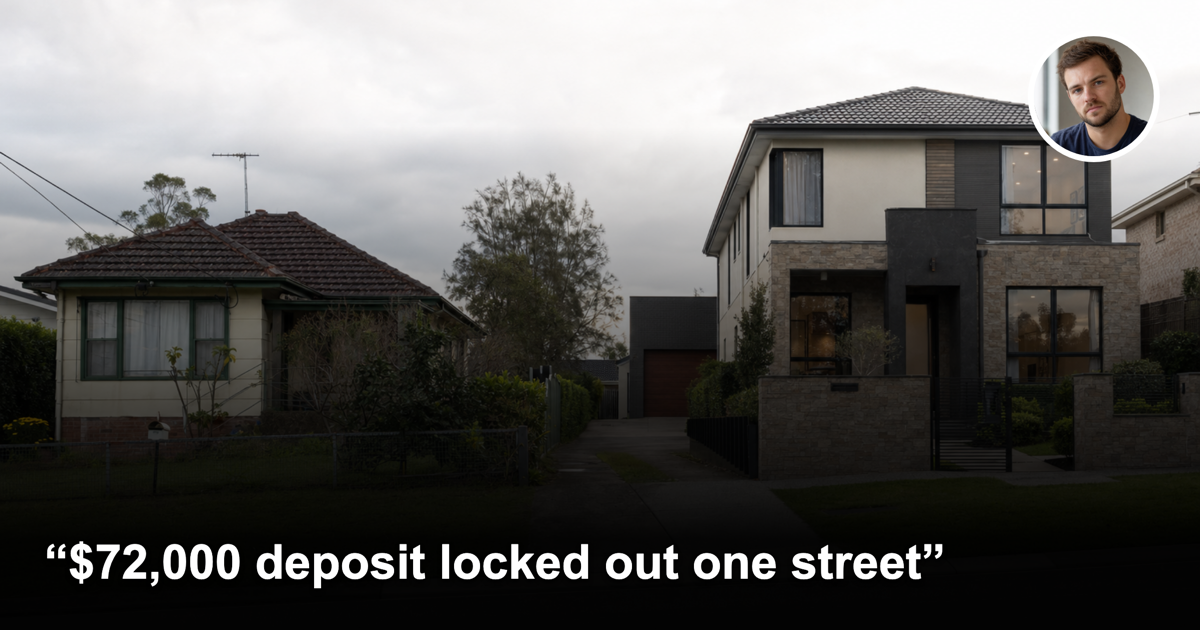
A 29-year-old man had done what every housing affordability campaign tells people to do: he saved. After years of renting, he moved back in with family, cut his spending and built a $72,000 deposit. He expected the hard part to be finding a home.
Instead, the hard part was discovering that a deposit does not buy “a suburb”. It buys one particular address, with one particular price, one particular buyer pool and one particular set of compromises.
His question was blunt: “If I have the deposit, why can I afford one street but not the next?”
The political promise meets the property market
The ownership problem is real. Recent housing reporting has put young Australians’ home-ownership rate at an 80-year low, while a growing share of children are growing up in rental housing. That is not just a statistic about young people. It is a sign that the entry point is moving faster than many households can follow.
The political response usually arrives as a big number: more homes, a new target, a guarantee, a planning reform or a package intended to reduce the deposit barrier. Those measures may help. But they cannot make every address equally affordable, equally financeable or equally suitable.
That is where the debate becomes personal. A buyer can be “in the market” nationally and still be locked out of the streets that make the most sense for their life, budget or future rental demand.
For this man, two homes were close enough to share a postcode and most suburb-level statistics. One was advertised at $742,000. The other was $814,000. The $72,000 difference was almost exactly the amount he had saved.
The cheaper home was not automatically the better answer. It had a narrower frontage, a darker rear room and weaker access to the local transport route. The dearer home had a more functional layout but sat near a busier connector road. Neither could be judged by the suburb median alone.
Why the next street can change the answer
A suburb report is useful for orientation. It can show broad price movement, typical rents and the direction of supply. It cannot tell you whether the next buyer will dislike the road noise, whether tenants will accept the walk to transport, or whether a small group of competing listings will sit unsold for weeks.
At street level, Ripehouse Advisory looks at the evidence that gets averaged away: achieved sales rather than asking prices, the depth of actual buyers, days on market, achieved rent, the length of vacancy and the pipeline of competing stock. The difference between the best and worst streets in one suburb can produce a 20–30 per cent effective-yield spread once price, rent, vacancy and holding costs are placed in the same column.
That spread matters to an aspiring owner because the cheapest entry price can carry the weakest future demand. A low purchase figure is not a bargain if the address takes longer to rent, attracts fewer buyers at resale or requires a discount every time the market slows.
The reverse is also true. A buyer can reject a suburb because its headline median looks too high, while a small pocket on the edge of the market contains addresses with better access, stronger buyer depth and a more durable rental case. The opportunity is often not “buy anywhere cheaper”. It is finding the precise street where the numbers and the lived experience still line up.
What should a buyer do with a deposit like this?
First, separate the policy question from the property question. A government can improve supply or reduce the upfront barrier. It cannot inspect the exact home for you. A guarantee may help you enter sooner, but it does not tell you whether the price is supported by comparable achieved sales or whether the future tenant pool is deep enough.
Second, build an address-level shortlist before falling in love with a suburb. Compare homes within a narrow radius and record the actual sale evidence, not just the listing language. Look for the recurring discount: traffic exposure, awkward access, flood or drainage history, poor natural light, an unusual lot shape, weak parking or a competing construction pipeline.
Third, test the exit as seriously as the entry. If circumstances change, who is the next buyer? If the home becomes a rental, what rent was actually achieved nearby, how long did comparable homes sit vacant and how many similar properties are coming online? A property can be affordable to buy and expensive to hold.
Finally, do not mistake a politically attractive number for a complete investment thesis. A deposit is a tool. The asset still has to work.
That is why the man’s $72,000 gap was not the end of the story. It was the beginning of a more useful question: which address gives the strongest combination of affordability, demand and future options? He was not choosing between “owning” and “renting” in the abstract. He was choosing between two very different assets a few minutes apart.
The answer for investors
The housing crisis is real, but broad headlines can make property look more uniform than it is. They are not. A deposit, a suburb median and a government target are all starting points. The investable difference is often on the street: the buyer depth, the rent actually achieved, the vacancy pattern and the physical features that make one address easier to own than the next.
For investors, that unevenness is opportunity. The right property in the right street, tested against evidence rather than headlines, can still build options through rental income, future demand and resale flexibility. Property investment is not won by guessing the national average. It is won by finding the address the average cannot see.
Read how a heritage line can split neighbouring assets in the same suburb, why a road-side exposure can create an 86,000-dollar value gap, and how street-level parking can change a terrace’s value.
If there's a specific street you're weighing up right now, check its Street Score first — it's free, takes ten seconds, and tells you whether that street is pulling the suburb average up or riding on it.
Frequently asked questions
Why can a deposit be enough for one street but not the next one over?
Because property prices can change at address level, not just suburb level. In the article, two nearby homes in the same postcode differed by $72,000, which was almost exactly the buyer’s deposit.
What did the article say suburb reports miss when you’re trying to buy a home?
Suburb reports can show broad trends, but they do not reveal street-level demand, achieved sales, vacancy, or how long similar homes sit unsold. They also won’t tell you about issues like road noise, awkward access or weak transport links.
What evidence should a buyer look at before choosing an address?
The article says to compare achieved sales, actual rent, days on market, vacancy length and the amount of competing stock. It also suggests checking for recurring discounts caused by features like traffic exposure, poor light or an unusual lot shape.
Why was the cheaper home not automatically the better choice?
The cheaper home had trade-offs such as a narrower frontage, a darker rear room and weaker access to transport. The article says a low purchase price is not a bargain if the address is harder to rent or resell later.
What is the main risk if you only focus on the deposit and the suburb median?
You can end up buying a property that is affordable to purchase but expensive to hold. The article warns that future buyers and tenants may be limited if the street has weaker demand, longer vacancies or more competing stock.
General information only. It does not take your objectives, financial situation or needs into account, and nothing here is legal, financial, taxation or investment advice specific to your circumstances.