News · 27 August 2026 · 3 min read
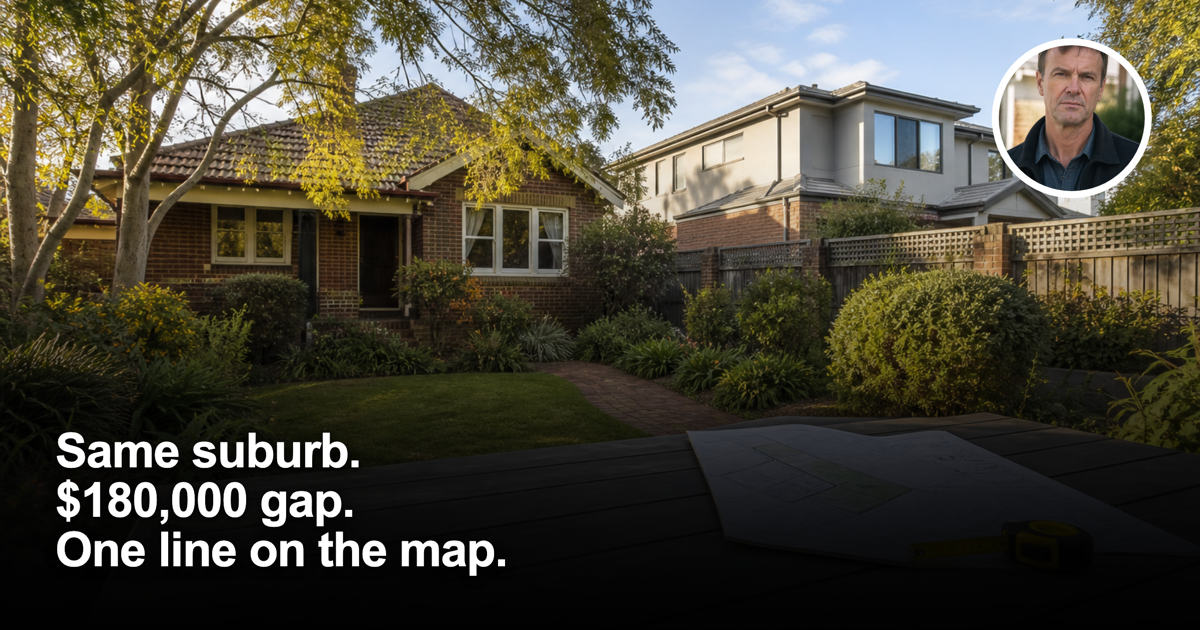
The $180,000 house next door can be rebuilt. His cannot.
A planning overlay put a sharp redevelopment gap between two otherwise comparable suburban houses.
## The question
When a 52-year-old man inherited his parents’ house, he thought he had inherited a straightforward asset: a tired three-bedroom property on a quiet suburban street, with a large rear garden and a mortgage-free title.
Then a planning search showed the address sat inside a heritage overlay.
The house next door had sold for $1.08 million. It was the same age, on a similar block and on the same bus route. His property looked comparable. But an adviser told him that a buyer wanting to demolish and build two homes would face an entirely different approval pathway. The difference between the two sites was not the suburb. It was a line on a map.
“The house next door can be knocked down,” he asked. “Why does mine suddenly have a $180,000 problem attached to it?”
The answer
A heritage overlay does not necessarily mean a building can never be altered. It means the ordinary development assumptions change. Demolition, external changes, additions, subdivision and sometimes even new fences or visible alterations can require additional approval. The exact controls depend on the planning scheme and the schedule applying to that address.
That distinction matters because buyers do not value a block only for its current dwelling. They value the choices attached to it.
If one property can be replaced, extended or subdivided with a relatively predictable approval process, while the neighbouring property needs heritage assessment and may have its design constrained, the two addresses are not equivalent investments. A suburb median will not reveal that. A desktop search of the exact title might.
The $180,000 figure in this story is his estimate of the redevelopment value he believed he was losing, not a universal heritage discount. Some protected homes sell at a premium because buyers value character, scarcity and streetscape. Others sell for less because the likely buyer pool is narrower and the cost, timing and uncertainty of works are higher.
That is why the first mistake is treating the overlay as either a disaster or a guarantee of value. It is neither. It is a constraint that has to be priced.
What should a buyer check?
Start with the address, not the suburb. Pull the planning map and identify the precise overlay, its schedule and the works that trigger permission. Then ask whether the proposed use is actually feasible: extension, secondary dwelling, subdivision, demolition or a new build may each be treated differently.
Next, test the economics against the likely approval pathway. A design that works on paper can fail once heritage setbacks, retained facades, specialist reports, construction staging and holding costs are included. The relevant question is not “What could this land be worth?” but “What can a buyer lawfully and realistically do with this land, at this price, within this timeframe?”
Ripehouse Advisory’s street-level approach is useful here because two houses in the same suburb can have completely different investment profiles. Compare achieved rents, real vacancy duration, days on market, buyer depth and the local supply pipeline at the address level. Then layer the planning constraint over those measures. The best street in a suburb may support a heritage premium; a less liquid street with the same overlay may simply carry extra risk.
The overlay should also be checked before making an offer, not after a contract becomes emotionally difficult to exit. A buyer who knows the constraint can negotiate on evidence. A buyer who discovers it after settlement has usually paid for somebody else’s uncertainty.
What it means for investors
Heritage controls can create unfair-feeling outcomes because the map does not care whether two owners bought nearly identical homes. One owner gets flexibility; the other gets a longer approval process and a smaller set of possible buyers. That is a policy choice, and it can be frustrating even where the streetscape protection has a genuine public purpose.
But constraints are not automatically bad investments. They become dangerous when they are invisible in the price, misunderstood by the buyer or treated as a suburb-wide statistic. The disciplined investor identifies the restriction, models the downside, checks the likely buyer and renter demand, and pays only for the version of the asset that can actually exist.
The inherited house did not become worthless. It became a different asset from the one next door. Once that was clear, the decision stopped being emotional: retain it as a character home, negotiate from the evidence, or walk away from a price that assumed redevelopment freedom.
The winning property investment is rarely the loudest headline. It is the right asset, on the right street, with the right data behind the decision.
If there's a specific street you're weighing up right now, check its Street Score first — it's free, takes ten seconds, and tells you whether that street is pulling the suburb average up or riding on it.
Frequently asked questions
What does a heritage overlay mean for a house in Australia?
A heritage overlay does not necessarily stop changes, but it can change what needs approval. Demolition, external alterations, additions, subdivision and sometimes even new fences may require extra planning consent depending on the local planning scheme.
Why can two similar houses on the same street have very different values?
Because buyers do not value only the dwelling itself; they value the choices attached to it. If one house can be rebuilt or subdivided more easily and the other sits under a heritage overlay, the two properties are not equivalent investments.
How should a buyer check whether a heritage overlay affects a property?
Start with the exact address, not just the suburb, and check the planning map and the overlay schedule. Then confirm which works need permission and whether your intended use, such as extension, subdivision or demolition, is actually feasible.
Why is it risky to rely on suburb median prices when buying a property with planning restrictions?
A suburb median will not show what is happening at a specific title. Two houses in the same suburb can have very different approval pathways, buyer pools and redevelopment potential, so the relevant question is what can be lawfully and realistically done with that address.
Can a heritage overlay ever be a good thing for an investor or buyer?
Yes. The article says some protected homes can sell at a premium because buyers value character, scarcity and streetscape. The key is to price the constraint correctly and not assume it is either a disaster or a guarantee of value.
General information only. It does not take your objectives, financial situation or needs into account, and nothing here is legal, financial, taxation or investment advice specific to your circumstances.