News · 29 August 2026 · 5 min read
The $86,000 road-side gap: why two homes in the same suburb can be different investments
A 56-year-old woman found an $86,000 gap between otherwise comparable homes in the same suburb. The difference appeared in the final 200 metres: one address faced a busy connector road.
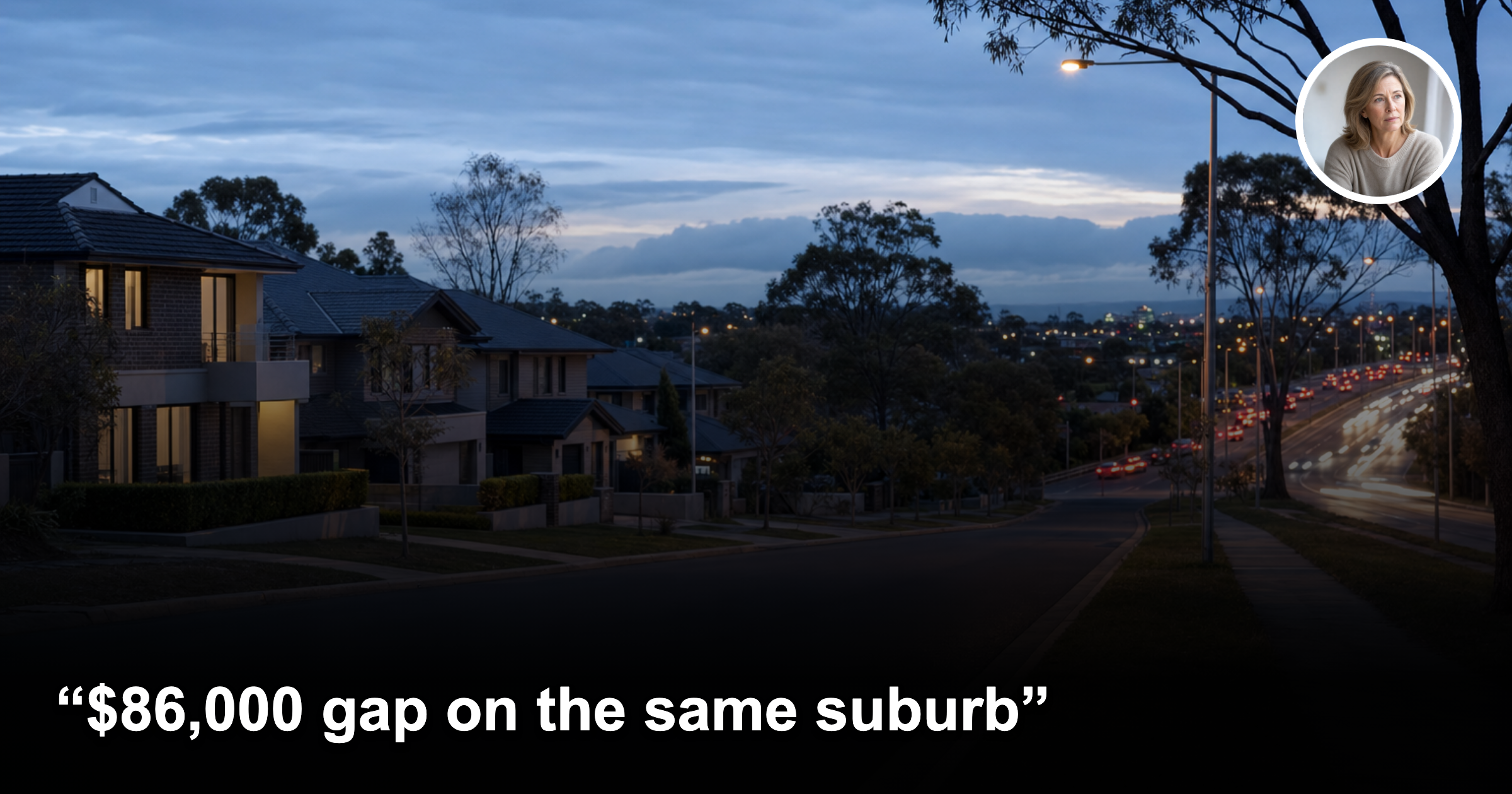
She thought the suburb was the decision. The road was the decision.
When a 56-year-old empty-nester began comparing two homes in the same established suburb, the numbers looked almost identical.
Both had three bedrooms, similar land, comparable renovation quality and access to the same shops and schools. The asking prices were close enough to make the choice feel like a matter of taste.
Then she put the addresses on a map.
One house sat on a quiet parallel street. The other was only a few minutes away by foot, but faced a busy connector road carrying traffic towards a shopping strip and a major intersection. The difference was not obvious in the suburb-level statistics. It appeared in the final 200 metres.
The gap between comparable settled sales was about $86,000.
That raised the question many buyers ask too late: can a noisy or heavily trafficked street turn a seemingly sound property into a poor investment, even when the suburb is performing well?
The answer: location is not a suburb name
A suburb is a useful starting point. It is a poor finishing point.
Buyers and investors commonly compare median price, vacancy, advertised rent and days on market at suburb level. Those measures can tell you whether demand exists in the broader area. They cannot tell you whether a particular front bedroom is exposed to braking traffic, whether tenants will pay extra for a quiet rear yard, or whether a buyer will discount the home after one inspection at peak hour.
That is why two properties sharing a postcode can trade as different assets.
Traffic exposure is one of the clearest examples. A house near a connector may have excellent access, but access and amenity are not the same thing. The road may create faster travel for residents while producing noise, headlight spill, difficult driveway movements and a less private outdoor area. The effect varies with the exact position: a home behind a solid row of established vegetation may experience a different market response from one with an uninterrupted view of the carriageway.
The same principle applies to a railway crossing, flight path, school pickup bottleneck, industrial access route, stormwater channel or proposed road widening. The factor is physical and local. It cannot be responsibly priced from a suburb median alone.
Why the $86,000 discount can be rational
The lower price is not automatically a bargain. It may be the market charging for a smaller future buyer pool.
Owner-occupiers often notice the issue immediately. Some will reject the property before making an offer. Others may still buy, but use the road exposure to negotiate. Investors face a second question: will the rent discount, shorter tenant stays or longer selling period outweigh the purchase discount?
There is no universal percentage that answers this. A main-road discount in one suburb may be modest if the street is quiet at night, the home is screened and the local buyer pool is deep. In another, the same road position can be heavily penalised because the property has no rear access, no acoustic separation and several competing homes offering a quieter alternative.
The important comparison is not “cheap house versus expensive house”. It is “risk-adjusted asset versus risk-adjusted asset”.
An investor should test at least four address-level signals:
1. **Achieved sales, not just listings.** Compare genuinely similar homes on the same side of the road, then adjust for land, condition, parking, orientation and outdoor usability. 2. **Buyer depth and days on market.** A property that attracts many inspections but few offers may be revealing a location objection that the listing photos hide. 3. **Rent and vacancy at the micro-level.** Ask whether tenants pay the same rent for the exposed address and whether it takes longer to secure a suitable applicant. 4. **The future road picture.** Check planned intersection changes, lane changes, traffic-calming works and nearby development. A road that is tolerable today may carry a different risk once a new connection opens.
The test is not to eliminate every imperfect street. That would eliminate much of the investable housing market. The test is to know what you are being paid to accept and whether the price compensates for it.
What she found by looking beyond the suburb report
The suburb-level report showed healthy demand. The street-level review showed a split.
The quiet-side addresses had stronger buyer depth and more consistent achieved prices. The road-facing homes still attracted tenants, but the achieved-rent range was wider and the selling period was less predictable. The difference was not dramatic in every transaction. It was persistent enough to matter when the purchase price was large and the exit depended on a future owner-occupier.
That is the value of combining street and suburb data. RHA’s research engine can put achieved sales, rent, vacancy, days on market, buyer depth and competing supply around the precise address rather than treating the whole suburb as one uniform market. A heatmap can show where the premium ends, where traffic begins and whether the apparent discount is isolated or repeated across a corridor.
The approach is similar to examining a heritage overlay value gap or a road-upgrade risk in Wyong. The question is always: what changes between these two streets, and does the market already know?
The practical buying question
Before dismissing a main-road property, inspect it three times: weekday morning, afternoon peak and after dark. Stand in the front room, the main bedroom and the outdoor entertaining area. Listen with the windows open and closed. Test the driveway. Look at the first 200 metres of the route, not just the house boundary.
Then compare it with the quietest plausible alternative using settled evidence.
If the discount is larger than the observed amenity penalty, the property may offer an opportunity. If the discount merely reflects the rent, resale and buyer-depth risk, it may be cheap for a reason.
Property investment does not require a perfect street. It requires a price that matches the street. The investor who measures the exact address, understands the buyer pool and buys the right risk at the right discount can find value where suburb-level headlines miss it. Right asset, right street and right data still beat a postcode story.
If there's a specific street you're weighing up right now, check its Street Score first — it's free, takes ten seconds, and tells you whether that street is pulling the suburb average up or riding on it.
Frequently asked questions
Why can two houses in the same suburb have such different values?
Because suburb-level data can hide very local issues. A house on a quiet street and one facing a busy connector road may look similar on paper, but the market can price in noise, traffic, privacy and access differences.
What was driving the $86,000 gap in the article?
The difference appeared in the final 200 metres to the property. One home faced a busy connector road carrying traffic towards a shopping strip and major intersection, while the other sat on a quieter parallel street.
Is a main-road discount always a bad sign for investors?
Not always. A lower price may simply reflect a smaller buyer pool and more risk around rent, resale and tenant turnover, so the key is whether the discount compensates for those drawbacks.
What should buyers check before deciding on a noisy or trafficked property in Australia?
They should inspect at different times of day, test the driveway, listen inside and outside, and compare the address with settled sales rather than just listings. It also helps to look at the first 200 metres of the route, not only the house boundary.
What local factors can affect value apart from a busy road?
The article points to railway crossings, flight paths, school pickup bottlenecks, industrial access routes, stormwater channels and proposed road widening. These are physical, address-level issues that suburb medians can’t capture.
General information only. It does not take your objectives, financial situation or needs into account, and nothing here is legal, financial, taxation or investment advice specific to your circumstances.