News · 30 August 2026 · 4 min read
Her $138,000 renovation became a $57,000 question nobody answered
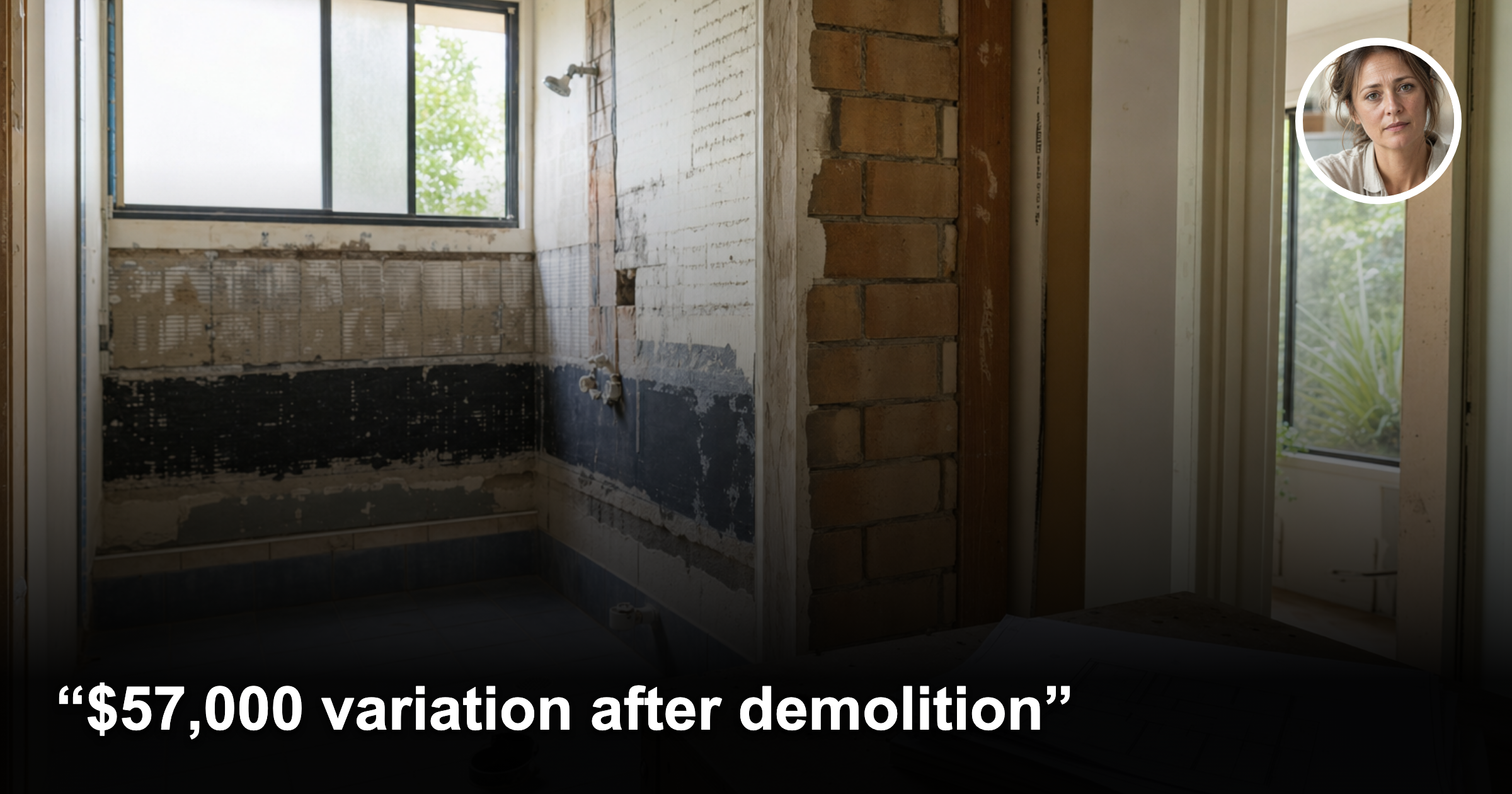
A $138,000 renovation became a $57,000 variation after demolition, forcing one homeowner to test the building risk against the exact street’s finished value.
At 44, she thought the hardest part of renovating the family home would be choosing the right finishes while caring for someone she loved.
The quote was clear: $138,000 for a kitchen, laundry and bathroom overhaul. Eight weeks later, after walls were opened and the original plans were questioned, the builder presented a variation bill for another $57,000.
Her question was simple: “How can a renovation that looked affordable before demolition become a financial risk after the work has started?”
The answer starts before the first wall comes down
Renovation budgets fail when owners price the visible work but not the uncertainty behind it. Older homes can contain unrecorded plumbing, non-compliant alterations, damaged framing, asbestos, drainage problems or waterproofing that was never installed correctly.
That does not make every variation legitimate. It does mean an owner needs to separate three things: work that was reasonably discoverable before the quote, genuine unforeseen conditions, and design changes requested after construction began.
The distinction matters because a signed quote is not a magic shield. The contract should explain how variations are identified, priced, approved and documented. If the process is vague, the owner may discover that the argument is no longer about tiles or tapware; it is about whether anyone can prove what was known at each stage.
The new building environment makes that paper trail even more important. Expectations around practitioner responsibility, documentation and duty of care are tightening, but a stronger rulebook does not remove the need for an owner to ask precise questions before committing money.
Why the $57,000 gap can destroy the investment case
The obvious response is to ask whether the finished home will be worth the extra spend. That is the right question, but suburb-level averages are too blunt to answer it.
Ripehouse Advisory tests the exact address against achieved sales, achieved rents, days on market, vacancy, buyer depth and competing supply. A renovation can be beautifully executed and still overcapitalise if the street’s resale ceiling is lower than the owner’s design ambition.
In her case, a broad suburb median suggested the upgraded home would be comfortably supported. The street-level comparison told a different story. Recent renovated sales nearby had a narrower buyer pool, while newer competing stock was offering similar kitchens with better parking and lower maintenance. The proposed spend was not automatically wrong, but the address could not be treated as if it had the same ceiling as the suburb’s best pocket.
This is the trap many owners miss: construction risk and market risk compound each other. A $20,000 surprise is painful when the finished property has clear demand. The same surprise can become unrecoverable when the street has weak buyer depth or when comparable homes are already sitting on the market.
The questions to ask before approving a variation
First, ask for a written description of the condition that triggered the extra work. Request photographs, measurements and the relevant plan or inspection finding. “The site was worse than expected” is not a scope of work.
Second, ask for the cost in a form that can be compared with the original quote. Labour, materials, subcontractor margins, demolition, waste and project-management charges should be visible. Ask what can be deferred without creating a compliance or safety problem.
Third, check the contract’s notice and approval process. A variation that appears after work is complete is a different dispute from a variation presented before the owner authorises it. Keep every email, invoice, drawing and site instruction together.
Fourth, re-run the property decision. Compare the revised total with recent achieved sales of renovated homes on the same or comparable streets. Test the likely rent, vacancy exposure, days on market and future competing supply. A renovation should improve the asset’s position, not merely make the owner feel committed to it.
Should she keep going?
Not automatically, and not simply because demolition has started. She needed to identify which work protected the building, which work improved liveability and which work was an optional finish. Those categories have different financial priorities.
The strongest response was not to abandon property or freeze every project. It was to make the address, contract and end value part of the same decision. A modest renovation that fixes defects and suits the street can preserve rental demand and resale appeal. A prestige specification that outruns the local buyer pool can turn a good home into an expensive lesson.
For investors, renovators and future buyers, the conclusion is encouraging: property still rewards informed improvement. The edge comes from knowing what the building needs, what the contract actually allows and what the exact street will pay for. The right renovation, on the right property, measured against street-level data, can create durable value rather than just a bigger bill.
Read Ripehouse Advisory’s guide to a hidden bathroom defect and street-level value gaps before approving the next variation.
If there's a specific street you're weighing up right now, check its Street Score first — it's free, takes ten seconds, and tells you whether that street is pulling the suburb average up or riding on it.
Frequently asked questions
Why can a renovation quote turn into a much bigger bill after demolition starts?
Older homes can hide unrecorded plumbing, damaged framing, asbestos, drainage problems or poor waterproofing that only become obvious once work begins. The article says the key is to separate genuinely unforeseen conditions from work that should have been discoverable before the quote or changes requested later.
What should a homeowner ask for before approving a variation on a renovation?
Ask for a written description of the condition that triggered the extra work, plus photos, measurements and the relevant plan or inspection finding. You should also ask for a cost breakdown that matches the original quote so you can see labour, materials and other charges clearly.
How can you tell whether a variation is legitimate or just a dispute about the quote?
The article says the contract should explain how variations are identified, priced, approved and documented. If the process is vague, it becomes hard to prove what was known at each stage, which makes the dispute more difficult to resolve.
Why is suburb median value not enough when deciding whether to keep renovating?
Because suburb averages can hide the real ceiling of a specific street. The article says you need to test the exact address against achieved sales, achieved rents, days on market, vacancy, buyer depth and competing supply.
What is the main financial risk of approving a big variation after renovation has already started?
Construction risk and market risk can compound each other. If the street has weak buyer depth or stronger nearby competing stock, the extra spend may not be recovered in resale value or rent, even if the renovation is well done.
General information only. It does not take your objectives, financial situation or needs into account, and nothing here is legal, financial, taxation or investment advice specific to your circumstances.