News · 15 August 2026 · 5 min read
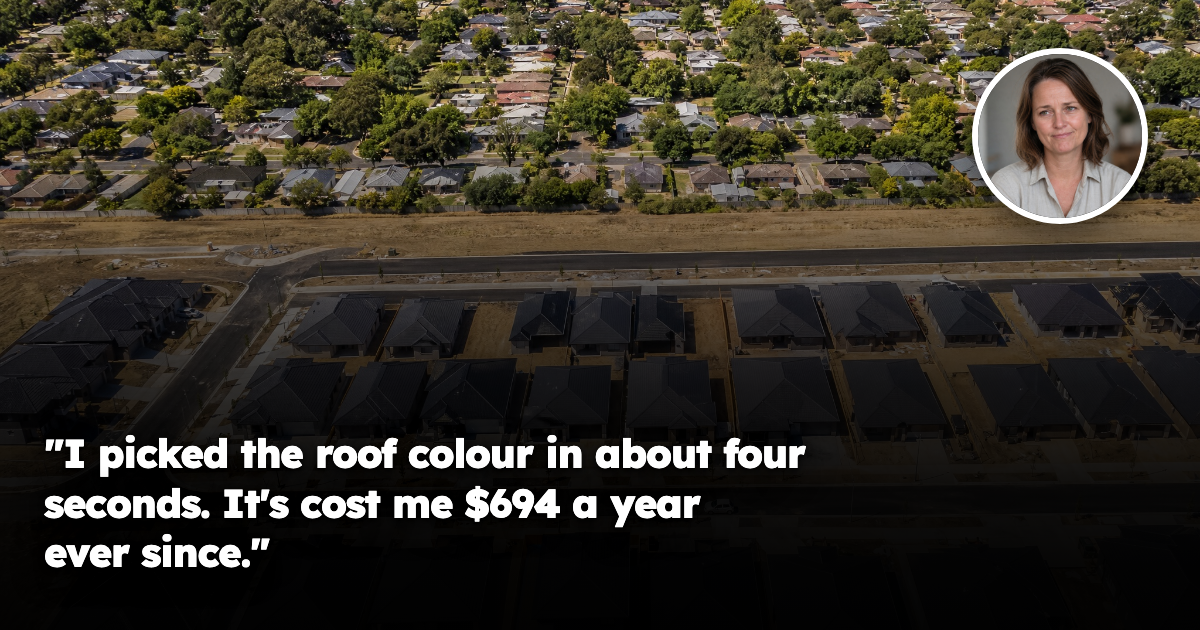
'I picked the roof colour in about four seconds. It's cost me $694 a year ever since'
An investor asked us why her newer, better-located rental was harder to hold than her older one two streets away. The answer was not the market. It was roof colour, road surface and tree cover - a set of variables decided at the estate level and paid for by the owner for thirty years.
A client came to us earlier this year with a question that sounded like a market question and wasn't.
She owns two rental properties in the same outer-metropolitan corridor, about two kilometres apart. One is a 1990s brick house on an established street. The other is a six-year-old house in a newer estate — bigger, better finished, closer to the new shops, and on paper the superior asset.
The newer one is the problem. It rents for less than she expected, the tenants turn over faster, and every summer she gets the same run of messages about how hot the house gets.
"Is it the suburb?" she asked. "Did I buy in the wrong pocket?"
No. She bought in a perfectly good pocket. The difference between her two houses is roof colour, road surface and tree cover — and she made one of those decisions herself, at a colour-selection appointment, in about four seconds.
What a dark roof actually costs
This is the part almost nobody prices, because it never appears on a contract.
A dark roof absorbs heat. A light roof reflects it. In a climate like ours that is not an aesthetic distinction, it is an operating cost.
Research into Australian housing puts hard numbers on it. Against an average east-coast household electricity spend of around $1,827 a year, a household with a light-coloured "cool" roof can pay up to $694 less, purely because the house needs less cooling. Framed the other way around: a dark roof in a warm-temperate capital lifts the power bill by roughly 38%.
Now the detail that turns this from unfortunate into genuinely irritating: a light roof costs the same to build as a dark one. There is no premium. The entire penalty is paid over the following decades by whoever owns and occupies the house.
It compounds, too. A dark roof reduces the output of rooftop solar, and it does so worst on the hottest days — exactly when the grid is most stressed and the air conditioner is working hardest.
The street is hotter than the suburb
Roof colour is only the piece she chose. The rest was chosen for her.
Blacktop roads reach up to 75°C in an Australian summer, and they hold that heat into the night. Reflective road surfacing can cut it by up to 13°C — but uptake has been minimal, so most new estates get the standard black.
Tree cover is the biggest lever of all. Residents on streets with established large trees experience less than half the number of extreme-heat days of residents on treeless streets. Not a marginal improvement — half. We have written before about how a single street tree can move a property's value by tens of thousands of dollars; shade is doing more work than the pleasant look of it suggests.
Stack those together and you get the pattern visible from the air over almost any new estate in the country: dark roofs, black roads, thin canopy, and lots of hard surface. Older streets two kilometres away, built before those defaults set in, have lighter roofs, thirty years of tree growth and more permeable ground.
Same suburb. Same postcode. Same median. Materially different houses to live in and to hold.
Why suburb-level data is structurally blind to this
Here is where it stops being a comfort issue and becomes an investment one.
A suburb median is an average. It averages the leafy established street and the exposed new release, and reports a single number that describes neither. Nothing in a suburb-level dataset registers roof colour, canopy cover, orientation, or how much hard surface sits between the front door and the road. These are per-street and often per-block attributes, and they are exactly the resolution at which we do our work.
That matters because thermal performance shows up in the numbers investors actually care about, just indirectly:
- Achieved rent, not advertised rent. A house that is uncomfortable for four months of the year gets negotiated down, or takes longer to let at the asking figure.
- Vacancy duration. Tenant demand for a hot house softens in exactly the season most leases turn over.
- Days on market, and tenant turnover. Turnover is one of the most expensive line items in a portfolio, and heat is a documented driver of it.
Across the corridors we research, the spread in effective yield between the best and worst streets inside a single suburb routinely runs 20–30% — measured on achieved rents, real vacancy duration and actual days on market, not on the median. Thermal performance is one of the quiet inputs to that spread, and it is invisible at suburb level by construction.
There is a policy layer sitting underneath this too. A plan to ban dark roofs in one of the eastern states was abandoned in 2022 after industry pushback, and sustainability standard upgrades have since been paused in several jurisdictions. One state has moved anyway, banning dark roofs outright in a large new housing development. The direction of travel is clear, even if the timing is not — which means today's dark-roof estates are being built into a standard that will eventually shift underneath them.
What we told her to do
Four things, in order.
Look at the aerial imagery before the listing photos. Roof colour, canopy and hard surface are all visible from above, free, in about two minutes. Listing photos are shot to hide exactly this.
Walk the street in the afternoon, not at the 10am open home. Heat is a time-of-day phenomenon, and inspections are scheduled at the flattering end of it. The same logic applies to which way the block faces, which is another variable decided once and paid for permanently.
Price the running cost, not just the yield. A house that costs several hundred dollars a year more to cool is a house with a permanently thinner margin, and the tenant feels it before you do.
If you already own it, the fix is cheaper than the problem. Roofs get recoated. Trees get planted. Neither is expensive relative to a decade of higher bills, shorter tenancies and softer achieved rent.
The part that should encourage you
It is tempting to read all this as another reason property is getting harder. It isn't.
Read it the other way. If entire estates are being built with a set of defaults that measurably degrade how they perform — and if the data everyone else is using averages that away into a suburb median — then the streets that were built well, or grew into it over thirty years, are systematically underpriced relative to what they deliver.
That gap is not sentiment. It is measurable, it sits below the suburb line, and almost nobody looks for it.
Our client's two houses are still two kilometres apart. One of them is quietly better than the market thinks it is, and she owns that one too.
She researched the suburb and bought the estate. The house she's happier with, she bought by accident.
If there's a specific street you're weighing up right now, check its Street Score first — it's free, takes ten seconds, and tells you whether that street is pulling the suburb average up or riding on it.
Frequently asked questions
Why can a newer rental house in a good suburb be harder to hold than an older one nearby?
The article says the difference can come down to estate-level design choices like roof colour, road surface and tree cover, not the suburb itself. These features affect heat, tenant comfort and running costs, which can make a property harder to rent and keep occupied.
How much can a dark roof add to cooling costs in an Australian home?
According to the article, a light-coloured cool roof can reduce a household’s electricity bill by up to $694 a year compared with a dark roof. In a warm-temperate capital, a dark roof can lift the power bill by roughly 38%.
Does choosing a light roof cost more to build than a dark one?
No. The article says a light roof costs the same to build as a dark one, so the extra cost shows up later in higher cooling bills rather than upfront construction cost.
What should investors check before buying in a new estate?
The article recommends checking aerial imagery for roof colour, canopy cover and hard surface, then walking the street in the afternoon to judge heat properly. These are not captured well by suburb-level data, but they can affect rent, vacancy and days on market.
If I already own a hot property, what changes can help?
The article says roofs can be recoated and trees can be planted, and both are cheaper than carrying a decade of higher bills, shorter tenancies and softer achieved rent. It also notes that the running cost should be priced in, not just the headline yield.
General information only. It does not take your objectives, financial situation or needs into account, and nothing here is legal, financial, taxation or investment advice specific to your circumstances.