News · 17 August 2026 · 6 min read
"I'm being charged $2,940 a year for a drain my house doesn't even use"
He went looking for the box that lets you disagree. The law had already settled it in a sentence he'd never read — and the remedy is a refund, not a veto.
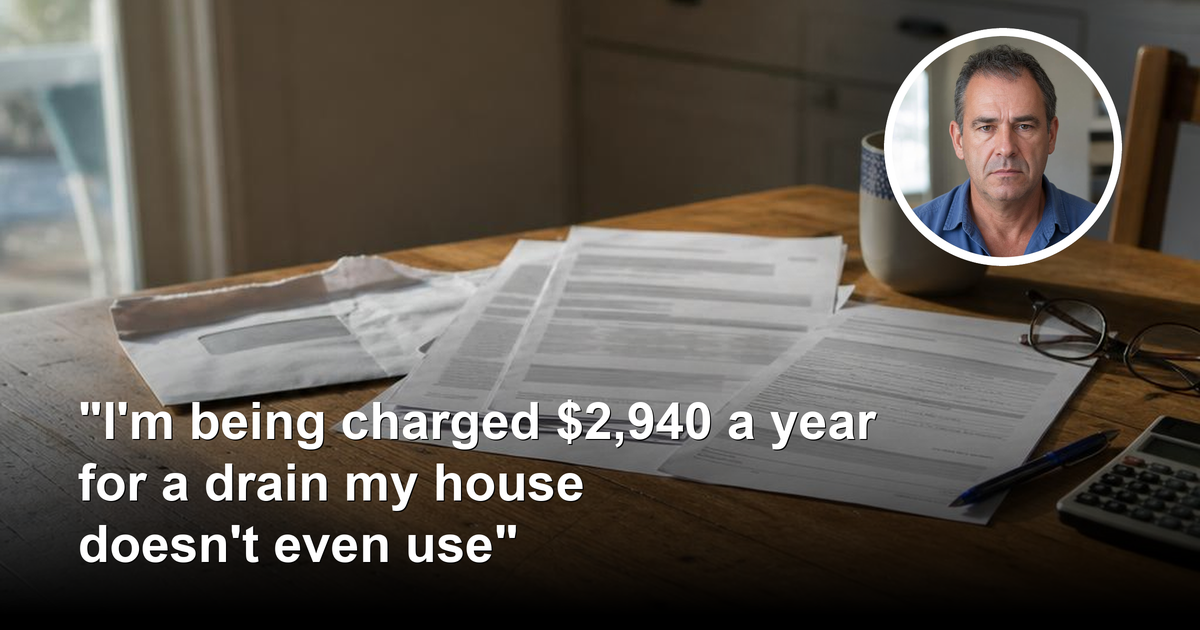
A landlord found a new line on his rates notice, went looking for the box that lets you disagree — and found the law had already settled the argument in a sentence he'd never read.
His general rates barely moved. That was the confusing part.
Eleven years in the same 1970s brick house, tenanted for seven. Then a new line appeared under the usual numbers. Not a rate rise — a separate item: $2,940. It came again the next year, and the year after: $8,820 across three notices, for a drainage upgrade to a section of his street.
His house does not drain into that section. He sits at the high end of the street. Four properties on his side are on the list. The three directly opposite — lower down, closer to the works, the ones water actually runs toward — are not.
So he went looking for the objection form. He couldn't find one, and brought us the question instead:
"How can I be on the list for a drain I don't use — and the house below me isn't?"
We get asked this often. The law has thought about his exact complaint — it just didn't resolve it his way.
There isn't one rates bill. There are four kinds
The state Act sets out four types of rates and charges: general rates (including differential rates), special rates and charges, utility charges and separate rates and charges.
General rates are for services supplied for the benefit of the community in general, rather than for a particular person. Special rates and charges are the opposite by design — for things with a special association with particular land, where that land or its occupier specially benefits, has special access, or is used in a way that specially contributes to the need for the work. The Act's own examples include, almost word for word for our landlord, replacing the drainage system in only part of the local government area.
So the levy is not a rate rise that went wrong. It is a different instrument behaving as intended: a defined list of properties paying for a defined piece of work — the same blind spot that catches owners when a bill jumps without the land valuation moving at all.
The document he should have been asking for
Before levying a special rate or charge, a council must resolve to do it — and that resolution must identify the rateable land the levy applies to and the overall plan.
The overall plan is a real, adopted document. The regulation says it must describe the activity, identify the rateable land and state the estimated cost and estimated time for carrying it out. It must be adopted before, or at the same time as, the first resolution to levy — and if it runs beyond a year, an annual implementation plan for each year.
Two things there surprise almost everyone. The money can be collected before anything is built — the levy may be charged for one or more years before any of it is spent. And the amount need not be the same for everyone: it may differ because, in the council's opinion, one property specially benefits, has special access, or specially contributes to the need — levied "on any basis the local government considers appropriate."
That phrase — in the council's opinion — is where his neighbours' absence from the list comes from.
The sentence that answers his question
Here is the part he was never going to find on the notice.
The regulation states that in any proceedings about special rates or charges, the resolution or the overall plan is not invalid merely because it fails to identify all the rateable land the levy could have been levied on, or incorrectly includes rateable land it should not have been levied on.
Read that again with his street in mind. The law contemplates, in advance and in writing, that the list will sometimes miss properties that belong on it and sometimes include properties that don't — and neither error, by itself, breaks the levy.
His argument is pre-answered. Not dismissed as wrong — just held insufficient, on its own, to invalidate the scheme. That is why there was no objection box: this is not built around a challenge. It is built around a refund.
The remedy is money back, not a veto
If a rate notice includes a special levy on land it does not apply to, the notice is still not invalid — but the council must return that money to the person who paid it. And when a plan finishes or is cancelled with money left over, the unspent amount goes to the current owners: sell mid-scheme and you funded a surplus repaid to whoever holds the title when the cheque is written.
Meanwhile the collection side has teeth unrelated to whether you agree. Overdue rates and charges are a charge on the land. A council can register that charge with the titles registrar, and once registered it ranks ahead of every other encumbrance except those favouring the State — including, ordinarily, the mortgage. The Act is explicit this doesn't limit any other remedy, including selling the land.
So the sequence is: pay, then argue about whether it applied to you.
What this actually means if you own or are buying
A special rate or charge attaches to a named parcel on a list — not a postcode, not a suburb, not a median. Two houses on the same street can share the same school catchment, zoning, growth figure and vacancy rate, and one can be carrying thousands a year of levy the other has never heard of. It never shows in price growth or vacancy; it shows in net yield, every year the plan runs — including the years the money is levied and not yet spent.
This is why our research runs at street and parcel level. Measuring achieved rents, real vacancy duration and actual days on market street by street, the effective yield spread between the best and worst street in one suburb is routinely 20–30% — the same divergence we mapped when insurance costs split one street in half.
A property modelled on an average rates bill isn't modelled. It's assumed.
The practical step takes one email: before you buy, ask whether the land is on the list for any special rate or charge, and ask for the overall plan — cost, timeframe, years remaining.
And that is the encouraging part. Every one of these levers is decided in writing and in public before the first cent is charged — which makes it checkable, and therefore priceable. Almost nobody prices it, so the market keeps pricing the anxiety instead of the fact, and that gap is where a data-led buyer gets paid. Property remains one of the few assets where the diligence is available to anyone willing to read one more page.
He was looking for the box to tick to say he disagreed. The law had already answered him — just not in the part of the notice he was reading.
If there's a specific street you're weighing up right now, check its Street Score first — it's free, takes ten seconds, and tells you whether that street is pulling the suburb average up or riding on it.
Frequently asked questions
What is a special rate or charge on an Australian council rates notice?
It is a separate levy for work with a special association to particular land, rather than a general community service. The article says councils can use it for projects like replacing the drainage system in only part of a local government area.
Can a council charge me for drainage works even if my house does not use that drain?
Yes. The article says a special rate or charge can be applied to a defined list of properties that the council considers specially benefits, has special access, or specially contributes to the need for the work.
Is there an objection box or appeal that can automatically stop a special levy on my rates notice?
Not in the way the landlord expected. The article says the law is built around a refund system, not a veto, so the levy is not automatically invalid just because the land list is imperfect.
What happens if my property is charged a special levy that should not apply to it?
The notice is still not invalid, but the council must return the money to the person who paid it. The article also says any unspent money at the end of a finished or cancelled plan goes back to the current owners.
What should I ask before buying a property to check for these charges?
Ask whether the land is on the list for any special rate or charge, and request the overall plan. The article says the plan should show the cost, timeframe and how many years are left.
General information only. It does not take your objectives, financial situation or needs into account, and nothing here is legal, financial, taxation or investment advice specific to your circumstances.