News · 29 August 2026 · 5 min read
His $20,000 retrofit shock exposed the “cheap housing” trap
A recently retired buyer was quoted about $20,000 to improve the comfort of a cheaper new home. The upfront-price debate may hide the bigger ownership question.
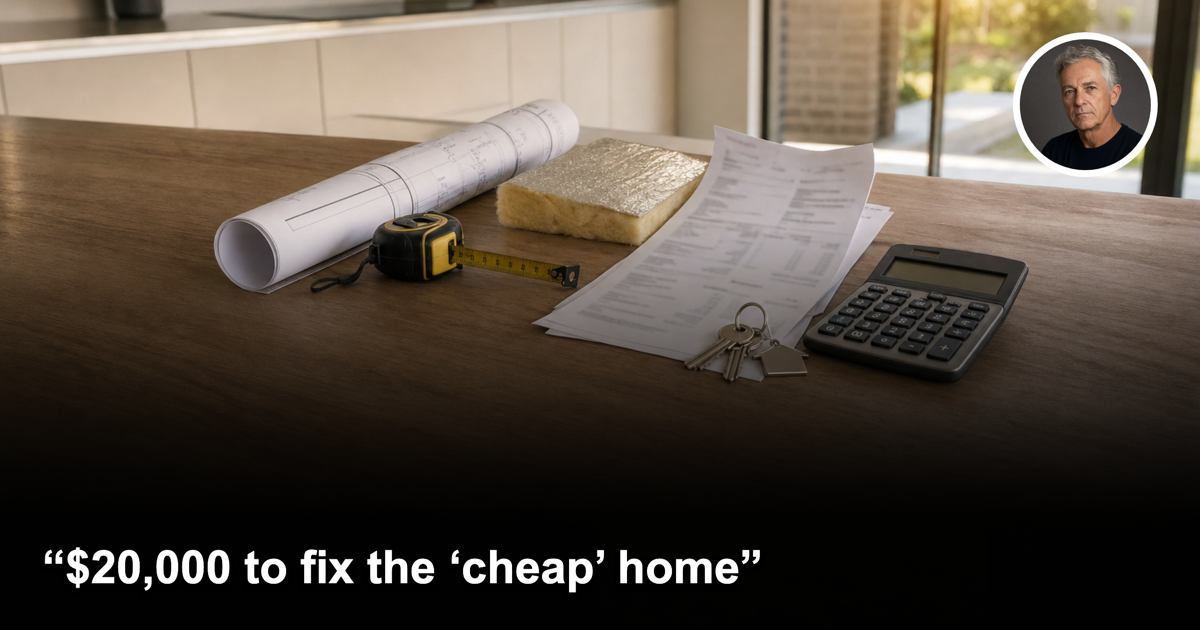
A recently retired buyer thought the argument was simple: if a new home can be built for less, more people should be able to afford one. Then he priced the work needed to make a lower-standard house comfortable.
The estimate came to about $20,000.
That did not mean every home built under weaker energy rules would require exactly that amount. It meant the headline saving was no longer an abstract political number. It had become a question about who pays later, who owns the risk, and whether a cheaper home is still cheaper when the first hot summer and winter power bill arrive.
The question
“If cutting standards makes a house cheaper to build, why am I being told that the owner may have to spend thousands to fix the result?”
It is a fair question because the current housing debate often treats construction cost as the only cost that matters. The upfront price is visible. The cost of overheating, poor insulation, weak shading, inefficient glazing and difficult retrofits is spread across years and may not appear in the sales brochure.
The political argument for reducing energy requirements is easy to understand. Builders face land, labour, materials, approval and finance costs. A policy change that trims the cost of a new dwelling sounds like a direct path to cheaper supply.
But a standard is not automatically waste. It is a rule about the minimum performance of an asset that may stand for decades. Removing it can move the cost from the builder to the buyer, then from the buyer to the electricity retailer, and eventually to the owner who has to sell into a market where thousands of similar homes have the same weakness.
The answer is in the whole asset, not the opening price
The right comparison is not “standard home versus non-standard home”. It is total ownership cost, resale demand and future flexibility.
A buyer should ask four practical questions.
First, what exactly is being removed or relaxed? “Energy rules” can cover several design and construction requirements. A headline about scrapping standards may conceal a narrower change, or it may leave buyers comparing homes with very different thermal performance. The contract, specifications and independent inspection matter more than the campaign slogan.
Second, can the missing performance be added later? Some improvements are straightforward. Others are expensive once walls, rooflines, windows and services are finished. A feature that costs a manageable amount during construction can be disruptive after settlement. The $20,000 estimate this buyer received was a reminder to price the retrofit before treating the discount as a saving.
Third, who will want the home in five or ten years? An owner may tolerate an uncomfortable room for a while. A future buyer may not. As energy costs, climate conditions and disclosure expectations change, a home’s performance can become part of the resale conversation. The risk is not only the next bill; it is the size of the buyer pool when the property is sold.
Fourth, does the location support the decision? A good building on a poor street is not automatically a good investment, and a cheaper building does not rescue weak demand. Ripehouse Advisory’s street-level analysis separates addresses that suburb averages blend together: achieved rents, vacancy duration, days on market, buyer depth and the local supply pipeline. Two homes can share a postcode and a median while one sits on a quieter, better-oriented street with deeper demand and the other faces a constant discount.
That is the same address-level problem explored in our street parking and driveway value analysis: a feature that looks minor in a suburb summary can change the buyer pool on one street. The borrowing-power guide makes the parallel clear from the finance side — the headline number is not the whole underwriting decision.
That is where the standards argument becomes an investment question. If a lower-cost specification leaves a property with higher running costs and a narrower resale audience, the buyer needs compensation in the price. If the discount is only theoretical, the risk has simply been transferred without being priced.
Why the anger is understandable on both sides
People who want more homes are right to be frustrated when every requirement adds cost, time or complexity. A family locked out of the market cannot pay a future benefit with money it does not have today. Builders are also right that inconsistent approvals and escalating requirements can make projects harder to deliver.
People who oppose weaker standards are right about the second bill. A home is not affordable merely because the first invoice is lower. If the owner then needs major work, pays more to heat and cool the property, or accepts a resale discount, the policy has not erased the cost. It has made the cost harder to see.
The useful answer is not to freeze every rule forever. It is to test each requirement against real construction evidence, publish the trade-off plainly, and make sure any saving is large enough to compensate the person who carries the long-term risk. Faster approvals, better design, serviced land and more predictable delivery may reduce cost without making the asset perform worse.
For an investor, the lesson is even more specific. Do not underwrite a new property from the brochure price alone. Model the likely running cost, inspect the specifications, compare orientation and neighbouring development, and test the address against actual local demand. A suburb-level growth story cannot tell you whether a particular street will attract quality tenants or competing listings.
It is also worth reading the recent guide to a $38,400 strata levy, because the same discipline applies: understand the future cost before deciding that the entry price is the opportunity.
The recently retired buyer did not reject new housing. He rejected the idea that a lower number at the start automatically meant a lower cost. That distinction matters. Property remains one of the clearest ways to build long-term wealth when the asset, the street and the holding costs are understood together.
The opportunity is still there: find the home whose performance, location and demand are legible before you buy. Right property, right street and right data beat a cheap headline every time.
If there's a specific street you're weighing up right now, check its Street Score first — it's free, takes ten seconds, and tells you whether that street is pulling the suburb average up or riding on it.
Frequently asked questions
Why can a cheaper new home end up costing more overall?
Because the upfront saving may be offset by retrofit costs, higher power bills and a weaker resale position. The article says the real comparison is total ownership cost, not just the build price.
What should a buyer check before assuming weaker energy standards are a saving?
Check exactly what standards are being relaxed, whether the missing performance can be added later, and what the retrofit would cost. The article notes that some fixes are much more expensive after construction is finished.
What is the main risk if a home has poor thermal performance in Australia?
The owner may pay more to heat and cool the property and may face a smaller pool of future buyers. The article says energy performance can affect both running costs and resale demand over time.
How does location affect the decision to buy a lower-cost home?
A cheaper building does not make up for weak local demand or a poor street. The article says street-level factors like achieved rents, vacancy duration, days on market and the local supply pipeline can matter more than suburb averages.
What is the practical takeaway for investors looking at a discounted new property?
Do not underwrite it from the brochure price alone. The article says investors should model running costs, inspect specifications, compare orientation and neighbouring development, and test the address against actual local demand.
General information only. It does not take your objectives, financial situation or needs into account, and nothing here is legal, financial, taxation or investment advice specific to your circumstances.