News · 28 August 2026 · 4 min read
Her $760,000 loan was $104,000 short. Why the same borrower can look risky at one bank
A 27-year-old woman is $104,000 short of the loan she needs, and the gap is hidden in the lender’s stress test.
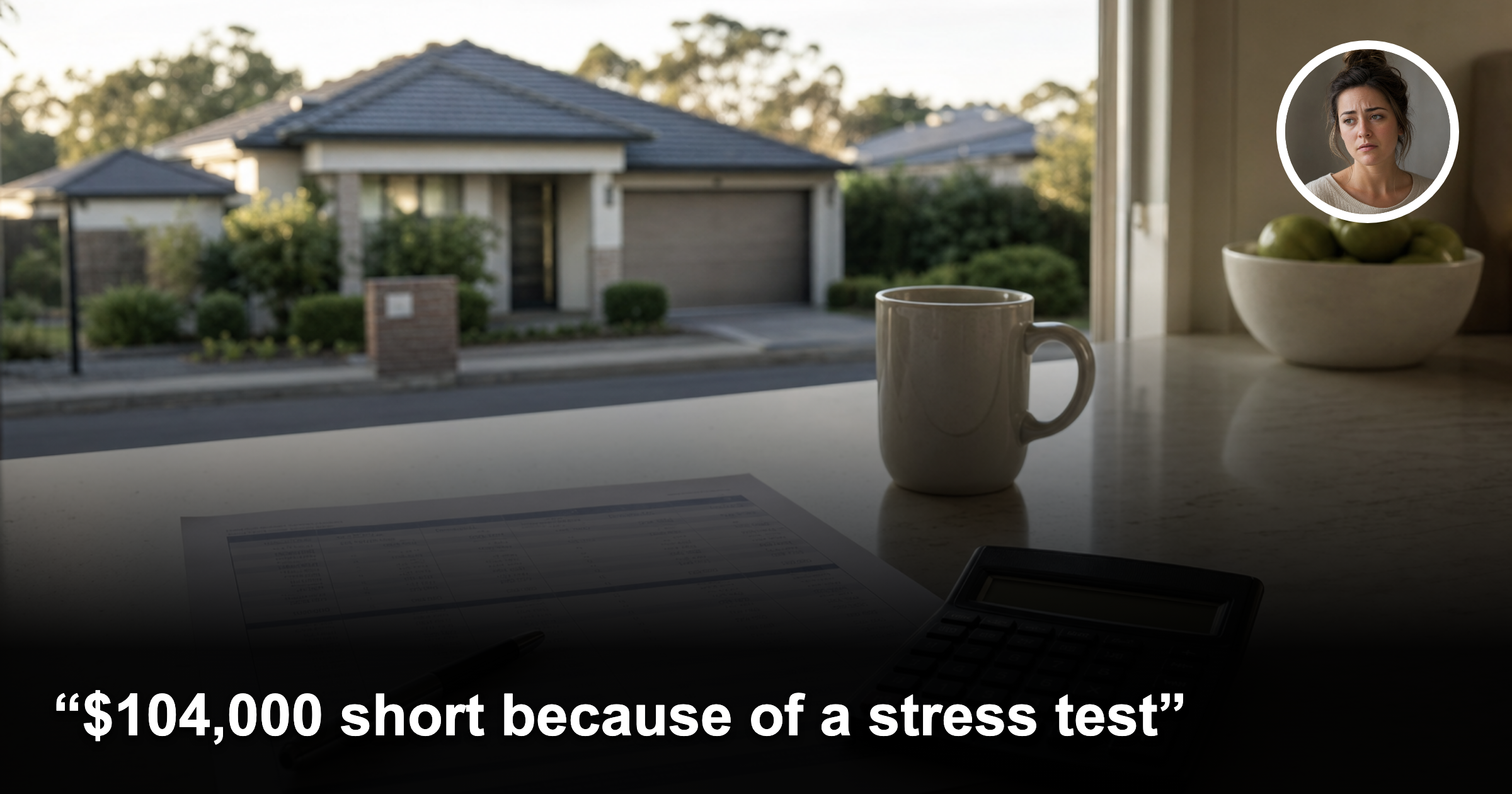
A 27-year-old woman had done what lenders usually ask first: she saved a deposit, kept her spending under control and found a property she could afford at today’s repayments. Then one lender’s calculator put her $104,000 below the amount she needed.
She had not suddenly become a worse borrower. The difference was hidden in the assessment: the interest rate used to test the loan, the way existing rent was treated and how the lender counted irregular household costs.
The question she brought to Ripehouse Advisory was blunt: if a $760,000 loan works in the real world, why can a bank say no on paper?
The answer starts with the rate you do not pay
Australian banks do not assess a home loan only at the advertised interest rate. They apply a serviceability buffer so a borrower is tested against a higher rate. The buffer is a safety mechanism for the household and the financial system, but it can make borrowing capacity move sharply when rates rise.
That assessment rate is not a forecast of the rate the borrower will actually pay. It is a stress test. A household can therefore have enough cash flow for the current repayment and still fail the lender’s test because the stressed repayment is too large beside the lender’s accepted income.
For this woman, the difference between a $760,000 approval and a $656,000 result was not a single careless purchase. It came from several small decisions being stacked together: a cautious treatment of overtime income, a higher living-expense benchmark and a loan repayment tested at a rate several points above the proposed rate.
Another lender assessed the same facts differently and came closer to the required amount. That does not make the second lender automatically better. It means the phrase “your borrowing capacity” is incomplete without asking: according to which policy, with which assumptions, for which property?
Why the property can change the answer
Borrowers often focus on the loan size and forget that the asset is part of the risk assessment. An apartment with a high owners-corporation bill, a house with unusual insurance costs or a property with weak rental evidence can make the numbers less comfortable.
The address also affects the exit plan. If the loan is for an investment, rent is not just a line in a spreadsheet. The quality of tenant demand, the depth of the buyer pool and the time a property typically takes to sell can influence how resilient the strategy is when circumstances change.
This is where suburb averages can hide the important part. Ripehouse’s street-level review compares achieved rents, vacancy, days on market, buyer depth and local supply around the precise address. Two homes in the same postcode can have the same headline yield while one sits near a persistent tenant-demand pocket and the other competes with a large pipeline of new stock. The lender’s calculator may be identical; the investment risk is not.
What should a borrower check before chasing a bigger approval?
First, ask for the assumptions behind the result. What assessment rate was used? Which income was excluded or discounted? Were credit-card limits, HECS-HELP obligations, dependants, strata costs and existing loans entered correctly? A $10,000 credit-card limit can affect a serviceability test even when the card balance is zero.
Second, run the numbers at the lower approval as well as the target approval. If the plan only works at the maximum a lender will offer, it is fragile. A smaller loan on a stronger street may create more options than a larger loan attached to a property with thin demand.
Third, compare policies carefully rather than collecting approvals like trophies. A lender with a friendlier calculator may also have a higher rate, tighter refinance rules or a less suitable treatment of future income. The useful comparison is total resilience: repayment buffer, cash reserve, rental evidence, holding costs and the likely resale audience.
Finally, separate the borrowing question from the property question. Being approved for $760,000 does not mean every $760,000 property is sensible. Equally, being $104,000 short with one bank does not mean the right investment is out of reach. It may mean the structure, the lender or the address needs to change.
The opportunity hidden in a lending “no”
The woman did not need a more optimistic story; she needed a sharper one. Once the assumptions were visible, she could test a lower loan, a different lender and streets with stronger rental demand and buyer depth instead of treating one automated result as a verdict on her future.
That is the pro-property-investment lesson. Lending rules matter, but they are only one filter. The investor who matches the right loan to the right asset and checks the exact street can turn a borrowing-power gap into a better purchase decision. In property, the headline number gets attention; the address-level evidence creates the advantage.
If there's a specific street you're weighing up right now, check its Street Score first — it's free, takes ten seconds, and tells you whether that street is pulling the suburb average up or riding on it.
Frequently asked questions
Why could the same borrower be approved for $760,000 at one bank but fall $104,000 short at another?
Because Australian lenders do not all assess loans the same way. In this case, differences in the stress-tested interest rate, how rent was treated and how household costs and income were counted changed the result.
What is a lender’s serviceability buffer, and why does it matter?
A serviceability buffer is the extra rate banks use to test whether you could still afford the loan if rates were higher. It matters because a borrower can handle today’s repayment but still fail the lender’s stress test on paper.
What should a borrower check if their borrowing capacity seems lower than expected?
They should ask which assessment rate was used, whether income was discounted, and whether things like credit-card limits, HECS-HELP, dependants, strata costs and existing loans were entered correctly. Small differences in inputs can change the outcome.
Does being approved for a loan mean any property at that price is a good choice?
No. The article says borrowing approval and property suitability are separate questions, and an address with weak demand, higher holding costs or poor resale depth can be riskier even if the loan is approved.
Why does the article say the property’s street matters, not just the suburb?
Because two homes in the same postcode can have very different rental demand, vacancy, days on market, buyer depth and supply. Those street-level factors can change the real investment risk even when the lender’s calculator stays the same.
General information only. It does not take your objectives, financial situation or needs into account, and nothing here is legal, financial, taxation or investment advice specific to your circumstances.