News · 20 August 2026 · 6 min read
'I didn't renovate. I didn't rezone. I put a sixth bed in a share house and the quote came back $46,000'
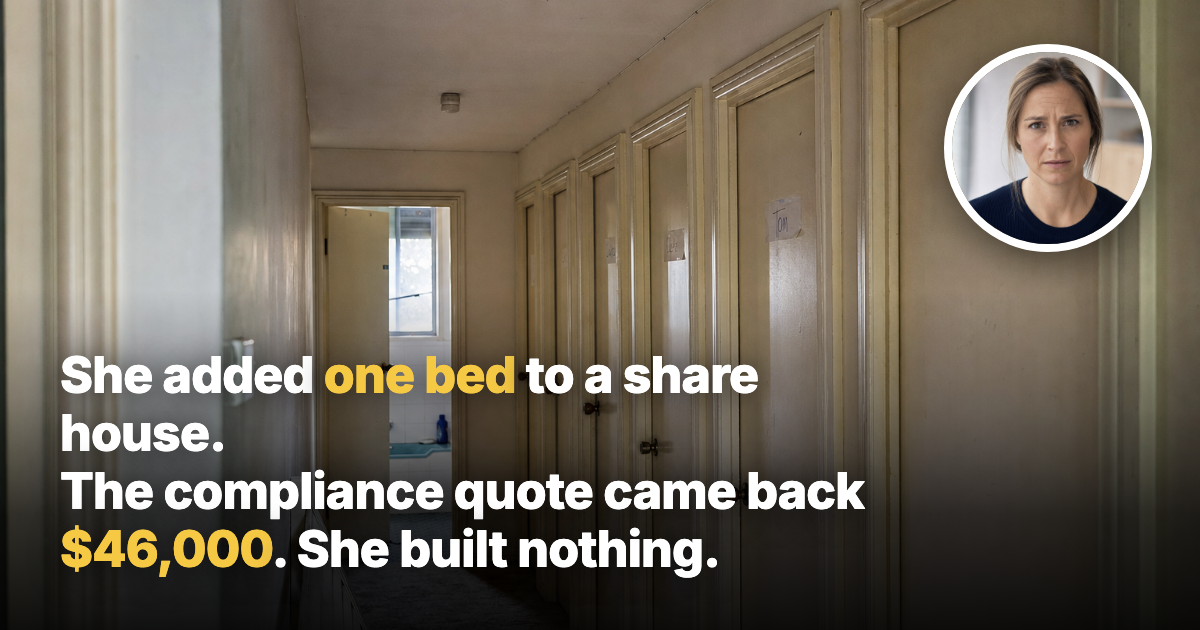
She converted a study into a sixth bedroom in a share house. No walls moved, no plumbing changed — and a $46,000 fire safety bill arrived. The trigger wasn't building work. It was a definition she crossed by counting.
A question landed with us this month that we have been turning over ever since, because the woman asking it had done nothing wrong.
She is 38, a dental hygienist, and she owns one investment property: a brick house built in 1987, five bedrooms, two bathrooms, bought four years ago and run as a share house ever since. Five tenants, five room agreements, two shared bathrooms. It has never been vacant longer than eleven days.
Last autumn she converted an oversized study into a sixth bedroom. No walls came down. No plumbing moved. She added a wardrobe and a bed and advertised the room. A tenant moved in. Nothing changed that anyone in the street could see.
Eleven weeks later a council officer attended after an unrelated neighbour complaint about bins. The officer counted bedroom doors, asked how many people slept there, asked whether the bathrooms were shared, and wrote none of it down as a bin matter.
The letter that followed asked her to demonstrate the building complied with a fire safety standard she had never heard of. The consultant she engaged quoted $46,000: interconnected early warning systems, emergency lighting on the exit path, door hardware and wall lining upgrades, an evacuation diagram in every room, and a written management plan she would be legally required to keep current.
Her question to us was one sentence long.
"Which building work triggered this?"
The answer is the part people find hard to accept. None. She never triggered it by building. She triggered it by counting.
The definition with no door
Most property compliance arrives with an envelope attached. You apply, someone assesses, a certificate issues, a date goes in a calendar. That is how approvals work, how pool certificates work, how almost everything an investor budgets for works.
This is not that. There is a category of building defined in law by two facts: the occupants share access to a bathroom or sanitary facilities, and the building provides accommodation for six or more persons of a described kind — boarding house, hostel, guesthouse, bed and breakfast, or share-house or similar accommodation.
That is the entire test. Six people, one shared bathroom.
There is no application to make. No inspector to book. No certificate to obtain, display or renew. No register your address appears on. Unlike the cases where a third party can veto an approval, there is no approval and no third party — there is nobody to tell you. You do not enter this regime — you simply satisfy it, and from that moment the obligations are true of you whether or not anyone has ever mentioned them. Her house crossed the line the night the sixth tenant unpacked, and stayed there for eleven weeks while she collected rent and thought about nothing.
At five tenants she was a landlord. At six she was operating a class of accommodation with its own fire safety standard, record-keeping duties and penalties — and the change was a bed.
Every escape hatch is closed on purpose
The first instinct is to argue the arrangement out of the definition. The law anticipated that and closes each exit explicitly.
It does not matter that no meals are provided. It does not matter what the legal basis of the occupancy is — the drafting is blunt here, because the definition still bites where there is no established legal basis at all. Informality is not a defence; it is another fact pattern the section covers.
It does not matter if some occupants pay nothing. Accommodation provided free of charge still counts toward the six. A friend between rentals, an adult child home for a year, a relative recovering from surgery — all are persons accommodated, and all count.
And the sharpest limb: proof does not depend on who is home. Evidence that the building has beds available for use is evidence that it provides accommodation — whether or not those persons are present. The measure is capacity, not occupancy — the same logic that lets a tenancy be ended on inference rather than fact. Empty the sixth room for a month and the bed still speaks.
There are genuine carve-outs — ordinary houses and standard apartment classifications, aged care, schools, refuges. None describe a suburban share house.
Why the clock is not on your side
For older stock there is a conformity timetable: the early warning and emergency lighting provisions inside one year, the balance inside three. An extension exists — but it may be granted only if the council is satisfied that refusing it would cause undue hardship to the building's occupants. Not to the owner. The one form of relief available cannot be argued on your own behalf.
There is also a provision that catches people trying to do the right thing. You may write and ask the council whether your building conforms. If the answer is no, the notice must set out what you have to do — and you must comply with it. A request for an opinion becomes a binding, penalty-backed order.
Where a performance-based fire solution was used, councils must inspect at least once every three years, without notice, at no charge. The management plan must be kept in the building and available for inspection, free, by occupants and members of the public.
What this actually says about buying
Here is where it stops being a horror story and becomes a numbers problem, which is a far better kind of problem.
Six-person capacity is a building-level fact. Bedroom count, bathroom configuration, construction era, exit paths, the distance from the furthest bedroom door to open air — these differ house to house on the same street, let alone across a suburb. A median price cannot see a bathroom. A suburb growth rate has never once counted a bedroom door.
This is the gap our research engine is built to read. Two houses two blocks apart, same postcode, same headline yield: one a 1970s four-bedroom, one bathroom, where a sixth bed is unreachable without a five-figure upgrade; the other a 2005 six-bedroom with two bathrooms and a compliant exit path, where high-occupancy income is available on day one. Same suburb average. Two completely different assets. Street-level work — achieved rents rather than asking rents, real vacancy duration, true days on market — routinely shows a 20–30% spread in effective yield between the best and worst streets inside a single suburb. Layer occupancy capability over that and the spread widens again.
Her numbers make the case better than any argument. The upgrade came in at $19,400, not $46,000, once a second consultant designed to the standard rather than around it. The sixth room grosses $11,200 a year. She lifted her gross yield by 0.9% on a property she already owned, and she now owns the only compliant six-bed house on her street.
She was never punished for scaling. She was punished for scaling without reading first.
Every element of this — the six-person threshold, the shared-bathroom limb, the carve-outs, the timetable, the inspection powers — is published, stable and readable long before it becomes urgent. Nothing here happens by ambush. It happens by assumption. Risk you can read before you buy is risk you can price, and priced risk is not a threat; it is an advantage over every bidder who counted the bedrooms and stopped there.
She didn't break a rule. She just crossed a line nobody had drawn on the floor.
If there's a specific street you're weighing up right now, check its Street Score first — it's free, takes ten seconds, and tells you whether that street is pulling the suburb average up or riding on it.
Frequently asked questions
When does a regular share house in Australia start attracting special fire safety rules?
According to the article, the trigger is when the building provides accommodation for six or more persons and the occupants share bathroom or sanitary facilities. It applies to a share house or similar accommodation even if no building work has been done.
Did adding a sixth bedroom or moving walls cause the compliance issue in the article?
No. The article says the issue was triggered by counting occupants, not by building work, rezoning, or renovations. The sixth bed simply moved the property into a different legal category.
Does it matter if some of the people living there are staying for free?
No. The article says accommodation provided free of charge still counts toward the six-person threshold. Informal arrangements and even no established legal basis do not avoid the rule.
What kind of upgrades can councils require once a property crosses this line?
The article says the property may need interconnected early warning systems, emergency lighting, door hardware and wall lining upgrades, evacuation diagrams in every room, and a written management plan kept current. For the example in the article, a consultant quoted $46,000, then $19,400 with a different design approach.
Is there any way to ask the council before changing a share house, or to get more time?
The article says you can ask council whether the building conforms, but if the answer is no, the notice becomes a binding order you must comply with. A time extension may be granted only if council is satisfied refusing it would cause undue hardship to the occupants, not the owner.
General information only. It does not take your objectives, financial situation or needs into account, and nothing here is legal, financial, taxation or investment advice specific to your circumstances.