
News · 21 August 2026 · 3 min read
This Kitchen Cost $19,320 — the Full Line-by-Line Breakdown
From 1987 laminate to modern in 11 days between tenants: every dollar itemised, the $70/week rent jump it bought, and the three tests that decide when a renovation pays — and when it burns money.
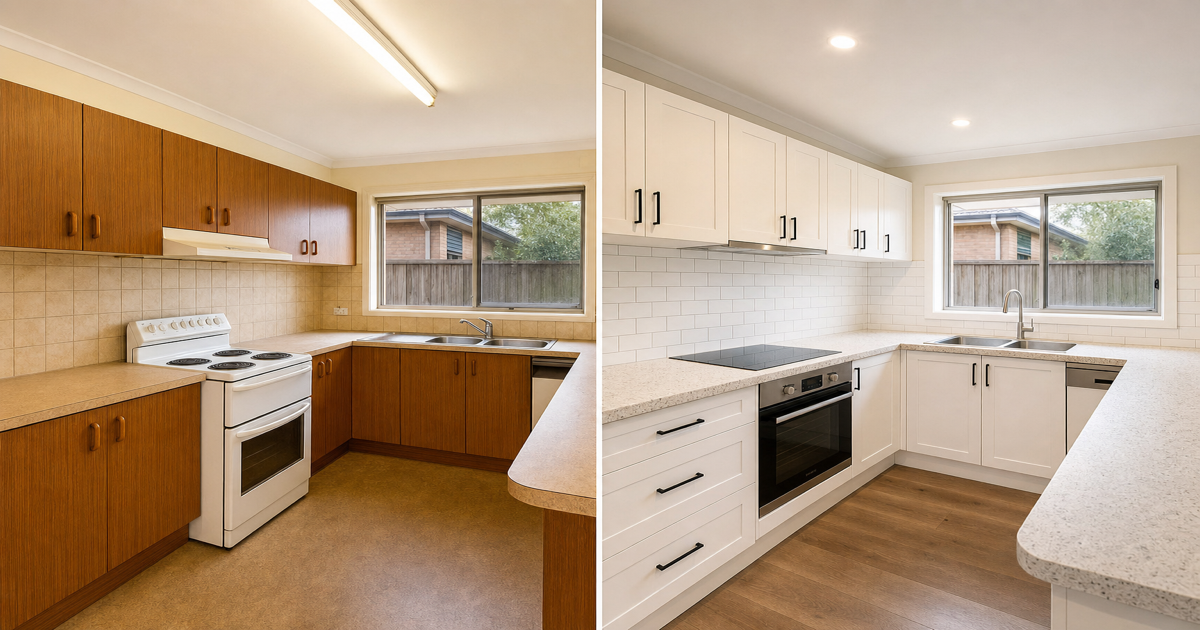
The kitchen in the photo went from 1987 brown laminate to what you see on the right in eleven days, between tenants, without moving a single wall or pipe. If you guessed the cost on our Facebook page — here's the answer, line by line.
The full breakdown
Cabinetry — $6,800. The single biggest decision on the whole job: the carcasses stayed. The original cabinet boxes were structurally fine, so only the doors and drawer fronts were replaced with white shaker profiles, plus new soft-close hinges and matte black handles. Ripping out and replacing the boxes would have added roughly $7,000 and a week — for something nobody sees.
Benchtop — $3,100. Stone-look engineered surface, templated and installed. Real stone would have been $5,500+; at this price point and rent bracket, tenants and valuers react to the look, not the quarry.
Splashback — $1,150. White subway tile, laid over the old beige tiles using tile-over adhesive — no demolition, no dust, one day.
Appliances — $2,350. Stainless underbench oven, cooktop and rangehood, mid-range brands. The old freestanding stove was the loudest "1987" signal in the room; this swap alone transformed the listing photos.
Lighting and electrical — $980. Fluorescent batten out, warm LED downlights in, two extra power points on the bench.
Plumbing — $640. New mixer tap and sink, same location — the golden rule of budget kitchen renos is never move the water.
Painting and finishing — $1,400. Walls, ceiling, and the reveal trims.
Labour coordination and contingency — $2,900. The unglamorous line every renovator forgets. Trades sequenced across eleven days, plus the inevitable surprise (in this case, a water-damaged kickboard).
Total: $19,320. Less than the stamp duty on most capital-city purchases — which was the hint.
What it bought
The property re-let within a week at $70 more per week — about $3,640 a year, a 19% cash-on-cash return on the reno before touching value. The bank valuation moved roughly $35,000, though we treat reno valuation uplift as a range, not a promise: it varies enormously by suburb, and this is exactly where street-level data earns its keep. A $19,000 kitchen adds real value in a suburb where renovated stock is scarce and rents are compressing upward. The identical kitchen in an oversupplied unit market adds close to nothing.
When a reno pays — and when it doesn't
Three tests before spending a dollar between tenants:
1. The rent gap test. Pull the rents for renovated versus unrenovated comparables on the surrounding streets. If the gap doesn't cover the spend inside six or seven years, the market is telling you tenants there won't pay for polish.
2. The suburb ceiling test. Every suburb has a price and rent ceiling. If the property already sits near it, a new kitchen pushes against a closed door.
3. The "never move the water" test. Cosmetic-over-structural is what made this job $19,320 instead of $45,000. The moment walls, plumbing or wiring move, you're not renovating — you're building.
This one passed all three, and that's the real lesson. The kitchen isn't the strategy; the data that said this suburb, this street, this spend is the strategy. Done in that order, a between-tenants renovation is one of the few ways an investor can manufacture equity and cashflow in the same fortnight — and it's a lever that well-chosen property hands you again and again.
If there's a specific street you're weighing up right now, check its Street Score first — it's free, takes ten seconds, and tells you whether that street is pulling the suburb average up or riding on it.
Frequently asked questions
What was included in the $19,320 kitchen renovation?
The spend covered new cabinet doors and drawer fronts, a stone-look engineered benchtop, a white subway tile splashback, new appliances, updated lighting and electrical, new plumbing fixtures in the same location, painting, and labour coordination with contingency. The original cabinet boxes stayed in place.
Why did this kitchen renovation only take 11 days between tenants?
It was designed as a cosmetic refresh rather than a structural rebuild. The job avoided moving walls, plumbing or wiring, which kept the work faster and cheaper.
How much extra rent did the renovation achieve?
The property re-let within a week at $70 more per week. That works out to about $3,640 a year in extra rent.
When does a kitchen renovation make financial sense for an investor?
The article says to test the rent gap, the suburb ceiling, and whether you can avoid moving water, walls or wiring. If the rental increase does not cover the spend within six or seven years, the market may not support the renovation.
What was the biggest risk in this type of between-tenants renovation?
The main risk is overspending in a suburb or street where renovated stock is already common or where the property is near the local price and rent ceiling. In that case, even a good kitchen may add little value.
General information only. It does not take your objectives, financial situation or needs into account, and nothing here is legal, financial, taxation or investment advice specific to your circumstances.