News · 26 August 2026 · 5 min read
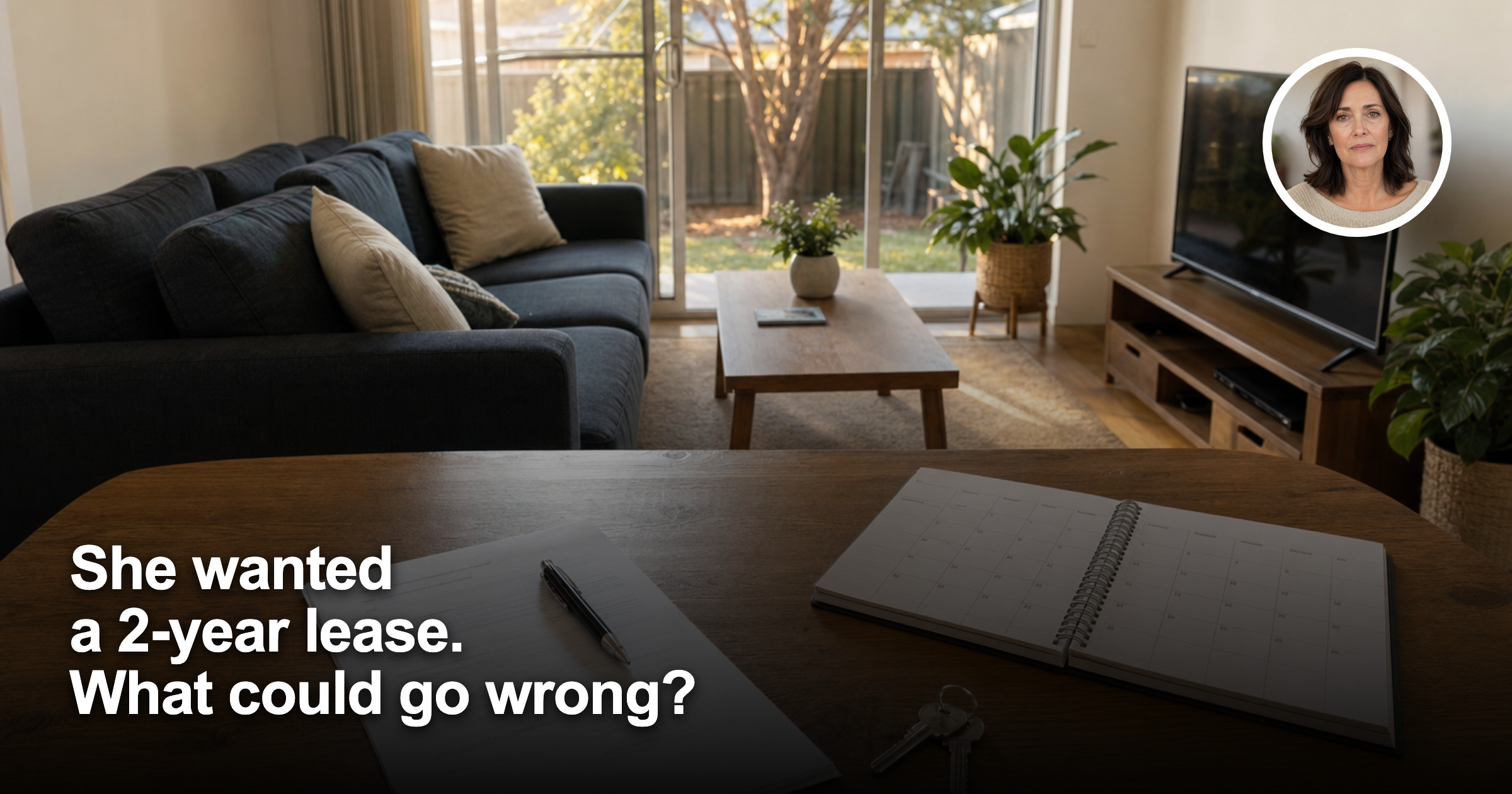
She wanted a two-year lease. Why the longer rental promise could still leave both sides exposed
A renter wants security from a two-year lease, but the right answer depends on the agreement, the property and the street-level rental evidence.
She wanted a two-year lease. Why the longer rental promise could still leave both sides exposed
The question
When a renter asks for a two-year lease, it sounds like the simplest possible win. She gets security. The owner gets a reliable occupant. The property manager gets fewer inspections, fewer advertising costs and less uncertainty.
But a longer lease is not automatically safer. The real question is whether the home, the street and the agreement can support two years of changing circumstances.
That question is becoming more heated as renters push for longer fixed terms and owners worry that a promise made today could become a constraint tomorrow. For a 56-year-old empty-nester who recently moved back into the rental market, the issue was personal: she found a home she liked, but wanted enough certainty to stop competing at every renewal.
Her request was reasonable. So was the owner’s hesitation.
What a two-year lease actually changes
A fixed-term agreement gives both parties a defined period. It does not freeze every part of the relationship forever, and it does not remove the ordinary rules around rent, repairs, access, ending an agreement or serious breaches. Those details depend on the state or territory and the wording of the agreement.
The practical change is commitment. A renter has more confidence that the owner cannot simply decide to re-market the home at the next short renewal point. The owner has more confidence that the property will not sit empty between frequent turnovers.
That trade can be valuable. A vacancy of three weeks on a home renting for $620 a week costs $1,860 before cleaning, advertising or small repairs. A longer stay can also reduce wear caused by repeated moves and preserve a good tenant relationship.
The risk is that a two-year term can be a poor fit when the property is likely to be sold, substantially renovated, occupied by the owner or affected by a major change in the surrounding area. A renter who needs certainty is not helped by an agreement that becomes a battleground later.
Why the address matters more than the headline
The same lease proposal can make sense for one property and be awkward for another only a few streets away.
Ripehouse Advisory’s approach is to test the address at street level before making a broad rental-market assumption. We look at achieved rent rather than just asking rent, vacancy duration, days on market, applicant depth and the nearby supply pipeline. A suburb can show a tight vacancy rate while a particular pocket has new apartments coming online, weaker tenant demand or a much larger pool of competing homes.
That distinction matters to both sides. If a street has consistently deep applicant demand and very few comparable homes, a stable two-year tenant may be worth more than the theoretical upside of re-advertising every 12 months. If several similar properties are due to complete nearby, the owner needs to understand how quickly the tenant pool could change before locking in assumptions about future rent.
It also changes the renter’s decision. A long lease in a home beside a future construction site, a flood-prone access road or a cluster of short-term vacancies may provide legal certainty but poor living certainty. Street-level evidence helps separate the two.
The points that should be settled before signing
First, both parties should be clear about the exact term and what happens at the end of it. A fixed term ending does not always mean the relationship ends automatically. Notice requirements and possession rules vary, so the agreement should be checked against the relevant state or territory framework.
Second, rent changes need to be understood in advance. A longer lease does not necessarily mean rent is permanently fixed, but the timing, amount and process for any change must follow the applicable rules. A vague promise about “market rent later” is an invitation to conflict.
Third, the owner should disclose known plans that could affect the home. A future sale, major renovation or planned change to an adjoining property can matter enormously to someone choosing a two-year commitment. Hiding the possibility may preserve a signature today and create a much larger dispute later.
Fourth, the renter should stress-test the commitment. A two-year lease can be reassuring, but it can also become expensive if personal circumstances change. The agreement should be read for break-lease, transfer, subletting, maintenance and access provisions, rather than treating the headline term as the whole deal.
Finally, document the property’s condition carefully. A long tenancy works best when expectations about repairs, alterations, gardens, pets and communication are written down. Good documentation protects the relationship because neither side has to rely on memory when something changes.
So should owners offer longer leases?
Longer terms deserve a serious look, especially for well-maintained properties with stable demand and a tenant who has demonstrated reliability. They can reduce churn and make income more predictable. But “two years” should not become a substitute for understanding the asset.
Owners should compare the value of certainty with the cost of losing flexibility. Renters should compare security with the consequences of being tied to a home that no longer suits them. Neither side wins by pretending the trade-off does not exist.
The best decision starts with the address. A street-level view of achieved rents, vacancy, buyer and tenant depth, days on market and incoming supply can reveal whether stability is genuinely valuable or merely sounds attractive in a heated rental market. RHA’s street-level property data approach shows why the address can matter more than the suburb label. That is the kind of evidence that turns a frightening headline into a workable property decision.
Property investment still rewards people who choose the right asset, on the right street, with the right data. The parking and driveway value gap is another reminder that two homes can share a suburb but behave like different assets. Headlines can tell you what feels urgent. Address-level evidence tells you where the opportunity actually is.
If there's a specific street you're weighing up right now, check its Street Score first — it's free, takes ten seconds, and tells you whether that street is pulling the suburb average up or riding on it.
Frequently asked questions
What does a two-year lease actually change for a renter and an owner in Australia?
It gives both sides a defined commitment period, but it does not freeze every part of the tenancy. The usual rules around rent, repairs, access, ending the agreement and serious breaches still apply, and those details depend on the state or territory and the wording of the lease.
When can a longer lease become risky for the owner?
A two-year term can be a poor fit if the property is likely to be sold, substantially renovated, occupied by the owner or affected by a major change in the area. In those cases, the owner may lose flexibility and the tenancy can become difficult later.
Why does the article say the street matters more than the suburb label?
Because rental demand can vary at street level even within the same suburb. The article says to look at achieved rent, vacancy duration, days on market, applicant depth and nearby supply, since one pocket may have strong demand while another faces new competing stock or weaker tenant interest.
What should be checked before signing a longer fixed-term rental agreement?
The exact term, what happens at the end of it, and how rent changes will work should all be clear before signing. The agreement should also be checked for break-lease, transfer, subletting, maintenance and access provisions, and matched to the relevant state or territory rules.
What information should an owner disclose before agreeing to a two-year lease?
The owner should disclose any known plans that could affect the home, such as a future sale, major renovation or planned change to an adjoining property. Hiding those issues may avoid a problem today but can create a bigger dispute later.
General information only. It does not take your objectives, financial situation or needs into account, and nothing here is legal, financial, taxation or investment advice specific to your circumstances.