News · 26 August 2026 · 4 min read
The house looked identical. Then the flight-path map changed the price by $120,000
A western Sydney woman discovers why a flight-path planning map can change the value of a backyard’s future use, even when two houses look almost identical.
The house looked identical. Then the flight-path map changed the price by $120,000
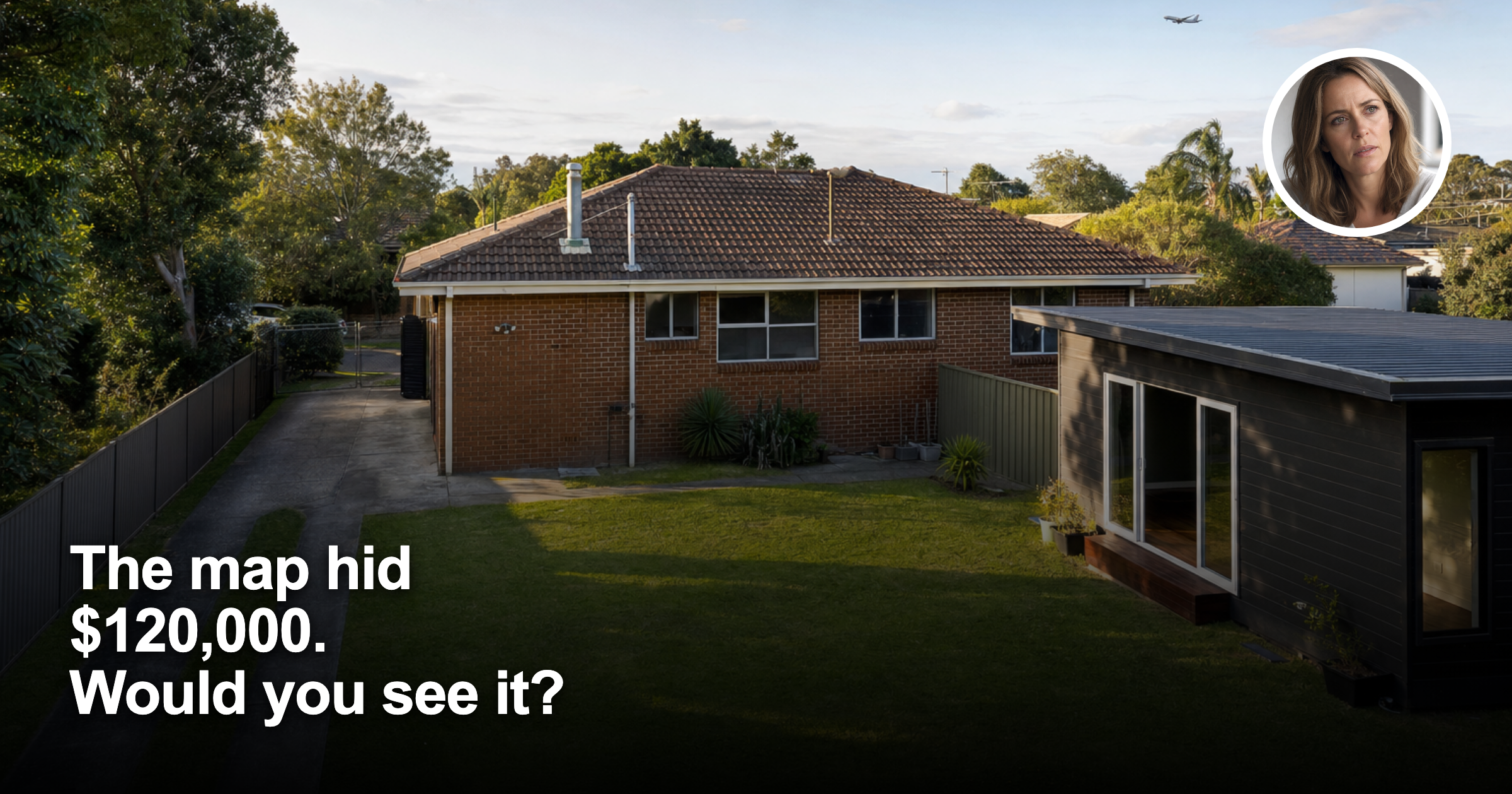
Two western Sydney houses looked interchangeable from the kerb. Same broad suburb, similar land size, similar three-bedroom layout and a comparable walk to shops. But one had a backyard that could potentially support a secondary dwelling. The other sat inside a flight-path planning constraint that made the same idea far harder.
The difference in the asking prices was about $120,000.
A 39-year-old woman brought the comparison to us after finding both properties online. She was not asking whether aircraft noise was annoying. She wanted to know a sharper question: could a line on a planning map really change the investment value of an otherwise ordinary suburban block?
The question investors miss
The answer is yes — but not because every property under or near a flight path automatically loses value.
The mistake is treating a suburb, postcode or school catchment as the whole asset. A house is also a position on a particular street, with a particular orientation, access arrangement, development-control history and set of future uses.
Recent changes affecting some western Sydney flight-path areas have put the issue back in front of buyers. Restrictions around secondary dwellings have been eased in parts of the city, but “eased” does not mean “guaranteed”. The exact address still matters. The relevant planning controls, aircraft-noise environment, lot dimensions, private open space, access, servicing and approval pathway need to be checked together.
That is where a cheap-looking block can become expensive. A buyer may mentally add a granny-flat rent, a future resale premium or an extra family accommodation option before confirming that the property can actually deliver it.
Why the $120,000 gap can appear
Consider the worked comparison brought to us. The first house had a reasonably usable rear yard, side access and no obvious physical obstacle to investigating a secondary dwelling. The second looked almost the same, but its location and controls created more uncertainty around the same plan.
The $120,000 figure was not a promise of profit. It was the buyer’s estimate of the value of the option she might be giving up: a possible $100,000-plus build-and-rent or multigenerational-use outcome, plus the resale appeal of a block with more than one credible use. If the option is unavailable, delayed or too costly to approve, the extra land does not have the same investment meaning.
This is why broad suburb medians can hide the real decision. Two sales can sit only a few streets apart while attracting different buyers. One may appeal to a family wanting a quiet backyard. Another may attract a buyer looking for dual accommodation. A third may be discounted because the rear yard is hard to access, even though the listing describes it as “generous”.
The map is only the starting point. Street-level evidence tells you whether buyers are actually paying for the feature.
What the street-level data should show
At Ripehouse Advisory, the useful comparison is not simply “what is the median price in this suburb?” We look for the gap between nearby properties after separating land size, dwelling condition and location factors.
For this type of question, the research screen should include:
Achieved sales for blocks with and without side access or secondary-dwelling potential.
Days on market and price reductions, especially where listings advertise development upside.
Rental evidence for comparable secondary dwellings, not a generic suburb rent.
Buyer depth: how many qualified buyers competed for the property, rather than how many people clicked the listing.
Nearby supply, including approved, proposed or recently completed small dwellings.
The exact overlay and the radius over which aircraft noise or planning constraints become commercially meaningful.
That last point matters. A suburb-level data set can tell you that the area is popular. A street heatmap can reveal that the premium fades on one side of a boundary, that demand is stronger on quieter streets, or that homes with rear access sell faster even when their internal finish is ordinary.
The buyer’s decision therefore should not be “flight path or no flight path”. It should be: what is the address-level trade-off, and has the market already priced it in?
The practical answer
Before paying a premium for a development story, ask for the planning evidence that supports it. Check the applicable state and local controls, confirm whether the proposed use is complying development or requires a fuller approval, and obtain advice on dimensions, access, services and construction constraints. Do not treat a real-estate listing’s “STCA” language as a completed feasibility study.
Then compare the target with at least five nearby achieved sales that share the same micro-factor. If the supposed upside is real, it should appear in buyer behaviour: stronger competition, a shorter selling period, a smaller discount or a clear rent premium. If it appears only in the listing copy, assume the option is unproven.
The woman eventually stopped comparing the two houses by suburb median. She compared the value of the block’s future uses, the probability of approval and the evidence from nearby streets. That produced a more useful answer than a simple “buy” or “avoid”.
The opportunity for investors
Flight paths, overlays and backyard access can look like defects, but they can also create mispriced opportunities. A property with a genuine, documentable use that the market has overlooked may be a better investment than a prettier home carrying an untested premium.
The winning approach is to buy the right asset on the right street with the right evidence. When the suburb headline is noisy, address-level data — not guesswork — can show where the next $120,000 decision is really hiding.
If there's a specific street you're weighing up right now, check its Street Score first — it's free, takes ten seconds, and tells you whether that street is pulling the suburb average up or riding on it.
Market data & R-Scores for locations in this article
Drill Down Into the Markets Mentioned Above
Inspect live monthly R-Scores, median prices, rental yields, and street-by-street scores for the cities and council areas referenced in this article:
Frequently asked questions
Can a flight-path planning map really affect the value of a house in western Sydney?
Yes. The article says a flight-path planning constraint can change what a backyard can realistically be used for, which affects investment value even if the houses look similar. The impact is not automatic, but it can matter when future uses such as a secondary dwelling are less certain.
Why did two almost identical houses end up with a price gap of about $120,000?
The gap came from different future-use potential, not just the homes themselves. One block appeared to have a more workable backyard and access for a secondary dwelling, while the other sat under planning constraints that made that option much harder or less certain.
What should buyers check before paying extra for a block with granny-flat potential?
They should check the applicable state and local planning controls, whether the use is complying development or needs full approval, and the lot’s dimensions, access, services and construction constraints. The article says a listing’s “STCA” wording is not a completed feasibility study.
What street-level evidence helps show whether the market has already priced in the upside?
Look at achieved sales for nearby blocks with and without side access or secondary-dwelling potential, plus days on market, price reductions and rental evidence for comparable secondary dwellings. The article also suggests checking buyer competition and nearby supply.
What is the main risk in comparing houses only by suburb median price?
Suburb medians can hide important address-level differences. Two homes in the same area may attract different buyers because of flight-path constraints, rear access, or future-use options, so the real value depends on the specific street and block.
General information only. It does not take your objectives, financial situation or needs into account, and nothing here is legal, financial, taxation or investment advice specific to your circumstances.