News · 27 August 2026 · 4 min read
The road upgrade question: why two Wyong streets can become different investments
A Wyong road upgrade shows why property investors must assess the exact street, access route and construction stage rather than rely on a suburb headline.
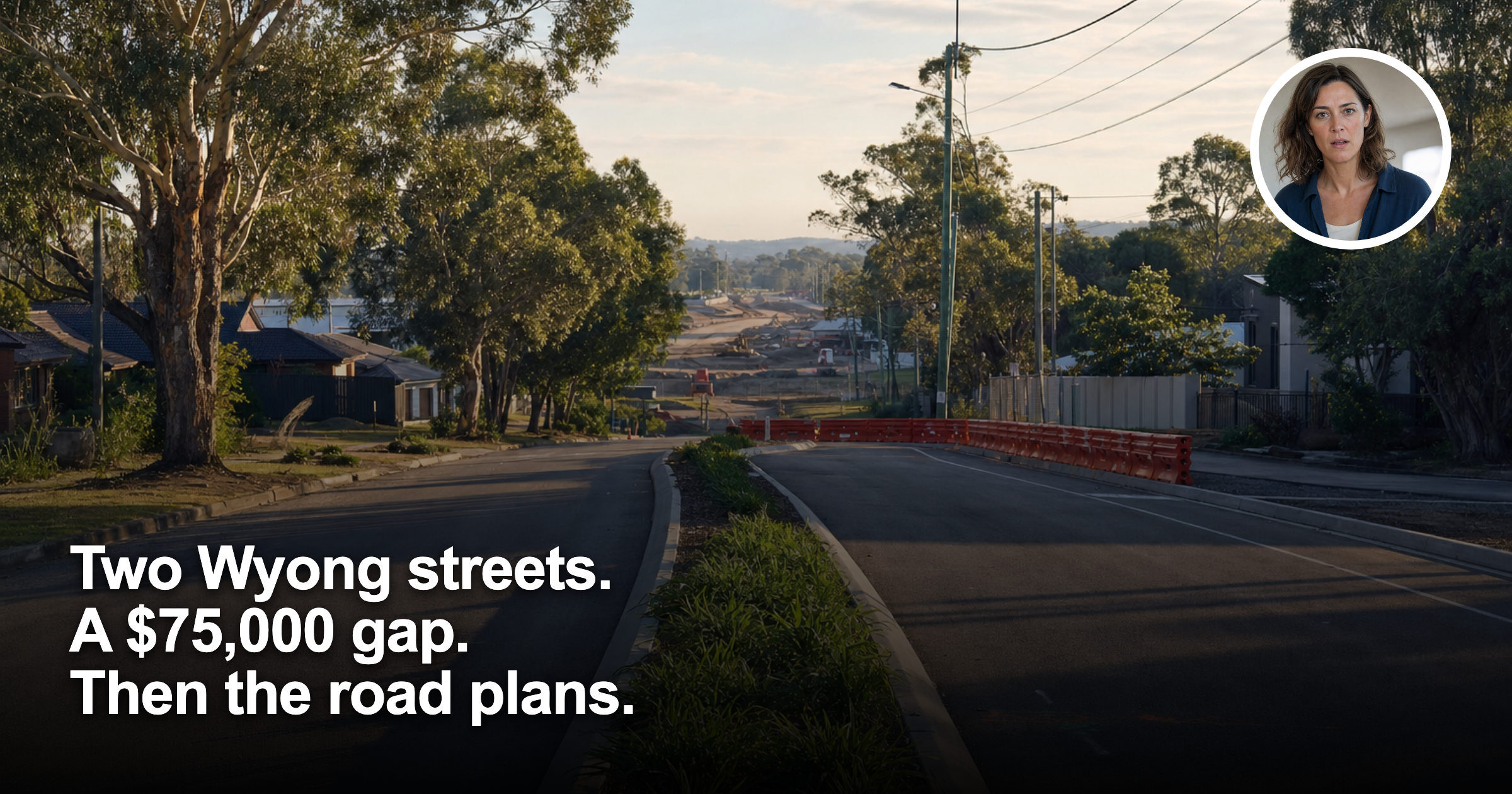
A 34-year-old woman thought she had found a straightforward first investment: a modest house in Wyong, close enough to shops and transport to attract tenants, but not so close that the price became impossible. Two otherwise comparable homes were about $75,000 apart. Then she placed the address over the plans for the Pacific Highway upgrade through Wyong Town Centre.
One nearby street appeared to gain easier access to the town centre. Another could face a very different pattern of traffic, parking pressure and construction disruption. The homes were less than a kilometre apart.
Her question was simple: “If the suburb is the same, why does the road project change the investment so much?”
The suburb average hides the part that matters
Property commentary tends to describe infrastructure in broad strokes. A highway upgrade is good for connectivity. New construction is good for growth. More access is good for demand. All three can be true while one particular house becomes harder to rent, harder to sell or more expensive to hold during the works.
The Wyong project is not just a line on a map. Current project information includes traffic surveys, town-centre works and a new car park at the corner of Ithome Street and Rose Street to ease parking constraints during construction. It also shows why the timeline matters: the project has a long planning history, but the effect on individual blocks changes as the work moves from investigations to construction and then operation.
For an owner, the question is not “Will Wyong benefit?” It is “What will a tenant, buyer or valuer experience at this address during each stage?”
Why the same upgrade creates winners and losers
Start with access. A property that gains a safer or more legible connection to shops, transport and employment can become easier to market. A property that loses a turning movement, visitor parking or a quiet approach can suffer even if the wider town centre becomes more attractive.
Then consider noise and movement. A road project can shift traffic away from one frontage and concentrate it on another. It can change where pedestrians cross, how delivery vehicles move and whether a street feels like a residential pocket or an edge of the transport network. Those are not suburb-wide facts. They are frontage and route facts.
Construction adds a separate holding question. Temporary barriers, changed parking, dust, altered bus routes and delayed access may not permanently reduce the value of a well-located home. But they can affect tenant retention, inspection numbers and the time needed to sell. A buyer who has budgeted only for the mortgage may discover that the real short-term cost is a weaker leasing or resale window.
What should the buyer check before making an offer?
First, identify the exact project footprint and the stages that touch the address. Do not rely on a suburb search or a listing description. Check the road reserve, proposed access changes, nearby acquisition areas, construction compounds, parking changes and the route a tenant would actually use to reach the property.
Second, compare the property with a control group. Look at homes on the same suburb’s quieter side, homes with similar floor plans and homes on the likely post-project access routes. Track achieved sale prices, advertised days on market, rental demand and vacancy by street rather than using one suburb median.
Third, stress-test the timing. Ask whether the investment still works if the property takes an extra three weeks to lease, if the tenant requests a reduction during disruptive works or if a sale overlaps with the least attractive construction stage. These are scenario tests, not predictions. Their value is that they reveal how much room the deal has.
Where street-level data changes the answer
Ripehouse Advisory’s data work treats an address as more than a pin inside a postcode. We layer street-level achieved sales, buyer depth, rental demand, vacancy, days on market and the local supply pipeline over the physical features around the property.
That matters because two streets in the same suburb can show a 20–30% difference in effective investment yield once rent, vacancy, days on market and purchase price are assessed together. A transport project will not automatically cause that gap, but it can widen an existing one by changing how each street is reached and experienced.
The investor’s advantage is not guessing whether a headline is positive or negative. It is measuring which addresses inherit the benefit, which carry the disruption and which sit far enough away to capture demand without taking the full cost.
So should she avoid a property near the upgrade?
No. Avoiding every construction corridor would mean missing some of the strongest long-term opportunities. Infrastructure can improve access, support town-centre activity and make well-positioned property more useful to future tenants and buyers.
But proximity is not a strategy. The right purchase is the one where the price already reflects the temporary inconvenience, the long-term access case is credible and the address-level numbers show enough tenant and buyer depth to carry the holding period.
She had started by asking whether the suburb would win. The better question was which side of the project she was buying. Property investment still rewards the person who buys the right asset on the right street with the right data — especially when a broad infrastructure headline makes every nearby address look the same.
If there's a specific street you're weighing up right now, check its Street Score first — it's free, takes ten seconds, and tells you whether that street is pulling the suburb average up or riding on it.
Frequently asked questions
Why can two streets in Wyong be affected differently by the same road upgrade?
Because the upgrade can change access, traffic flow, parking and construction impacts at a street or frontage level. Even homes less than a kilometre apart can face different conditions for tenants, buyers and valuers.
What should a property buyer check before buying near the Pacific Highway upgrade in Wyong Town Centre?
They should check the exact project footprint, construction stage, access changes, nearby acquisition areas, parking changes and the route people will actually use to reach the property. A suburb-level view is not enough.
Can a road upgrade make a property harder to rent or sell during construction?
Yes. Temporary barriers, dust, altered bus routes, changed parking and access disruption can weaken leasing and resale conditions. The article says these effects may be short term, but they can still affect holding costs and timing.
Should an investor avoid buying near a major infrastructure project altogether?
Not necessarily. The article says infrastructure can improve access and support long-term demand, but the purchase has to be priced for the temporary inconvenience and the address-level data must still stack up.
What kind of data gives a better picture than the suburb median alone?
Street-level achieved sales, buyer depth, rental demand, vacancy, days on market and supply pipeline give a clearer view. Two streets in the same Wyong suburb can perform very differently once those factors are assessed together.
General information only. It does not take your objectives, financial situation or needs into account, and nothing here is legal, financial, taxation or investment advice specific to your circumstances.