Market Analysis · 15 June 2026 · 6 min read
The Banks Are Already Cutting. Here's What Happens Next.
The RBA is still hiking, but Australian banks are quietly cutting long-term fixed rates. Here's why that's the starting gun for the next property cycle and what it does to prices and rents.
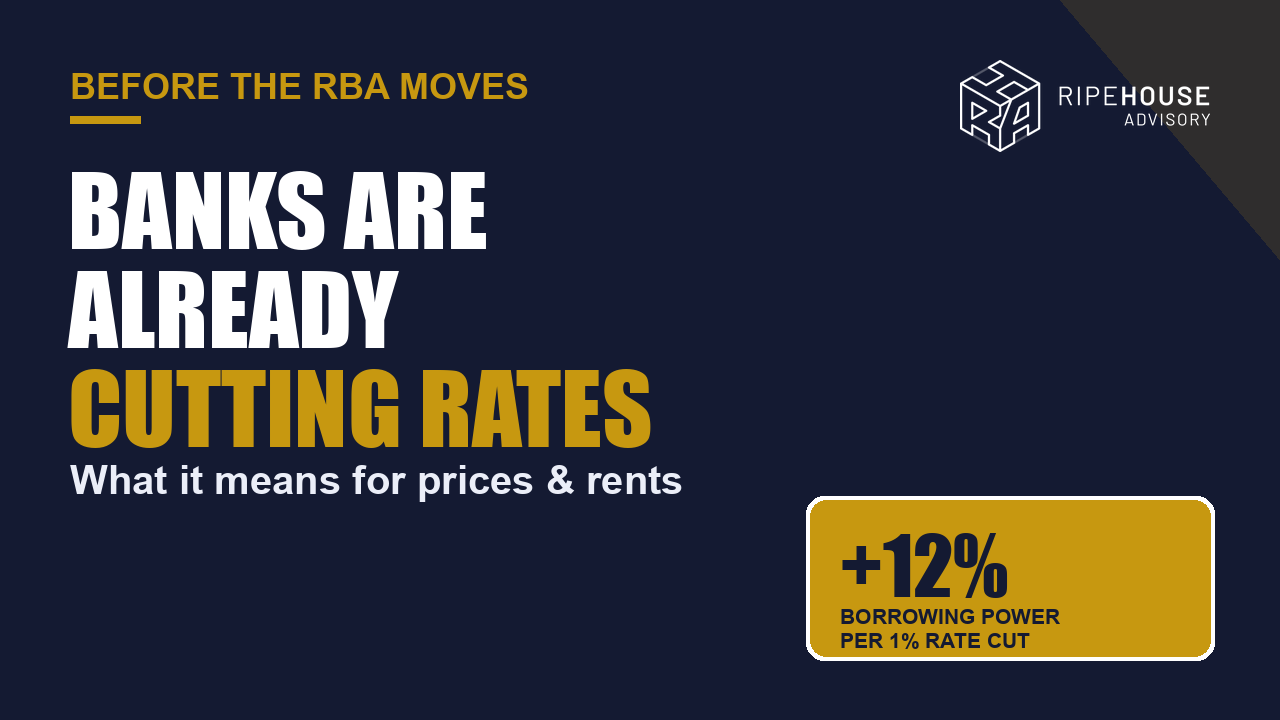
The RBA is still hiking. The banks are already cutting. Here’s why that gap is the most important signal in the market right now.
The Reserve Bank has raised the cash rate three times this year — February, March and May — and it now sits at 4.35%. Every headline tells you the same thing: rates are going up, up, up.
And yet, right now, Australian lenders are quietly doing the exact opposite.
They’re cutting. Not their variable rates — their fixed rates. The long-term ones: the three-year, four-year and five-year fixed rates.
That isn’t a contradiction. It’s a signal. And once you understand the mechanism behind it, you understand something most of the market is about to learn the hard — and expensive — way.
The starting gun
Think of it like a race. When the banks start cutting their fixed rates before the RBA has even hinted at a cut, that’s the starter raising the pistol. The race is about to begin — and the crowd that waits for the official announcement at the finish line will already be behind the people who moved when the pistol went up.
So let’s break down three things: why the banks are cutting now, why that almost guarantees RBA cuts are coming, and — most importantly — what actually happens to property prices and rents after the gun fires.
The mechanism most people miss
When a bank offers you a fixed rate for three or five years, it is not looking at today’s cash rate and adding a margin.
It’s looking at the swap market and the bond market — the markets that price what interest rates will be one, two, three and four years from now.
Think about it from the bank’s side. If it locks you in at a low fixed rate for three years and the RBA keeps hiking, the bank loses: it has sold you money cheap while its own funding costs went up. So banks only cut their long-term fixed rates when the market is telling them rates are heading down.
In other words, when banks start trimming their three- and five-year fixed rates, they’re not reacting to the RBA. They’re betting on where the RBA will be. They are pricing in cuts — not because they want you to know, but because they can’t afford to be wrong.
And that is exactly what’s happening now. In June 2026, with the RBA having hiked three times this calendar year, the major banks, the regionals and the non-bank lenders are all quietly trimming long-term fixed rates, week by week, because swap rates are falling. The banks are telling you — in the only language a bank speaks, which is price — that rate cuts are coming.
Why the market is betting on cuts
The RBA has one job: keep inflation between 2% and 3%. And right now, inflation is doing exactly what all that hiking was designed to make it do. It’s coming down.
- In March, the Consumer Price Index sat at 4.6% annual.
- In April — the latest ABS reading — it dropped to 4.2%.
That’s a four-tenths-of-a-percent fall in a single month. The trend is bending. The RBA’s preferred measure, the trimmed mean (which strips out the wild price swings), is at 3.4% — still above the target band, but firmly on its way back down.
The RBA’s own Statement on Monetary Policy says the economy is expected to slow, spending is softening, and the jobs market — while still strong — is forecast to loosen. This is the playbook: inflation peaks, the RBA hikes until the economy cools, inflation starts falling, and the market starts pricing in the cuts that will follow.
And here’s the thing about financial markets: they don’t wait for the official announcement. They move on the expectation. By the time the RBA governor walks to the podium and says “the board has decided to lower the cash rate,” the banks have already priced it in. The fixed rate has already moved. The starting gun has already fired.
What happens after the gun fires — channel one: prices
Here’s the single number that ties the whole thing together.
When interest rates fall by one full percentage point, borrowing capacity — the amount a bank will lend you, all else equal — rises by roughly 10–12%.
That’s not an opinion. It’s just mortgage mathematics. A household that can borrow $500,000 at 6% can borrow roughly $560,000 at 5% — same income, same deposit, same bank.
Now multiply that across every buyer in the market: every first-home buyer, every investor, every upsizer and downsizer. When the cost of money falls, the amount of money chasing the same number of properties goes up. And when more money chases the same number of properties, prices rise. Every time. Every cycle. Same mechanism, same result.
We’ve seen this movie before. In 2019, the RBA cut rates and property prices — which had been falling through 2018 — turned on a dime and ripped higher. Sydney jumped more than 5% in a matter of months. Melbourne followed. Brisbane followed. The cycle didn’t wait for the newspapers to catch up.
The starting gun fires, the people who are already positioned — pre-approved, researched, ready — move. Prices start rising, and the crowd that waited for the announcement ends up buying into a market that’s already running away from them.
Channel two: the rent rise nobody talks about
Most people stop at prices. But rate cuts have a second channel — and it runs through rents.
When rates fall, investors return to the market. Lower borrowing costs make investment property stack up again. And here’s the part the headlines always miss: when an investor buys an existing property, they are not adding a new dwelling to the housing stock. They are converting an owner-occupied home into a rental.
Net housing supply doesn’t change. The population keeps growing. The supply pipeline stays clogged. The ratio of people to dwellings keeps tightening.
That’s why rents don’t fall when investors return — they keep rising, because the underlying supply shortage hasn’t been solved. The rate cut makes the investment maths work for the landlord, and does nothing to fix the structural undersupply of homes.
The numbers back it up. The ABS put housing inflation at 6.3% annually in May, with rents alone up 3.5%. These aren’t figures from a property spruiker — they’re the official statistics. Housing costs are the single largest contributor to Australia’s inflation, and the thing rate cuts are most likely to accelerate.
Both engines, pointing up
So put the two channels together:
- Rate cuts push borrowing capacity up → prices go up.
- Rate cuts bring investors back → rental income goes up, because supply is still tight and the population keeps growing.
Both engines point in the same direction. Up.
The order it plays out — every single time
- The swap market moves — the rates banks pay to fund your loan start falling.
- The banks quietly cut their fixed rates. (This is happening now.)
- The RBA starts cutting.
- Borrowing capacity expands.
- Prices start rising — and the headlines catch up.
By the time the headline reads “property prices are surging,” the smart money is already in. The starting gun fires early. The crowd shows up late. Don’t be the crowd.
The bottom line
The banks have already started moving. The market is already pricing in the cuts. The only question left is whether you position yourself before the crowd or with it — and one of those options costs a lot more than the other.
This is the kind of research you want in your corner: the data the headlines miss, not just the noise. At Ripehouse Advisory we operate as a national buyers agency and property advisory business, moving at the speed of the data — not the speed of the headlines.
If you want to position yourself before the starting gun fires, book a free discovery call. We’ll assess your position, overlay your strategy against the fundamentals, and make sure that when the gun fires, you’re already off the blocks — not still tying your laces in the crowd.
The gap between falling fixed rates and a still-hawkish RBA leaves buyers and investors guessing when to act, so the Ripehouse Advisory webinar is a useful way to understand how that signal can flow through borrowing power, prices and rents.
Frequently asked questions
Why are Australian banks cutting long-term fixed home loan rates while the RBA is still hiking the cash rate?
Because fixed rates are priced off swap and bond markets, which reflect where rates are expected to be in the future. When banks cut three- to five-year fixed rates, they are effectively pricing in lower rates ahead rather than reacting to today’s cash rate.
Does a cut in bank fixed rates mean the RBA is about to cut rates too?
It is a strong signal that the market expects RBA cuts to follow. The article says banks move first, because they are pricing where rates will be one to four years out, not waiting for the official RBA announcement.
What usually happens to Australian property prices after interest rates start falling?
Lower rates increase borrowing capacity, which means more buyers can borrow more money for the same income and deposit. As more money chases the same number of properties, prices tend to rise, and the article points to the 2019 rate-cut cycle as an example.
Why would rate cuts also affect rents, not just house prices?
The article says lower rates can bring investors back into the market because investment property becomes easier to fund. But when an investor buys an existing home, it does not add new housing supply, so tight supply can keep pushing rents higher.
What is the main risk for buyers and investors waiting until the RBA officially cuts rates?
By the time the RBA announces cuts, the banks and the market may have already priced them in. That can mean property prices and fixed rates have already moved, leaving late movers paying more than people who acted earlier.
General information only. It does not take your objectives, financial situation or needs into account, and nothing here is legal, financial, taxation or investment advice specific to your circumstances.