News · 22 September 2026 · 5 min read
Her $240,000 is in property. She owns none of it
ASIC says the first stress fractures are emerging in Australian private credit, and the RBA says any weakening of lending standards there is 'primarily going to be a problem for investors who invested in those funds'. What that means for anyone whose money is 'secured against property' they have never seen - and the street-level evidence you can only get when you own the asset yourself.
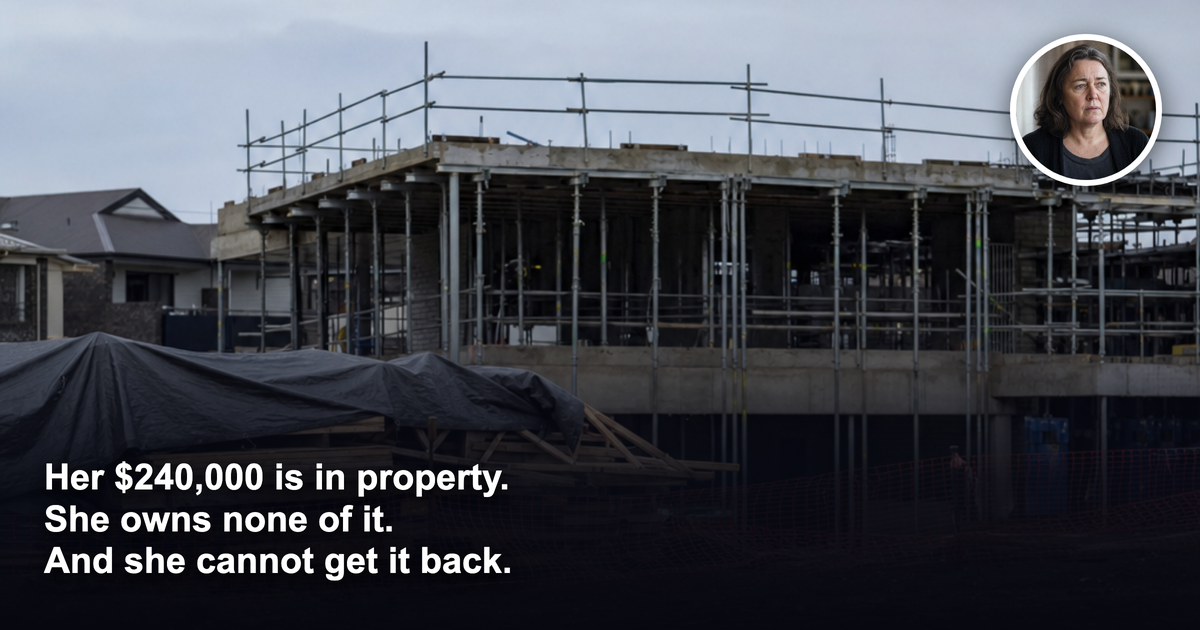
She moved $240,000 into a fund because the money was "secured against property". She has never seen the property. This year she asked for some of it back and was told redemptions are limited.
She is a composite illustration used to show how the numbers work. She is not a real person, she is not connected to anyone named in the reporting below, and every dollar figure attached to her is illustrative only.
The regulator said it quietly
The most consequential sentence in Australian property finance this week was not shouted. It was delivered calmly, by a regulator, to a room of Sydney finance brokers: the clock is ticking on "whether we see broader credit stress or not".
That was ASIC commissioner Simone Constant, speaking at a gathering hosted by the Commercial and Asset Finance Brokers Association, as reported by the ABC's business correspondent David Taylor. Her subject was private credit — non-bank lending, much of it secured against Australian property development. By one estimate cited by ASIC, the sector has grown 500 per cent over the decade.
"Our work has shone a light on the weaknesses in private credit," Constant said, "but despite our ongoing calls for uplift across the sector, too many have been too slow to respond." Then the line that should stop every income-focused investor mid-scroll: "And what we're seeing now, as some of those weaknesses are tested at scale for the first time by current conditions, are the first significant cracks — the first stress fractures — beginning to emerge."
She is 57 and she cannot find her property
Years ago she moved about $240,000 — the bulk of her non-super savings, built across a working lifetime — into a pooled property credit fund. The pitch was reasonable: monthly income, and the money was secured against property. That one word did the heavy lifting. It sounded like bricks.
Here is what she has never seen. An address. A street. A valuation she could test. Her money is lent against Australian building sites and she owns none of them. She cannot inspect one, improve one, sell one or exit one.
She sold nothing and bought nothing. She is simply finding out, in the least comfortable way available, what she actually holds.
So what does she own?
That is the question the sector is now being asked, and the honest answer for many investors is that they cannot say.
The reported facts sketch the terrain. The collapse of NSW developer Bathla left private lenders exposed — the CVS Lane First Mortgage Fund and CVS Lane Property Finance Fund had exposure to Bathla across nine different loans, and Bathla's stalled pipeline of 14,000 apartments is about 18.5 per cent of the new housing stock to be built in NSW this year. Offshore, Morgan Stanley again curbed redemptions at its nearly US$7 billion (A$9.5 billion) private credit fund in the third quarter. Its North Haven Private Income Fund capped withdrawals at 5 per cent after investors asked to pull 11.4 per cent of shares — more than twice what the fund was willing to repurchase.
Constant catalogued the failings directly: "The poorer practices — opaque remuneration and fee structures, inadequate governance arrangements, poor valuation practices, ineffective disclosure — were concerning and demanded scrutiny." She added that "governance, controls and underwriting standards have not kept pace with this growth". ASIC found Australia falls well short of the disclosure standards of Singapore, the US, the UK and Switzerland.
The picture is not uniformly grim, and it would be dishonest to report it that way. FinCap executive chairman Christian Ryan told the ABC that while a contagion or broad, rapid exit of cash from the sector was "possible", many private credit funds are well run, and some are limiting redemptions precisely as a precaution: "That is why some funds are getting ahead of this given the general negative sentiment in the sector." As he put it, "There are losses from time to time and being a credit manager, it is about limiting this risk as much as possible before investing." RBA governor Michele Bullock told a federal parliamentary hearing on Friday that non-bank lending is "helping to, for instance, provide the financing that's important for greenfield construction", and that the Reserve Bank does not "have a strong sense that there's been a systematic weakening of lending standards".
Read Bullock's next point carefully, because it is the crux. Any weakening of lending standards in that segment, she said, is "primarily going to be a problem for investors who invested in those funds".
There it is, from the central bank. The risk sits with her. By design.
Property exposure without the property
What follows is Ripehouse interpretation, not reported fact.
Millions of Australians are exposed to private credit — some directly, some through shares in credit fund managers, many through their superannuation fund. A large class of them took the property exposure without the property. They cannot see what they own, cannot independently value it, and some of them currently cannot leave. On the regulator's own account, disclosure here sits behind comparable markets. ASIC has published ten principles of private credit done well, and Constant's challenge to funds that have not measured themselves against them was blunt: "ask yourselves — why not?"
The opposite of an opaque pooled exposure is a single asset you can stand in front of and evidence at street level. That is the whole point of our research. An R-Score that grades the asset rather than the marketing. Street-level heatmaps instead of suburb averages. Achieved versus advertised rent on that exact street, not the agent's quoted range. Street-level vacancy. Days on market for that exact stock type. Approved-but-unbuilt competing supply within walking distance, because tomorrow's supply decides today's rent. And buyer depth on exit — evidence of who actually buys this asset when you want out.
None of that makes direct property risk-free. Values can fall as well as rise, rents can fall, tenants leave, and capital invested is at risk. This is general information only and does not take your objectives, financial situation or needs into account.
But a directly held asset gives you three things a pooled credit exposure does not: an address you can inspect, a valuation you can test against real transactions on real streets, and an exit you control.
See what you own
If part of your wealth is "secured against property", you are entitled to know which property, on which street, worth what, to whom, on exit. The right asset, on the right street, chosen on data, beats a headline — and it beats a yield you cannot inspect.
Bring us the street. We will bring the evidence.
General information only. It does not take your objectives, financial situation or needs into account, and nothing here is legal, financial, taxation or investment advice specific to your circumstances.