News · 22 September 2026 · 5 min read
She is 63 and renting. The retirement system assumes her rent stops
She is 63, has rented the same unit for nine years and has about $180,000 in super. Australia's retirement system assumes that by pension age your rent has stopped. For a growing group it never does, and the fix being floated in Canberra would have her spend the one asset she has on the one she could never buy.
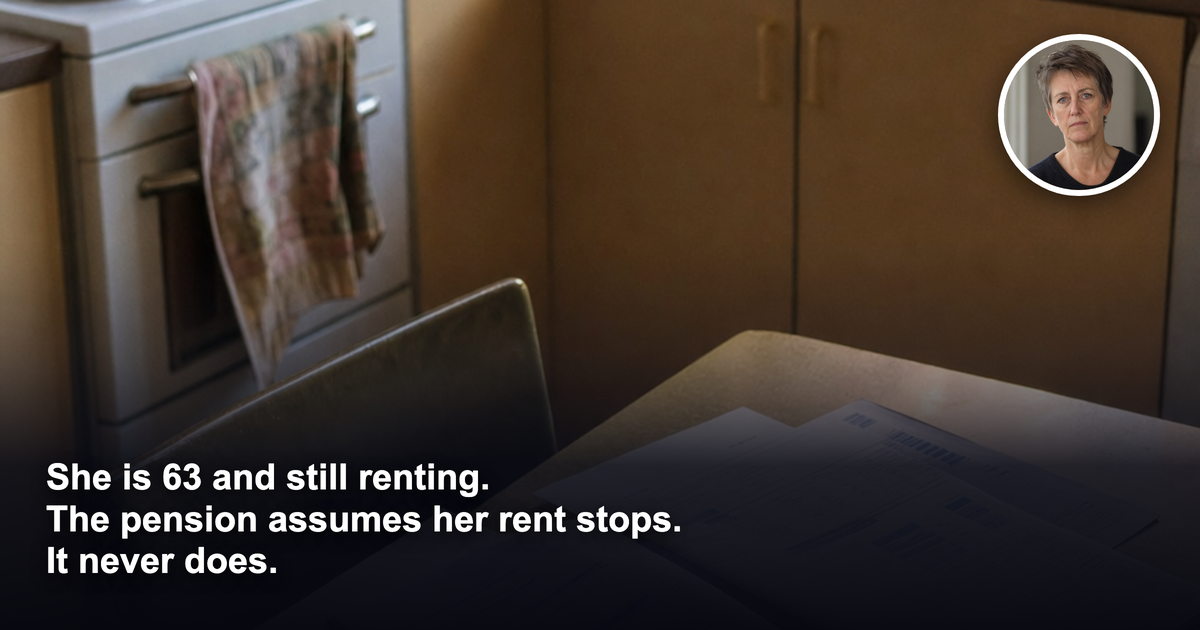
She is 63. She has rented the same older two-bedroom unit for nine years. Every Thursday about $520 leaves her account. It will leave next Thursday too, and the Thursday after she turns 67, and every Thursday after that.
She is a composite illustration used to show how the numbers work. She is not a real person, she is not connected to anyone named in the reporting below, and every dollar figure attached to her is illustrative only.
Nine years, $520 a week, $180,000
Run her numbers. Nine years in the same unit at roughly $520 a week is more than $240,000 in rent already paid. She has about $180,000 in super. She will reach pension age still renting.
Here is the arithmetic nobody puts on a poster. Five hundred and twenty dollars a week is about $27,000 a year. Australia's retirement settlement, from the age pension rate to the drawdown tables to the "modest lifestyle" budgets, was built on one quiet assumption: that you arrive at pension age owning your home outright. The pension is calibrated for a person whose housing cost has collapsed to rates and maintenance. The whole machine assumes rent stops.
For her, rent does not stop. Her $180,000, drawn down carefully, might reasonably produce something in the order of $9,000 to $12,000 a year across twenty years. Her rent consumes more than double that before she buys a single bag of groceries. The system was not designed to fail her. It was designed around her absence.
So what is actually on the table for her?
That is the question. A 63-year-old renter, $180,000 in super, four years to pension age: what is being offered?
The answer, with numbers
On 22 September, ABC News political reporter Erin Handley reported that Shadow Housing Minister Andrew Bragg is floating ideas for using superannuation to lift home ownership. Note the word floating. Bragg has announced no policy. These are canvassed options: using super as collateral for a loan, using it as an offset, or withdrawing a lump sum for a deposit or to pay down a mortgage.
"We don't want to become a nation where renting in retirement becomes mandatory," Bragg told ABC News Radio. "You could keep the money in the system and it could operate as a collateral or an offset," he said, or "you could take it out to pay off a mortgage or to pull together a first home loan."
The Coalition's policy at the last two elections was to allow withdrawal of $50,000 from super towards a house deposit. And here is the sharpest line in the story, because it comes from Bragg himself. He admitted a "credible critique" of that policy: the people most likely to have accrued $50,000 in super are in their mid to late 30s, so the policy would not have significantly helped younger people.
Read that from her side of the ledger. The remedy is realistically available to people in their mid to late thirties. It is aimed past the people already closest to retiring without a home. She is told the answer is a fund that, for her, is both too small and too late. That reading is ours, not the ABC's, and we think it is the honest one.
The rest of the reported landscape. One Nation has released a policy letting people keep 3 per cent of salary out of super for three years, worth about $2,300 a year, or $44 a week, for someone on $90,500. Critics say it could be inflationary in the short term and would hurt compound growth over the long term. Treasurer Jim Chalmers said the Coalition and One Nation were "coming after super" and wanted to "vandalise" the scheme. "That would be devastating for people's retirement incomes. It would make people worse off," he said. The government's existing First Home Super Saver scheme already lets people make voluntary contributions and later withdraw up to $50,000 towards a deposit.
Shadow Treasurer Tim Wilson named the real problem plainly: "The biggest leading indicator of poverty in retirement is people don't own their own home."
He is right about the indicator. In the same week, ABC analysis of the 2026 Intergenerational Report described an Australia that is older, more indebted, carrying what increasingly looks like a permanent budget deficit, with productivity growth at zero and a smaller share of workers carrying the cost of everyone's care. The report projects more Australians dying than being born by 2066. Its framing on housing is blunt: housing shortages, coupled with tax arrangements that diverted investment funds into suburban house-flipping ventures instead of productive activity, pushed up the cost of putting a roof over your head and drained household incomes. Average real net household wealth grew from $500,000 in 1993 to more than $1.3 million in 2019/20. Averages hide her completely.
Nobody in this story is accused of any wrongdoing. This is a design failure, not a scandal.
What it means for you
If you are 25 to 55, you are not her yet. The window in which this is fixable is measured in decades, and it is exactly as long as your working life. The real question is not who wins the super argument. It is whether you arrive at 67 with a rent bill or without one. What you buy, and precisely where, decides that.
This is where a national headline fails you and street-level evidence does not. A debate in Canberra cannot tell you whether one specific asset will carry you to a debt-free retirement. Our R-Score is built to score individual streets rather than suburbs, because the gap between the right street and the wrong one is the gap between compounding and treading water. Street-level heatmaps show where owner-occupier demand is genuinely deepening rather than simply being talked about. We measure achieved rent against advertised rent on the exact street you are considering, because that gap is where cashflow projections quietly die. We track street-level vacancy and days on market for that precise stock type, and we map approved-but-unbuilt competing supply within walking distance, because nothing erodes a future exit like a block of approved apartments two streets away that has not been built yet. Buyer depth on exit is the final test: who buys this from you in fifteen years, and how many of them are there?
She never had any of that. You do.
This is general information only and does not take your objectives, financial situation or needs into account. Property values can fall as well as rise, rents can fall, and capital invested is at risk.
The close
Canberra will argue about whose hands are on your super for another decade. Do not wait for the result. The people who reach 67 without a rent bill will not be the ones who picked the winning headline. They will be the ones who bought the right asset, on the right street, on the right data, while there was still time to let it work.
Bring us the street. We will bring the evidence.
General information only. It does not take your objectives, financial situation or needs into account, and nothing here is legal, financial, taxation or investment advice specific to your circumstances.