News · 30 August 2026 · 5 min read
“The bank found a $52,000 gap”
A borrower can be approved in principle and still face a funding gap when the lender values the exact property below the contract price.
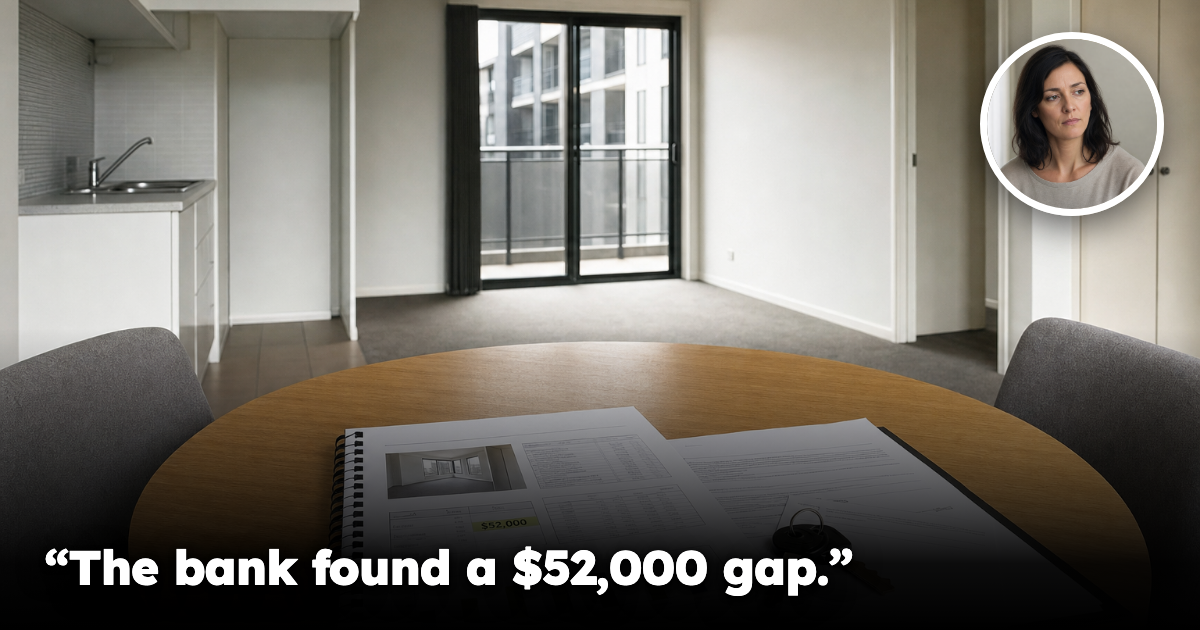
For months, the numbers looked comfortable. A 42-year-old new migrant had saved a deposit, received a conditional borrowing indication and found a two-bedroom unit she believed would give her a foothold in the market.
Then the bank valued the exact property at $52,000 less than the contract price.
The loan had not suddenly become impossible because the advertised interest rate changed. The problem was that the lender was no longer assessing only her income and deposit. It was assessing the property as security — and it did not agree that the contract price represented the asset’s current value.
Her question was simple: “If the bank already said I could borrow the money, why do I now need another $52,000?”
The short answer
A borrowing estimate answers, “How much debt might this household service?” A valuation answers, “How much is this specific property worth if the lender needs to rely on it?” Those are different tests.
Suppose a buyer signs at $720,000 and expects an 80 per cent loan of $576,000. If the lender values the property at $668,000, an 80 per cent loan against that valuation is $534,400. The difference is $41,600 before allowing for stamp duty, legal costs and other purchase expenses.
In a real transaction, the gap can be larger or smaller depending on the lender’s policy, the loan-to-value ratio, the valuation method and whether the buyer has other acceptable security. But the principle is the same: the bank lends against its valuation, not simply against the price written on the contract.
That is why a conditional approval is useful, but it is not a guarantee that every property will pass unchanged.
Why can two nearby homes produce different answers?
This is where broad suburb averages can mislead investors.
Two units may share a postcode, a school catchment and a recent sales headline, yet be different lending risks. One may have a quiet outlook, better natural light, secure parking and a floor plan that attracts more buyers. The other may face a busy access road, have a difficult building configuration, carry an unusual owners-corporation history or sit in a pocket with more competing stock.
Lenders and valuers usually examine comparable sales, condition, presentation, configuration, location and marketability. They are not trying to reward a buyer’s optimism. They are asking what a defensible sale might look like if the property had to be sold within a reasonable period.
RHA’s street-level work is built around this distinction. We examine achieved sales, asking rents, vacancy, days on market, buyer depth and competing supply at the address and immediate-street level. The important signal is often not “this suburb is rising”, but “this particular pocket has fewer credible alternatives and a stronger resale audience.”
That evidence cannot force a lender to accept a price. It can, however, expose a weak assumption before a buyer commits to an unconditional contract.
What should the borrower do next?
First, obtain the valuation details and check whether the issue is factual. A missing car space, incorrect bedroom count, wrong building description or overlooked renovation can matter. The buyer should ask the lender or broker what was used and whether a review or second valuation is available under that lender’s process.
Second, test the comparable sales rather than arguing from the asking price. The strongest evidence is usually recent, genuinely comparable and close to the property. A larger renovated townhouse across the suburb may be emotionally persuasive but weak valuation evidence for an older unit.
Third, calculate the cash gap in full. It is not enough to divide the difference by two. The buyer needs to include the required contribution, duty, conveyancing, lender fees, inspections, moving costs and a sensible cash buffer. A deal that works only if every cost lands at the lower estimate is not robust.
Fourth, review the contract dates. A finance clause, cooling-off right or negotiated extension may provide options, but those rights depend on the contract and state rules. The practical mistake is waiting until the settlement deadline to discover that the funding structure no longer works.
This is also why the cheapest headline loan is not always the most useful loan for a particular property. The RBA’s published June 2026 average for new investment housing loans was 6.41 per cent, compared with 6.24 per cent for new owner-occupier loans. The rate matters, but so do valuation policy, serviceability treatment, acceptable security and the speed of the lender’s review process.
Does a valuation gap always mean the property is a bad investment?
No. It means the contract price and the lender’s risk assessment are not aligned yet.
Sometimes the gap reflects an aggressive offer in a competitive campaign. Sometimes it reflects a stale or poorly selected comparable. Sometimes the property really is less liquid than the buyer assumed. An investor should be most cautious when the same weakness appears in several forms: thin buyer depth, long selling times, heavy competing supply and rents that do not support the proposed value.
The reverse can also be true. A property in a tightly held street, with proven tenant demand and few comparable alternatives, may deserve deeper investigation even after a conservative valuation. The question is not whether a bank has delivered a high or low number. The question is what the number reveals about the asset’s resale audience and downside risk.
For a broader look at how lenders examine the whole property file, see our guide to the $640,000 loan application that faced a whole-file test. Rental resilience also matters when rates and funding costs are uncomfortable; our recent analysis of Victoria’s permanent rental enforcement shift explains why the exact asset and management process matter.
The lesson from the $52,000 surprise is not to avoid property investment. It is to make the property earn its place in the plan before the contract becomes irreversible. The right asset, on the right street, tested against real sales, rent and supply data, gives an investor a much better chance than a suburb headline or a conditional approval alone.
If there's a specific street you're weighing up right now, check its Street Score first — it's free, takes ten seconds, and tells you whether that street is pulling the suburb average up or riding on it.
Frequently asked questions
Why can a bank approve a borrower in principle and still later say there is a funding gap on the property?
Because a borrowing estimate and a property valuation test different things. The approval looks at how much debt the household may service, while the valuation tells the lender what that specific property is worth as security.
If the bank values a property below the contract price, what happens to the loan amount?
The lender generally lends against its own valuation, not the contract price. If the valuation is lower, the maximum loan can fall and the buyer may need to make up the difference from cash.
What should a buyer check first if the valuation comes in low?
Check whether the valuation contains any factual errors, such as the wrong bedroom count, missing car space or incorrect building description. The buyer should also ask what comparable sales were used and whether a review or second valuation is available under the lender’s process.
Does a valuation gap mean the property is a bad investment?
Not necessarily. It may mean the buyer’s offer was aggressive, the comparable sales were weak, or the property is less liquid than expected. The article says the bigger concern is when the same weakness shows up in buyer depth, selling times, competing supply and rents.
What is the practical risk for buyers in Australia when relying on conditional approval alone?
A conditional approval is useful, but it does not guarantee every property will pass the lender’s valuation unchanged. Buyers should factor in the full cash gap, including duty, legal costs and other purchase expenses, and check their contract rights before settlement deadlines.
General information only. It does not take your objectives, financial situation or needs into account, and nothing here is legal, financial, taxation or investment advice specific to your circumstances.