News · 5 August 2026 · 7 min read
'We separated in January. We're still living in the same house because we can't afford not to — do we sell now or wait for the market?'
A separated couple has been sharing a house for seven months because neither can afford to move out. Their question — sell now or wait for the market — is one thousands of Australians are facing. The answer has nothing to do with the national figures everyone keeps quoting, and everything to do with the street you actually own on.
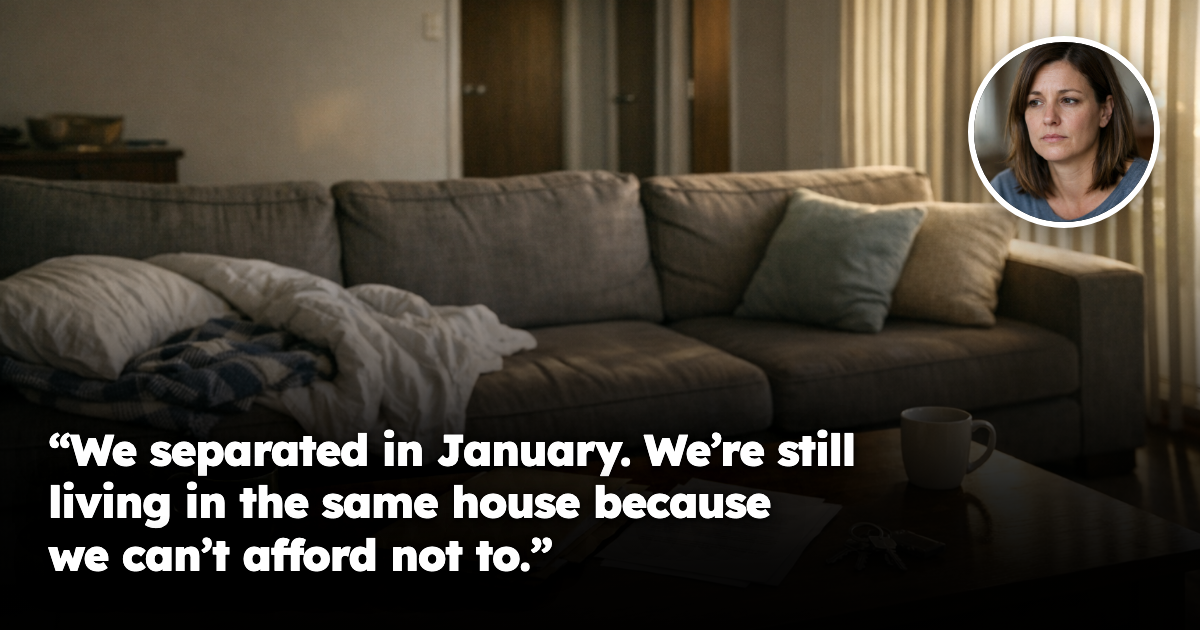
They still split the grocery bill. They just don’t speak much anymore.
A couple in their forties on the Sunshine Coast came to us with a question we are hearing more and more, and it is not the one they thought they were asking. They separated in January. Seven months later they are still living in the same four-bedroom house, sleeping in different rooms, coordinating school pickups through a shared calendar, because the numbers on moving out simply do not work.
Neither of them can service the mortgage alone. Neither of them can borrow enough to buy the other out. And the one option they have left — sell it, split the equity, start again — has become a moving target, because every month they wait, the number they are splitting gets smaller.
Their question was this: “Do we sell now while we still can, or hold on jointly until the market turns?”
It is a brutal question. It is also one of the most consequential decisions either of them will ever make, and most people make it while they are the least equipped to think clearly.
This is far more common than anyone admits
If you assume this is a rare, unlucky situation, the data says otherwise.
Roughly one in five separated or divorced Australians are still living with a former partner because they cannot afford to sell. Among those sharing a roof after the relationship has ended, 42 per cent say the cost of living has made living separately too expensive to contemplate.
It is worst where housing costs have risen fastest relative to incomes. In Queensland, 48.1 per cent say separated couples are staying under the same roof because they cannot afford to live apart. New South Wales sits at 45.4 per cent, South Australia and the Northern Territory at 44.4 per cent, Victoria and Tasmania at 42.4 per cent. Western Australia is the clear outlier at 17.1 per cent.
And the financial pressure arrives long before anyone packs a box. Thirty-nine per cent of separated Australians say money worries significantly delayed the decision to separate at all — rising to 46 per cent of women, 61 per cent of Gen Y and 77 per cent of Gen Z. Around 40 per cent felt financially dependent on their partner before separating: 54 per cent of women compared with 27 per cent of men.
Sit with that for a moment. For a meaningful share of Australians, the property market is now a factor in whether they can leave a relationship.
Then there is what happens to the house itself. Around 27 per cent of Australians have been through a separation while jointly owning a home. Of those, only about half had one partner able to keep the property. Thirty-one per cent were forced to sell because neither side could afford to hold it or buy the other out. Just 2 per cent managed to keep it as an investment.
The part that should stop every reader cold is what comes next. Of people who sold in a separation, 58 per cent eventually bought again on their own and 30 per cent re-entered the market with a new partner — but 12 per cent never bought property again. Not “took a while.” Never.
So: sell now, or wait?
Here is the honest answer, and it has two halves.
On timing, waiting for “the market” to save you is usually the wrong bet. National home values fell 0.7 per cent in July — the largest single-month fall since December 2022 — and the downturn has broadened well beyond Sydney and Melbourne into Brisbane and Adelaide. Capital city auction clearance rates have sat below 50 per cent since late May, and advertised supply across the capitals is now running about 5.7 per cent above the five-year average. Waiting has a carrying cost: two sets of living expenses inside one house, a mortgage on a single-income capacity, legal fees accruing, and a market that is not currently paying you to be patient.
But — and this is the part that gets missed — “the market” is not what determines their number. That is the wrong unit of measurement entirely, and it is the reason so many separating couples make an avoidable mistake.
Look at what actually happened in July. Upper-quartile home values fell 3.2 per cent over the three months to July. Over exactly the same period, the lower price tier rose 0.3 per cent. Same country, same month, same interest rates — a gap of roughly three and a half percentage points in a single quarter, depending purely on which segment your property sits in.
That divergence does not stop at price tiers. It runs all the way down to the street.
When we run our data across a suburb, the spread between the strongest and weakest streets inside that same suburb, same median, same postcode is routinely wide enough to be the entire difference between a clean sale and a painful one. Days on market on one street can sit at a fraction of the street three blocks away. Vacancy rates, tenant depth, the ratio of owner-occupiers to investors, the supply pipeline aimed at that specific pocket — none of it is uniform across a suburb, and none of it shows up in the median price a headline quotes at you.
In a separation, that spread stops being academic and becomes the whole outcome, because a property settlement comes with a timeline you do not control. A court-ordered window is not a suggestion. If you own on a tightly-held street with genuine owner-occupier demand, you get a competitive campaign and a fair number inside your window. If you own on a saturated street with a thin buyer pool, you get a discount and a six-month campaign — in a window where you do not have six months.
So the advice we gave them was not “sell” or “wait.” It was: stop guessing at the national number and get the actual number for the actual asset. Pull the street-level data on their own house — real days on market for that street, real buyer depth, real competing supply — and you convert an emotional standoff into an arithmetic problem. In their case the house sat in the lower-middle segment on a street with materially tighter days-on-market than the suburb average everyone had been quoting at them. Their realistic sale window was weeks, not months. That single fact changed the entire negotiation between them, because they finally had the same set of facts.
Then, critically: plan the re-entry before you exit. The reason 12 per cent never buy again is almost never the sale price. It is that they split the equity, discover that a single applicant borrows dramatically less than a couple did, and spend two years looking in the same suburb they just left — a suburb they can no longer afford — instead of the suburbs where their new single-income budget actually buys a quality asset. The market you sell in and the market you buy in do not have to be the same market. Getting priced out is very often a research failure, not a money failure.
What it means for you
If you are anywhere near this situation, three things are worth doing before you do anything else. Get independent legal and financial advice early, not after a decision is made. Find out what your genuine borrowing capacity is as a single applicant, because it will surprise you and it changes every option on the table. And get street-level evidence on your own property, so that “sell now or wait” becomes a calculation instead of an argument.
And here is the wider point, because it would be easy to read all of the above as a reason to steer clear of property altogether.
The opposite is true. Every number in this story is a symptom of the same underlying condition: well-located Australian housing is scarce, expensive and stubbornly resilient, which is precisely why losing your position in it is so costly and why regaining it is so hard. The people who came through separation and bought again did not do it by timing a market bottom. They did it by re-entering with better information than they had the first time — a smaller budget spent with far more precision, in a pocket the data supported rather than one that felt familiar.
A softening market is not the end of property investment. Falling upper-quartile values alongside a rising lower tier is not a market collapsing — it is a market re-sorting, and re-sorting markets are where the best entry points of the next decade are being created right now, street by street, for the buyers who can actually see them.
The mistake is not buying property. The mistake is buying an average.
If there's a specific street you're weighing up right now, check its Street Score first — it's free, takes ten seconds, and tells you whether that street is pulling the suburb average up or riding on it.
Market data & R-Scores for locations in this article
Drill Down Into the Markets Mentioned Above
Inspect live monthly R-Scores, median prices, rental yields, and street-by-street scores for the cities and council areas referenced in this article:
Frequently asked questions
If a separated couple in Australia still lives in the same house, should they wait for the national market to improve before selling?
Usually not. The article says timing should be based on the actual property and its street-level demand, not national headlines, because carrying costs keep rising while the market may not reward waiting.
Why does the article say street-level data matters more than the suburb median when a couple is separating?
Because properties on different streets in the same suburb can have very different buyer depth, days on market and sale outcomes. A median price can hide whether the home is likely to sell quickly or sit for months.
What are the main risks of delaying a property sale after separation?
Delaying can reduce the equity to be split, add legal and living costs, and leave both people stuck in a mortgage they cannot comfortably service. The article also warns that a court-ordered timeline may not allow time for a long sale campaign.
What should separated homeowners check before deciding whether to sell the home or keep it?
They should get independent legal and financial advice early, confirm their borrowing capacity as a single applicant, and obtain street-level evidence for their property. That turns the decision into a practical calculation instead of a guess.
What happens if one partner hopes to buy again after selling during a separation?
The article says many people do buy again, but some never do because a single applicant can borrow much less than a couple. It recommends planning the next purchase before exiting so you do not look in a suburb you can no longer afford.
General information only. It does not take your objectives, financial situation or needs into account, and nothing here is legal, financial, taxation or investment advice specific to your circumstances.