News · 25 August 2026 · 4 min read
“He stayed with the bank for 12 years. The loyalty tax cost him $3,900 a year”
A homeowner discovered that staying with the same lender had quietly become his most expensive financial habit. The answer is in the gap between headline loyalty and loan-level evidence.
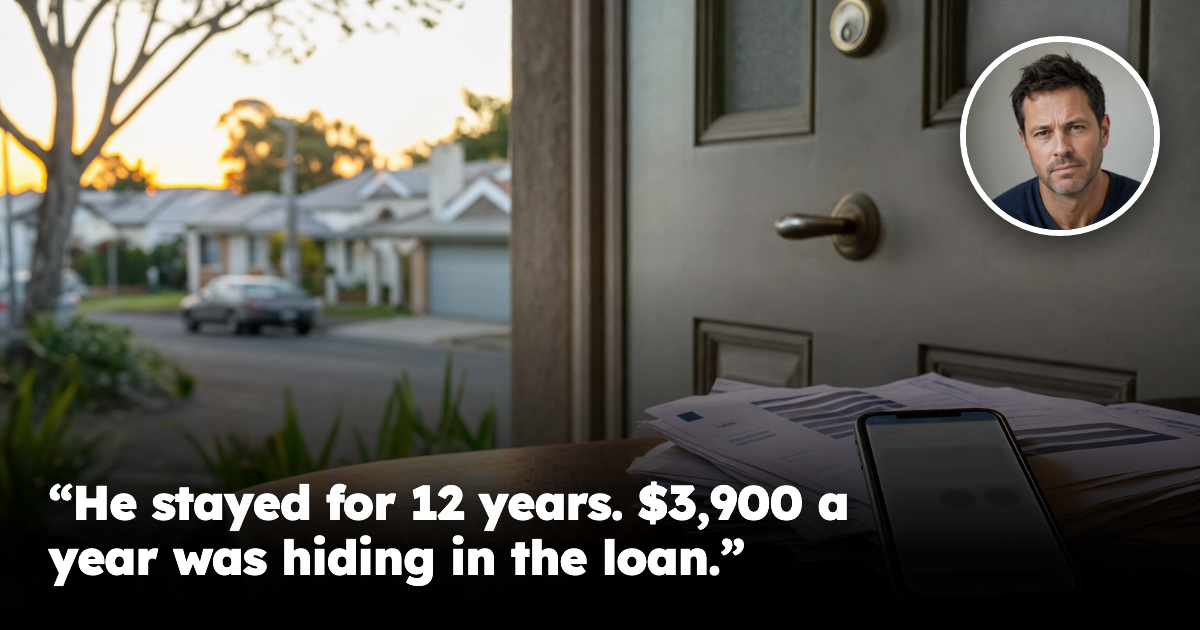
When a 42-year-old homeowner opened a competing rate offer on his phone, he thought the difference would be too small to matter.
He had held the same home loan for 12 years. The repayments were automatic. The redraw was familiar. Every time the bank sent a message calling him a valued customer, he assumed that loyalty was being recognised somewhere in the numbers.
Then he compared the rate on his $612,000 balance with the rate being advertised to new borrowers.
The gap was 0.60 percentage points. Add the annual package fee, and his estimate was stark: about $3,900 a year, or more than $320 a month, for staying put without asking a question.
His question was simple: “If the bank can offer the lower rate to someone new, why am I paying the higher one after 12 years?”
The uncomfortable answer is that a lender does not price gratitude. It prices risk, competition and the likelihood that a borrower will move. A long-term borrower with direct debits running smoothly can be commercially valuable precisely because switching feels like too much work.
That does not mean every existing borrower is being overcharged. It means “I have always been with them” is not evidence of a good deal. The evidence is the loan balance, the rate, the fees, the remaining term and the alternatives available today.
The question behind the headline
Mortgage competition is often discussed as if a rate cut automatically reaches every homeowner. It does not. A lender may reduce some variable rates, launch a sharper product for new applications or reserve a special offer for borrowers who threaten to leave. The customer who does nothing may see a smaller change, or none at all.
That creates a loyalty tax without a separate invoice. It appears as a few extra basis points in every repayment. On a large balance, a small-looking gap compounds into real money.
The first calculation is straightforward. Multiply the balance by the rate difference to estimate the annual interest effect. On $612,000, a 0.60 percentage-point gap is roughly $3,672 in the first year before considering fees, principal changes and tax treatment. His $3,900 estimate included the package fee and was his own loan-level calculation, not a promise that every borrower would see the same result.
The second calculation is less obvious: what will the switch cost? A lower rate can be a poor result if it comes with a materially higher fee, an unsuitable offset structure, an expensive break cost on a fixed portion or a repayment that no longer fits the household’s cash flow. The question is not “What is the lowest rate?” It is “What is the lowest total cost for the loan I actually have?”
Why the same suburb can hide different borrowing risk
This is where a property investor’s analysis has to leave the suburb median behind.
Two properties on the same street can share a suburb’s growth story while carrying completely different borrowing pressure. One owner may have a comfortable buffer, a flexible loan and a tenant profile that supports the repayment. Another may have bought at the top of the cycle, fixed part of the debt at the wrong time and be relying on a rent increase that the street cannot support.
Ripehouse Advisory’s street- and suburb-level data is useful because it tests the asset and the debt together. Achieved rents, vacancy, days on market and supply around the specific street help reveal whether the income assumption is durable. A suburb-wide median can look healthy while the weakest pocket takes longer to lease and produces less cash flow.
The same principle applies to a refinance. A headline rate is a suburb median for debt: useful for orientation, inadequate for a decision. The loan-level comparison must include the actual property value, the balance, the repayment history, the offset, the term and the likely exit costs.
What he did next
He did not immediately move the loan. He requested a written comparison of his current rate, the proposed rate, all annual fees and every condition attached to the offer. He checked whether the new product preserved the features he used and calculated the repayment under a higher-rate scenario.
Then he asked his existing lender to match the evidence rather than the emotion. The bank improved the rate, but not all the way. He decided that the remaining gap was worth the administration of moving, after checking the costs and keeping a cash buffer.
The important change was not the lender. It was the habit of reviewing the loan as an investment input rather than a household utility bill.
For an owner, the review can begin with five numbers:
The current balance.
The effective interest rate, including package and account fees.
The comparable rate available for the same loan structure.
The total cost of changing lenders.
The monthly buffer after the proposed repayment and realistic property expenses.
An investor should add a sixth: the achieved rent and vacancy performance of the actual micro-market, not the optimistic figure in a generic suburb report. A refinance that looks profitable on paper can be undermined by one weak street, one long vacancy or one maintenance bill that was never included.
For more on how property risk sits in the structure around an asset, see the repayment-arrangement question that changed an enforcement timeline and the source-of-funds check that stopped a mortgage application.
The answer
Staying with a lender for years is not itself a mistake. Staying without testing the numbers is.
The best property investors are not loyal to a bank, a suburb or a headline. They are loyal to evidence. When the rate, cash flow, street-level demand and exit costs all make sense, refinancing can turn a silent drag into usable investment capacity. The right asset, the right street and the right debt structure beat habit every time.
If there's a specific street you're weighing up right now, check its Street Score first — it's free, takes ten seconds, and tells you whether that street is pulling the suburb average up or riding on it.
Frequently asked questions
Why can a long-term homeowner end up paying more than a new borrower at the same bank?
The article says lenders price risk and the likelihood of a borrower switching, not gratitude. A customer who stays put may keep paying a higher rate than a new borrower unless they test the numbers and ask for a better deal.
How did the homeowner work out that staying with the bank was costing him about $3,900 a year?
He compared his rate on a $612,000 balance with a lower advertised rate for new borrowers. The 0.60 percentage-point gap, plus the annual package fee, produced his own estimate of about $3,900 a year.
What should a borrower compare before deciding whether to refinance?
The article says to compare the current balance, the effective interest rate including fees, the comparable rate for the same loan structure, the cost of changing lenders, and the monthly buffer after the new repayment. The lowest rate is not always the lowest total cost.
What risks can make a cheaper refinance a bad decision?
A lower rate may come with higher fees, an unsuitable offset structure, break costs on a fixed loan, or repayments that no longer suit household cash flow. The article says the key question is the lowest total cost for the loan you actually have.
Why does the article say suburb-level property data is not enough for refinancing or investing decisions?
It argues that two properties on the same street can face very different income and borrowing pressure. Street-level evidence such as achieved rents, vacancy, days on market and local supply can show whether the cash flow is actually durable.
General information only. It does not take your objectives, financial situation or needs into account, and nothing here is legal, financial, taxation or investment advice specific to your circumstances.