News · 5 August 2026 · 8 min read
‘My house didn’t sell, so I’ll just rent it out’ — then she found out she legally couldn’t for six months
Six offers in three months and none of them close. So she pulled the property off the market and rang a property manager — and was told she couldn’t re-let her own house for six months. She is one of hundreds. Here is the arithmetic, and the two questions every owner should answer before ending a tenancy to sell.
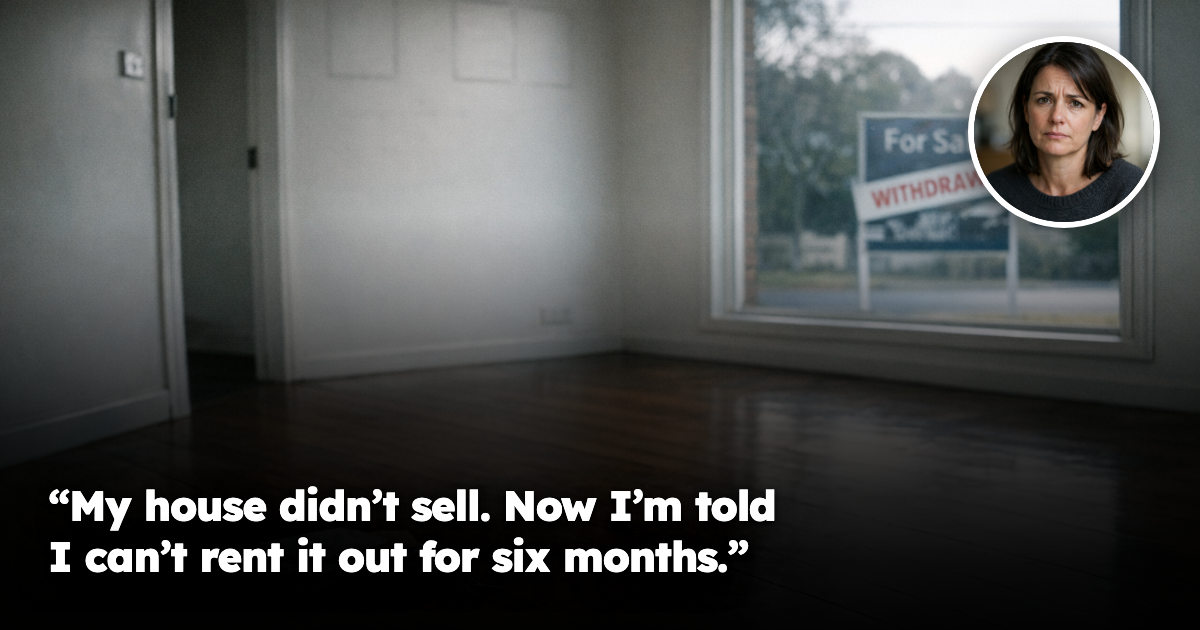
She thought she had a backup plan. It turned out she had an empty house and a mortgage.
A Sydney owner came to us last week with a question we are now hearing almost every day. She had listed her investment property in autumn, ended the tenancy so it could be presented and photographed empty, and gone to market with a price based on what the place was worth last year. Six offers came in over three months. None of them were close. Her agent told her the honest number was about $180,000 below her guide.
So she did what a lot of people are doing right now: she pulled it off the market and rang a property manager to put it back into the rental pool. Hold, collect rent, sell in a better year. It sounds like the safest decision in property.
Then she was told she could not rent it out for six months.
The question
"I ended my tenant's lease so I could sell. The sale didn't happen. Now I'm being told I can't re-let my own property for six months and I have to apply for permission to do it earlier. Is that real \u2014 and what do I do with a house I can't sell and can't rent?"
It is real. And she is one of hundreds.
The rule almost nobody priced in
Under NSW rental reforms, when a tenancy is ended on the grounds that the property is being sold, a six-month re-letting exclusion attaches to that property. The intent is straightforward and, honestly, defensible: it stops an owner evicting a tenant on a sale pretext and quietly re-listing the same place two weeks later at a higher rent.
The problem is what happens when the sale genuinely doesn't proceed. The exclusion doesn't care why. It applies automatically.
Owners can apply for an early re-letting exemption, but they have to demonstrate the change in circumstances is real and outside their control, and applications go through a rigorous review. Since these rules started, there have been almost a thousand applications. More than 600 were approved \u2014 and 374 were knocked back. More than half of all applications came from owners whose sale simply didn't go through.
Nobody knows how many more properties are sitting empty because the owner never applied at all \u2014 either they didn't know they could, or they took one look at the process and gave up. One investor put the arithmetic bluntly in public: six months of mortgage, rates and insurance on a house with nobody in it.
That is the part that should stop every owner reading this. If your holding costs are $1,100 a week, a failed sale plus a re-letting exclusion is not a delay. It is roughly $28,000 of pure cash burn, on top of the sale that didn't happen.
Why so many people are suddenly reaching for the same backup plan
This is not one unlucky owner. It is a market-wide pattern.
House values fell in 91 per cent of Sydney suburbs over the three months to July. More than 200 suburbs saw house medians drop by over $100,000, and close to 400 recorded falls above $50,000 in house or unit values. The heaviest damage landed at the top end, where more than $300,000 came off median house values in some coastal suburbs.
At the same time, sellers piled in. National listings jumped more than 12 per cent in a single winter month to nearly 279,000 properties \u2014 22 per cent higher than a year earlier, in what is normally the quietest month of the year. Auction listings fell about 20 per cent as vendors retreated to private treaty. Properties sitting unsold for 180 days or more rose again. Capital city asking prices fell for a third straight month.
What you get from those two facts together is a stalemate. Buyers are active but disciplined \u2014 there are multiple bidders at some auctions that still don't convert to a sale, because nobody will stretch past what they think is fair value. Sellers are anchored to a number from a market that no longer exists. Those who must transact are cutting. Everyone else is stepping back.
And "stepping back" increasingly means renting it out instead. Prestige property managers now field weekly calls from owners asking not can you sell my house but if I don't sell it, what could I rent it for. At the very top of the market that pivot works spectacularly \u2014 furnished trophy homes leased at $10,000 to $30,000 a week, one Woollahra house generating $2.34 million in rent over four and a half years while the owner waited.
The reason it works up there is not that renting is clever. It is that those specific homes sit in streets with genuinely scarce, genuinely deep tenant demand. That is the whole answer, and it is where most owners get it wrong.
The answer: "rent it out instead" is a street-level decision, not a fallback
Here is the uncomfortable truth. For most owners, "I'll just rent it out" is not a strategy. It is a reflex \u2014 a way of avoiding a decision by assuming a rental market exists at the number you need. Sometimes it does. Frequently it doesn't, and the gap is decided at street level.
Two things have to be true before renting beats selling. First, you have to legally be able to let it. Second, the rent has to actually be there.
That second one is where suburb data lies to people. A suburb median rent is an average of streets that behave nothing like each other. In the work we do at Ripehouse Advisory, the spread inside a single suburb is routinely the largest number on the page: two streets sharing a postcode, a median and a school catchment can differ by 20 to 30 per cent on effective rental yield once you account for actual achieved rent, vacancy and days-on-market \u2014 not asking rent, achieved rent. One street has a queue of applicants and a two-week vacancy. Four hundred metres away, backing onto a stalled development site or carrying a stock of near-identical units released in the same stage, the same house takes seven weeks to lease and needs a rent reduction to move.
Suburb-level data will never show you that. It is the single most expensive blind spot in Australian property, and it is exactly what our street-level dataset \u2014 R-Score, street heatmaps, vacancy, days-on-market, tenant depth and supply pipeline \u2014 is built to resolve.
You can see the same effect in the current numbers if you look closely. Brisbane's overall market has fallen for two consecutive months after three and a half years of growth. Yet specific inner-Brisbane rental markets in that same city are still producing gross rental returns between 4.6 and 5.2 per cent. "Brisbane is falling" and "this pocket of Brisbane is one of the best-yielding rental holds in the country" are both true at the same time. If you make a sell-or-rent decision on the city-level headline, you'll get it wrong in both directions \u2014 panic-selling a strong asset, or holding a weak one because the average looked fine.
So the practical sequence for the owner who asked us, and anyone in the same position:
- Check the legal position before you end a tenancy, not after. If you are even 20 per cent likely to withdraw from sale, ending the lease to present the property empty is the most expensive convenience in property. A tenanted sale campaign is usually worth more than perfect photography.
- Get the achieved rent on your street, not the suburb median. Ask what comparable properties in a 400-metre radius actually leased for, how long they sat vacant, and how deep the applicant pool was. If your street's numbers are thin, "rent it out" is not a plan, it is a slower loss.
- Compare the real hold cost against the real discount. A $180,000 price gap sounds unbearable next to a $28,000 vacancy bill \u2014 until you model three years of negative cash flow in a street with no rental depth. Sometimes the discount is the cheap option. Sometimes it is a rounding error against a strong hold. Only street-level data tells you which.
- If you're holding, hold the right thing. The asset that survives a downturn is the one where scarcity is structural \u2014 limited comparable stock, no pipeline about to compete with you, and tenants who want that street specifically. That's a data question, and it's answerable before you commit.
For a broader view of why the rental side of the ledger has become so decisive, our analysis of record rents in every capital and what it means for landlords is worth reading alongside this. If you're weighing whether the reform environment changes your hold decision, we've also covered what the tax changes mean for a sell, hold or buy decision, and for a concrete demonstration of how far apart streets in the same region can sit, see five NSW towns compared, where the real story is in the streets.
What it means for you
If you own an investment property and you have been quietly holding "I'll just rent it out" as your safety net, test it now rather than in the middle of a failed campaign. Two questions: can you legally let it, and will your street actually pay the rent you're assuming? Most owners can't answer either with evidence, which is precisely why so many are currently sitting on empty houses.
And the honest read on the wider market is not the read the headlines are giving you. Ninety-one per cent of suburbs falling is a genuinely bad number for anyone who bought an average. But rents are being driven upward by exactly the same forces \u2014 investors exiting, construction delays deepening the supply bottleneck, and hundreds of would-be rentals sitting legally idle. Tighter rental supply, resilient yields in the right pockets, motivated vendors, and a buyer pool that has stopped stretching is not a bad time to own property. It is one of the better times in a decade to buy a specific property \u2014 if you know which one.
That has always been the real work. Property doesn't reward the people who time the market; it rewards the people who can tell the difference between two houses that look identical on paper. This cycle is simply making the cost of not knowing much more visible.
The mistake isn't owning property in a falling market. The mistake is owning an average one, and finding out which kind you have at the worst possible moment.
If there's a specific street you're weighing up right now, check its Street Score first — it's free, takes ten seconds, and tells you whether that street is pulling the suburb average up or riding on it.
Market data & R-Scores for locations in this article
Drill Down Into the Markets Mentioned Above
Inspect live monthly R-Scores, median prices, rental yields, and street-by-street scores for the cities and council areas referenced in this article:
Frequently asked questions
Can a NSW owner re-let a property straight away after ending a tenancy to sell it?
No. Under NSW rental reforms, a six-month re-letting exclusion applies when a tenancy ends because the property is being sold. It applies automatically, even if the sale falls through.
What can an owner do if the sale didn’t happen but they need to rent the property again sooner?
They can apply for an early re-letting exemption. They must show that the change in circumstances is real and outside their control, and the application is reviewed rigorously.
Why is ending a tenancy to sell such a risky move if the property might not sell?
If the sale fails, the owner can be left with an empty property, ongoing holding costs and no ability to re-let for six months. The article says that can mean roughly $28,000 in cash burn on a property with $1,100 a week in holding costs.
Why isn’t ‘I’ll just rent it out instead’ always a safe backup plan?
Because two things have to be true: the owner must be legally able to rent it, and the rent has to actually exist on that street. The article says suburb-level averages can hide big differences in achieved rent, vacancy and tenant demand.
What should an owner check before ending a lease so they can sell the property empty?
They should check the legal position first and compare it with the real rental demand on their street, not just the suburb median. The article says it is usually better to know the tenant depth, vacancy and achieved rent before ending the tenancy.
General information only. It does not take your objectives, financial situation or needs into account, and nothing here is legal, financial, taxation or investment advice specific to your circumstances.