News · 15 September 2026 · 4 min read
The furnace went cold. Her mortgage didn't. Who compensates the houses?
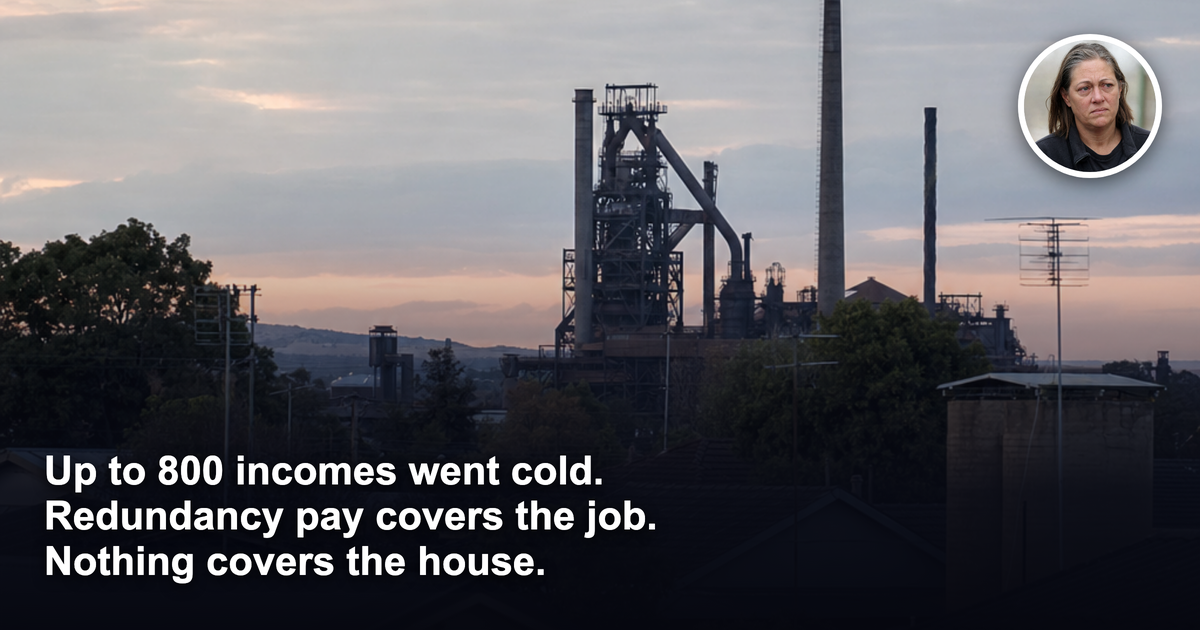
A 60-year-old blast furnace shut for good and up to 800 incomes went with it. Redundancy pay covers the job. Nothing covers the house - and street-level data showed the concentration risk long before the announcement.
The Furnace Went Cold. Her Mortgage Didn't.
Last week, a 60-year-old blast furnace in Whyalla was switched off for good. It had been silent since April. Now administrators KordaMentha have confirmed what the town feared: the furnace "will now go completely cold", in the words of partner Sebastian Hams, and 500 jobs go with it.
Add 100 labour hire workers and the total hits 600. Another 200 embedded contractors sit in limbo. Potential initial losses: about 800 incomes, in a city built around one employer, at the only plant in Australia that manufactures long steel products.
Experts say it will be two to four years before steelmaking resumes — if one of the two remaining bidders closes, or the third party holding a right of last offer steps in.
The redundancy cheques will be written. The governments have found $10.2 million for impacted workers. But here's the question nobody in a press conference is answering: who compensates the houses?
The Person
She's 49. She owns her home in Whyalla — well, she and the bank do. The mortgage still has years to run.
The household income that services it was built on the steelworks economy, the way almost every household income in that city is, directly or three steps removed. When 800 pay packets vanish from a town of that size, it doesn't matter whose name was on which payroll. Every dollar in Whyalla was downstream of that furnace.
Her home is not one asset among several. It's the balance sheet. The super is modest. The shares are token. The house is where 25 years of work actually lives.
And she can do the maths faster than any Treasury official.
The Question She's Actually Asking
Not "will I get a payout?" The AWU's Shane Karger has already told members there will be "some hard roads ahead", and called them "stubbornly determined" — and they are.
Her question is simpler and colder: what is my house worth on the day 800 households in this town stop earning — and who exactly would buy it?
Because a house is only worth what the next buyer will pay. And the next buyer in Whyalla just lost their job too.
The Answer, With the Numbers
Run the arithmetic — and to be clear, this is arithmetic, not a government figure:
- $10.2 million in support, spread across roughly 800 affected workers, is about $12,750 a head.
- Premier Peter Malinauskas says the redundancies themselves will cost state and federal governments $60 million to $80 million.
- Steelmaking resumes in two to four years — maybe.
So the package covering the humans is worth roughly one-sixth to one-eighth of what the redundancies cost. And the package covering the houses is zero. There isn't one. There never is.
Redundancy pay covers the job. Nothing covers the home.
If her house drops even 15 per cent in a market where the buyer pool has just been gutted, she loses more equity than the entire per-worker support package — several times over. She didn't mismanage a furnace. She didn't structure the debt. She bought a house and paid her mortgage for two decades. Her reward is holding an unsellable asset through a two-to-four-year employment winter, while the people who did make the decisions negotiate with bidders behind closed doors.
That is the injustice. It's not the job losses — those at least get counted, packaged and press-released. It's the silent write-down of every family balance sheet in the postcode, compensated by nobody, caused by none of them.
What It Means for You
You probably don't live in Whyalla. That's not the point.
The point is single-employer concentration risk, and it is invisible in every headline metric investors use. Median price growth won't show it. Rental yield won't show it. The suburb looked fine in April.
It shows up in the street-level data — before the announcement, not after.
When Ripehouse runs a market through our screening, one of the first things we test in regional cities is exit buyer depth: how many genuine, financed buyers actually transacted on that specific stock type, on those streets, in the last quarter. A suburb median can look stable on a dozen sales while the depth underneath it is two or three real buyers a month — and every one of them paid by the same employer.
We test it alongside the rest of the street-level picture: achieved rent against advertised rent on that street, not the suburb; vacancy at street level; days on market for that exact stock type; and approved-but-unbuilt competing supply that will land on the same buyer pool you are relying on to exit.
That is what an R-Score is doing. It is not a growth prediction. It is a measure of how many independent legs the demand for your specific asset is standing on — and a town where every leg is one furnace scores accordingly, in April, before the announcement.
The Reframe
None of this is an argument against property. It is an argument against buying a postcode instead of an asset.
The households in Whyalla are not being punished for investing in property. They are carrying the cost of concentration they were never shown — a risk that was fully visible in the data and completely absent from the headline metrics.
The right asset, on the right street, with real data behind it, beats a headline every time. Diversified local demand, genuine buyer depth, rent that is actually achieved rather than advertised: those are the things that hold when something in a town goes cold.
Screen for that before you buy, not after the press conference.
If you want to know how many legs your own asset is standing on — or the one you are about to buy — talk to us about a street-level review before you sign anything.
If you’re trying to avoid buying into a town where one employer can hollow out demand overnight, the Ripehouse Advisory webinar is a practical way to see how street-level data can reveal concentration risk, exit buyer depth and vacancy pressure before the headline does.
Frequently asked questions
What happened in Whyalla when the blast furnace shut down, and why does it matter for local homeowners?
The 60-year-old blast furnace was switched off for good, putting about 800 incomes at risk across workers, labour hire staff and contractors. In a town built around one employer, that kind of shock can weaken housing demand because the next buyer pool shrinks too.
Does redundancy pay or government support cover the impact on home values in a town like Whyalla?
No. The article says redundancy pay covers the job losses, but there is no package that compensates houses or lost equity. If demand falls after a mass layoff, homeowners can be left holding a property worth less with no direct compensation.
Why is single-employer concentration risk a problem for property buyers?
Because a suburb or town can look stable on headline figures while its buyer demand depends heavily on one employer. If that employer closes or cuts jobs, both resale demand and local confidence can fall quickly, even if earlier data looked fine.
What street-level data should investors check before buying in a regional market?
The article points to exit buyer depth, achieved rent versus advertised rent, street-level vacancy, days on market for the exact stock type, and approved-but-unbuilt competing supply. These measures help show whether demand is genuinely broad or reliant on a small number of buyers.
Why might a suburb median or rental yield miss the real risk in a town like Whyalla?
Because median prices and rental yield can hide weak underlying demand. The article says a suburb may look stable on a handful of sales, but the real market can depend on only a few financed buyers, often tied to the same employer.
General information only. It does not take your objectives, financial situation or needs into account, and nothing here is legal, financial, taxation or investment advice specific to your circumstances.