News · 17 September 2026 · 4 min read
98 per cent built, legally unlivable: who wears the loss when a developer collapses?
Sydney developer Bathla collapsed owing about $3.4 billion, leaving 45 projects unfinished. A 108-apartment Wollongong complex is 98 per cent complete yet under a prohibition order for serious defects. Who wears the loss - and the street-level checks that remove completion risk before you sign.
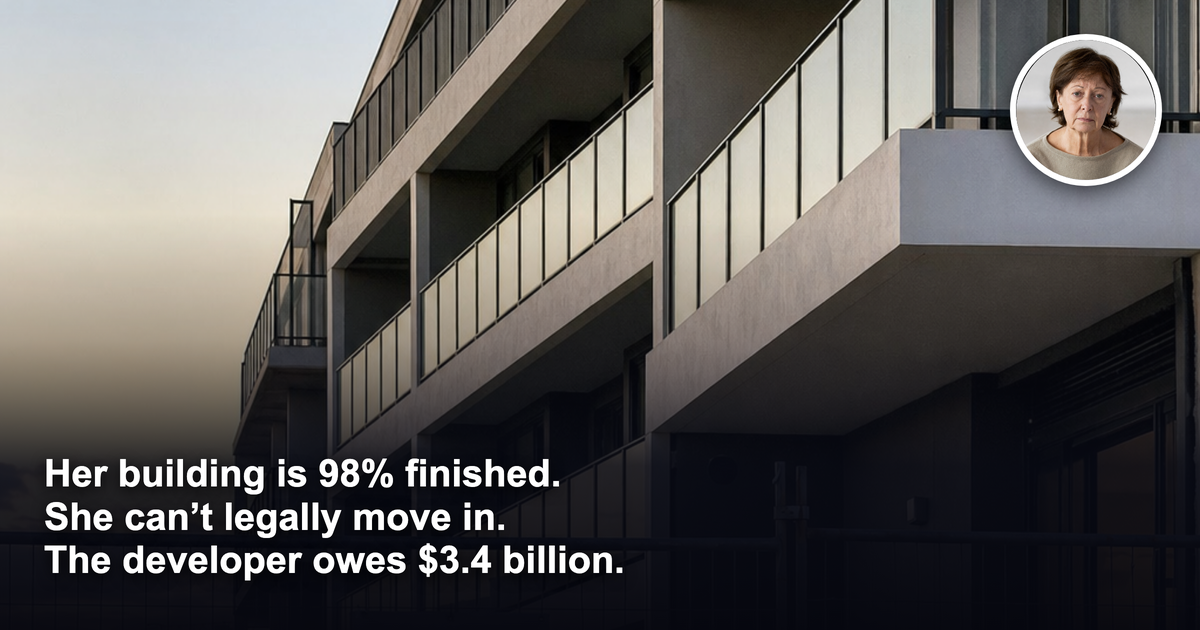
A building can be finished and still be worthless to the person who paid for it. That is the position hundreds of Australian buyers woke up to this month, and it is worth understanding exactly how it happened — because the mechanism has nothing to do with the property market and everything to do with who signed what.
The person
Picture a woman in her late sixties. She did what the entire system told her was the sensible move: she sold the family home while the market was strong, downsized into an off-the-plan apartment, and put a deposit down on a building that was scheduled for completion before Christmas. Her furniture went into storage for what she was told would be a few months.
Fourteen months later the furniture is still in storage, she is paying rent she had not budgeted for, and the apartment she contracted to buy is physically standing but legally cannot be occupied.
She is a composite of the buyers in this story, not any one of them. But every number below is real.
What actually happened
Sydney developer Bathla entered administration in August with debts of about $3.4 billion, according to ABC reporting. That collapse left 45 active projects unfinished across New South Wales.
One of them is a 108-apartment complex at Kembla Grange, outside Wollongong. The project's lender, Balmain, says the building is 98 per cent complete. And this month the NSW Building Commissioner issued that same near-finished building a prohibition order for serious defects — the regulatory instrument that stops a building being occupied or settled until the defects are fixed.
Ten minutes south, at a 92-townhouse estate at Avondale, buyers who did move in found something else. A building report on one of those homes listed around 100 defects — a missing smoke detector among them. Across the estate, several townhouses sit empty and incomplete. About 60 per cent of the developer's staff have been stood down statewide, so there is no longer anyone to call. The administrator, Teneo, secured funding for a small number of projects; the ABC understands this estate was not one of them.
There is a partial reprieve at Kembla Grange. Balmain's chief executive, Andrew Griffin, has confirmed receivers are appointed and the lender will finish the building with contingency funds, working through the prohibition order, with completion hoped for very late this year or early next.
The question
So who wears the loss?
Not the lender — it holds security over the land and can appoint receivers to protect its position, which is exactly what happened. Not the regulator — the Building Commission's response was to encourage affected owners and customers to contact the administrator. Not the stood-down workforce, who are creditors themselves.
The loss lands on the buyer. She is unsecured, she is last in the queue behind a $3.4 billion debt, and her remedy is to write to an administrator. She had the least information of anyone in the transaction and no ability to inspect, influence or accelerate the work she was funding. That is what makes this an injustice rather than a misfortune.
The part that is actually within your control
You cannot audit a developer's balance sheet from the outside. You can, however, refuse to accept counterparty risk as the price of entry — and the way you do that is by buying assets that already exist, on streets that have already proven themselves.
This is why Ripehouse Advisory works at street level rather than suburb level. A suburb median tells you nothing about the two hundred metres you are actually buying into. Our R-Score and street heatmaps resolve to the individual street, and the three measures that matter most here are the ones an off-the-plan contract cannot give you:
- Achieved rent versus advertised rent on that exact street and stock type — a completed, tenanted comparable produces a real number, not a rental estimate in a brochure.
- Street-level vacancy and days on market, which tell you whether there is genuine depth of demand for that dwelling type, or whether you would be the third identical listing on the block.
- Approved-but-unbuilt competing supply, the single most underweighted risk in any growth corridor. Ninety-two townhouses and 108 apartments do not just create construction risk; on completion they create your competition, on your street, at your price point.
An existing house on a street with tight vacancy, short days on market, verified achieved rent and thin competing supply carries none of the completion risk and all of the fundamentals. You can stand in it. You can have it inspected. You can settle on it.
The right asset, on the right street, chosen on data, beats a headline and a brochure every time. That is the whole argument for buying property properly rather than optimistically — and this month, several hundred people are learning the difference the hard way.
If you want to know what the data says about the street you are looking at, that is exactly what we do.
If you're trying to avoid being trapped by defective off-the-plan supply, the webinar offers a practical way to test street-level vacancy, achieved rent and competing stock before you sign.
Frequently asked questions
What happens if an off-the-plan apartment is almost finished but still has serious defects in NSW?
If the NSW Building Commissioner issues a prohibition order, the building cannot be occupied or settled until the defects are fixed. In the article’s example, a complex that was 98 per cent complete was still legally unlivable.
Who is most likely to lose money when a developer collapses on an unfinished project?
According to the article, the buyer wears the loss. Buyers are unsecured and last in the queue behind creditors, while lenders hold security over the land and can appoint receivers to protect their position.
Can a buyer do anything if the developer has already collapsed and the apartment is unfinished?
The article says the regulator tells affected owners and customers to contact the administrator. But the buyer has limited power because they cannot inspect, influence or speed up the work they funded.
What is the main risk of buying off-the-plan instead of an existing property?
The main risk is completion risk: the building may not be finished, may be defective, or may be unable to be occupied even if it looks nearly complete. An existing property removes that risk because it already exists, can be inspected and can be settled.
What street-level checks does the article suggest matter most before buying property?
It highlights achieved rent versus advertised rent, street-level vacancy and days on market, and approved-but-unbuilt competing supply. These checks help show whether demand is real and whether future supply could compete with the property.
General information only. It does not take your objectives, financial situation or needs into account, and nothing here is legal, financial, taxation or investment advice specific to your circumstances.