News · 17 September 2026 · 2 min read
The rate decision has not happened. The mortgage market is already moving.
Nine lenders have lifted fixed mortgage rates this month before the RBA's September meeting, with markets pricing an 88 per cent chance of a hike. What has already changed in your borrowing cost, and the street-level checks that decide how much room you have left.
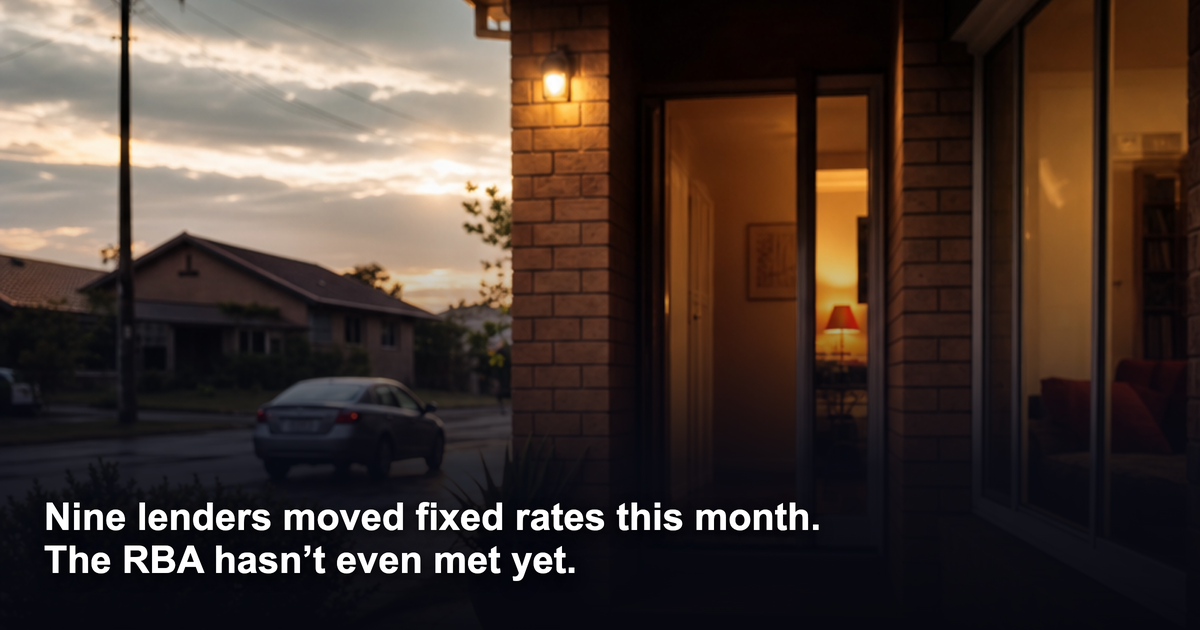
A borrower renewing a fixed loan this month does not get to wait for the Reserve Bank's next meeting. Their bank can move first.
That is the practical consequence of the latest interest-rate shift. Overnight, the US Federal Reserve lifted its policy rate by 25 basis points to a 3.75–4 per cent range. Australian markets are now pricing an 88 per cent chance of an RBA increase at the September 29 meeting. And before that meeting has occurred, Australian lenders have begun repricing fixed mortgages.
ABC reported that NAB and ANZ lifted fixed rates by up to 0.20 percentage points on Thursday, taking the number of lenders to move fixed rates this month to nine. ING and Macquarie had already moved, with ING's lowest fixed rate reported at 6.39 per cent. The four major bank economics teams expect the next cash-rate move to be higher, although they differ on whether it comes in September or November.
The question for a household is not simply “Will the RBA raise rates?” The question is “Which part of my borrowing cost has already changed, and what decision does that force now?”
For an investor, the arithmetic matters. A 0.20 percentage-point rise on a $600,000 loan is roughly $1,200 a year in simple interest before repayment structure and tax effects. That is not a forecast of any individual loan payment; it is a scale check. The real outcome depends on the balance, term, product, repayment type, lender and whether the rate is fixed or variable.
The risk is greatest when the asset was bought on a thin buffer and the owner is relying on a rent estimate, a future valuation or a refinance that has not yet been tested. A lender's rate sheet is not the same thing as a forced sale, but it changes the margin available before a household has to make one.
This is why a purchase decision cannot stop at suburb-level growth or the headline yield. At street level, you want to check achieved rents rather than advertised rents, actual vacancy for the relevant stock, days on market and the depth of buyers who could exit if the hold no longer works. You also need to test approved-but-unbuilt competing supply, because a new wave of stock can pressure both rent and resale liquidity at the same time as debt costs rise.
A property that only works at yesterday's rate is not a high-yield asset. It is a leveraged assumption.
There is also an important limitation. The RBA has not yet announced a September increase. Market pricing is a probability, not a decision, and the US Fed's move does not mechanically dictate what Australia's central bank will do. The domestic inflation, employment and demand data still matter. Anyone claiming certainty here is selling a story, not reporting a fact.
The useful decision is more boring: stress-test the debt at a rate you could actually carry, confirm the rent with comparable achieved leases, and make sure the street has enough buyer depth if your plan changes. The headline tells you what may happen. The asset-level evidence tells you whether you can stay solvent while it does.
General information only, not financial advice. Obtain advice about your own circumstances before acting.
If your holding only works at yesterday’s rate, the next question is whether the debt still clears when rents, vacancy and refinance assumptions are tested, which is why Ripehouse Advisory webinar can help you stress-test the numbers at street level before the market moves again.
Frequently asked questions
Why are fixed mortgage rates changing before the RBA’s September meeting?
Australian lenders can reprice loans before the RBA makes its next cash rate decision. In this article, nine lenders had already lifted fixed rates this month, even though the September 29 RBA meeting had not yet happened.
Which lenders have moved fixed rates, and by how much?
ABC reported that NAB and ANZ lifted fixed rates by up to 0.20 percentage points. ING and Macquarie had already moved earlier in the month, bringing the total number of lenders to move fixed rates to nine.
What does a 0.20 percentage point rise mean for a borrower with a $600,000 loan?
The article says a 0.20 percentage point rise on a $600,000 loan is roughly $1,200 a year in simple interest. The exact impact still depends on the loan balance, term, product, repayment type, lender and whether the rate is fixed or variable.
What is the biggest risk for property investors when rates rise before the RBA decides?
The greatest risk is buying or holding a property with a thin buffer and relying on a rent estimate, future valuation or refinance that has not been tested. Rising debt costs can reduce the margin before a household has to make a hard decision.
What should buyers and investors check before relying on a property deal working out?
The article says to check achieved rents, actual vacancy for the relevant stock, days on market, and the depth of buyers who could exit if the plan changes. It also recommends testing whether approved-but-unbuilt competing supply could दब pressure on both rent and resale liquidity.
General information only. It does not take your objectives, financial situation or needs into account, and nothing here is legal, financial, taxation or investment advice specific to your circumstances.