News · 16 September 2026 · 5 min read
The only law holding up her town was repealed this week. So what was holding up her house?
Queensland has repealed the one law underpinning the viability of Glenden and offered the entire town to the market. Her house has been empty for 10 years. Street-level data showed the concentration risk long before the legislation did.
This week, amendments introduced to Queensland Parliament quietly removed the one piece of legislation underpinning the viability of an entire town.
Not a subsidy. Not a grant program. The actual legal requirement — passed in 2023 after a hard-fought campaign by the local council and residents — that QCoal house its Byerwen mine workforce in the town of Glenden, 160 kilometres west of Mackay, instead of in a fly-in fly-out camp down the road.
That requirement is now gone. In its place, the government has opened registrations of interest for Glenden's homes, its commercial buildings, and a lease over the entire town. Not a suburb. Not a street. The whole town, offered to the market to see who bites. QCoal, meanwhile, can renew its camp lease beyond 2030 — the very deadline that was supposed to force workers into Glenden's empty houses.
Isaac Regional Council Mayor Kelly Vea Vea didn't mince words. "The legislation that was introduced to parliament yesterday completely blindsided my council and blindsided Glenden," she told the ABC. "The only bit of legislation that underpins the viability of Glenden has been ripped away in favour of an expression-of-interest process that tests the market."
Resources Minister Dale Last says the original laws were rushed: "There was no consultation, no consideration of the impact on services and no consideration of the future of that community and the impact that would have."
Both of them are talking about legislation. Neither of them is talking about her.
The house nobody lives in
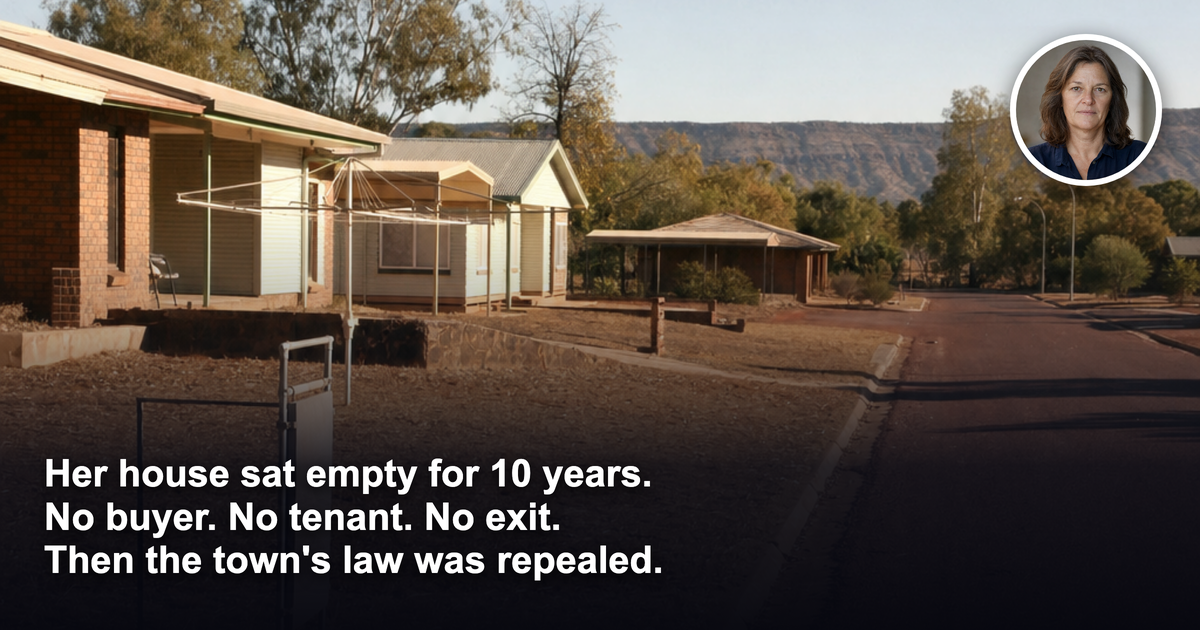
The ABC's reporting contains one detail that should stop every property owner in the country cold. A former resident, back for a recent visit, described street after street of empty homes — including her own, which her family left ten years ago and which nobody has occupied since.
Hold that in your head, because it describes a whole class of people, not one household. Picture her: 52, gone from the town for about a decade, still the owner of a house nobody has lived in since the day the family drove out.
Think about what that sentence actually means. Ten years of rates. Ten years of insurance. Ten years of a locked front door in a town built in the 1980s for one purpose — housing mine workers — where the purpose slowly walked away.
She can't sell it. There is no buyer. She can't rent it. There is no tenant. Her family's equity — the asset that was supposed to be the quiet foundation under everything else — sits behind that locked door, and this week the state repealed the only law that gave it a future.
She wasn't reckless. She bought a house in a working town with a school, shops, neighbours. She did what millions of Australians have done and been rewarded for doing. The difference between her outcome and theirs wasn't effort or character. It was information she never had.
The question every investor should be asking
Here's the uncomfortable question: was Glenden's fate actually invisible? Or was it sitting in the data the whole time, waiting for someone to look?
Because "the government blindsided us" and "the market blindsided us" are two different claims. The first is true — the council found out about the repeal when it hit parliament. The second is not. Markets telegraph this stuff for years, on the exact street you're about to buy on, if you know where to look.
What the street would have told her
At Ripehouse Advisory we spend our days in street- and suburb-level data, and towns like Glenden light up like a warning flare long before they make the news. Here's what that looks like in practice — what she would have been able to see before buying, and what any investor can check today:
Achieved rent versus advertised rent. In a healthy market, the rent a landlord asks and the rent a landlord gets sit close together. In a single-employer town, that gap blows out the moment the employer wobbles — advertised rents hold up on the listing portals while achieved rents quietly collapse in the lease data. It's the first tremor, and it shows up street by street, years before a headline.
Street-level vacancy. Suburb-wide vacancy averages hide everything. Street-level vacancy hides nothing. When the houses on one street start going dark — not listed, not leased, just empty — that's not noise. Her own house has been part of that signal for ten years. A buyer looking at that street today would see it instantly on a street heatmap. She never got the chance.
Days on market for that exact stock type. Not "houses in the region". Her house: that build era, that configuration, that street. When comparable stock stops transacting — when days on market stretches from weeks into seasons — the market is telling you buyer depth is evaporating. Which brings us to the number that matters most.
Buyer depth on exit. Every property investment is really two transactions: the one where you buy, and the one — years away — where you sell. In a diversified suburb, your future buyer pool is deep: owner-occupiers, upgraders, investors, downsizers. In a single-employer town, your entire exit rests on one company's accommodation policy. Glenden's buyer depth was always, structurally, close to one. This week we found out who that one buyer might be: whoever answers a government expression-of-interest for the lease of an entire town.
Roll those signals together and you get what our R-Score exists to measure: the resilience of a location when its biggest single assumption breaks. A town built in the 1980s for one mine, sitting on land leased by another mining company, with its population underwritten by a single act of parliament, scores exactly how you'd expect. That's not hindsight. That's arithmetic.
What this means for you
The lesson of Glenden is not "property is risky". Australians will draw that conclusion this week, and they'll be wrong.
The lesson is that concentration risk is visible, measurable, and avoidable — at the street level, before you sign anything. A law can be repealed overnight. A parliament can blindside a council. But achieved rents, street vacancy, days on market and buyer depth don't get repealed. They accumulate in plain sight, for anyone who checks.
She is 52, and her equity is locked in a house the market forgot a decade before parliament did. That should never happen to an informed buyer again — because the information now exists, down to the individual street.
The right asset, on the right street, chosen with the right data, beats every headline. Property remains one of the great wealth builders available to ordinary Australians — when you can see the street before you buy it.
We can show you yours. Talk to Ripehouse Advisory before your next purchase, and never buy blind again.
Glenden shows how a town can look buyable while concentration risk is already embedded in rents, vacancies and buyer depth; the Ripehouse Advisory webinar is useful if you want to see how to test those street-level signals before you commit.
Frequently asked questions
Why did the Queensland government’s change matter for Glenden’s housing market?
The amendments removed the law that required QCoal to house its Byerwen mine workforce in Glenden. That law had been underpinning the town’s viability, so its repeal leaves the future of Glenden’s homes and businesses to a market process.
What happened to the empty house described in the article?
The former resident said her family left about 10 years ago and the house has not been occupied since. She cannot sell it because there is no buyer, and she cannot rent it because there is no tenant.
What property signals would have warned an investor about Glenden before the repeal?
The article points to achieved rent versus advertised rent, street-level vacancy, days on market for that exact stock type, and buyer depth on exit. Together, those signals can show concentration risk long before a headline or law change.
Why is a single-employer town like Glenden riskier for property owners?
In a single-employer town, the housing market can depend on one company’s accommodation policy. If that employer changes direction, buyer depth and rental demand can weaken quickly, making it hard to sell or lease a property.
What is the main lesson for Australian property buyers from this story?
The article says concentration risk is visible and measurable at street level before you buy. It argues that checking local data such as vacancy, rents, and days on market is more useful than relying on broad assumptions about a town or region.
General information only. It does not take your objectives, financial situation or needs into account, and nothing here is legal, financial, taxation or investment advice specific to your circumstances.