News · 30 August 2026 · 4 min read
Victoria’s rental crackdown is permanent. What does it mean for property investors?
Victoria’s permanent rental taskforce changes the risk test for investors — and makes the exact property, agent and street matter more than the statewide headline.
The question
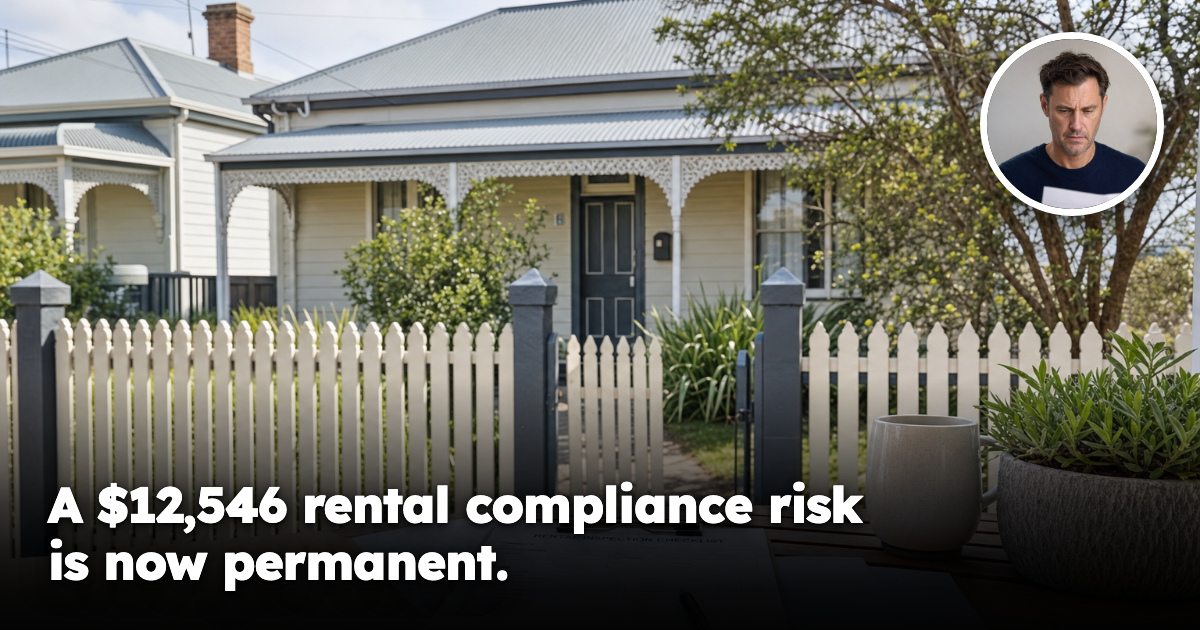
When a 47-year-old Victorian empty-nester renewed the lease on his investment property, he expected another routine year. Instead, he found himself reading through a growing list of rental obligations, wondering whether one missed detail could turn a normal tenancy into a costly dispute.
His question was simple: if the state is making rental enforcement permanent and expanding inspections, is owning a Victorian rental still worth the risk?
The answer
Yes — but the easy version of property investing is disappearing.
Victoria’s rental taskforce is being made permanent, with six additional inspectors and support staff planned to monitor rental advertising and inspect homes for compliance. Since its creation in March 2024, the taskforce has issued 130 infringement notices worth about $900,000, sent roughly 250 warnings and taken 11 rental providers to court. The penalties can reach $12,546 for an individual and $62,730 for a company.
That is not a theoretical change. A landlord can be exposed by an unlodged bond, an unsafe blind cord, a missing minimum standard or an advertisement that promises something the property does not deliver. An agent can also be held responsible. It is the same practical rental-security pressure explored in RHA’s recent piece on a two-year lease becoming a rental-security question.
The political argument is already dividing owners. Renters say stronger enforcement is necessary because the rental crisis gives them little bargaining power. Property owners say years of rule changes have created a compliance maze without producing enough new homes. Both things can be true: a tenant deserves a safe, lawful home, and an investor needs a system that makes the obligations clear before committing capital.
Why the same rule can hurt one property and help another
The biggest mistake is treating “Victoria” as one investment market. A compliance cost, a vacancy period and a rent increase are all address-level outcomes.
Ripehouse Advisory’s street and suburb data is designed to test that difference. At street level, an investor can compare achieved rents, vacancy, days on market, buyer depth and competing supply rather than relying on a statewide headline. Two properties may sit under the same Victorian rules, but one may have a deep pool of long-term tenants and a realistic repair margin while the other depends on aggressive rent assumptions and constant turnover.
That distinction matters when enforcement becomes more visible. A well-maintained property in a stable pocket can absorb the cost of documentation, inspections and occasional repairs. A marginal property with thin cash flow cannot. The regulation may be the same; the investment resilience is not.
For context, the taskforce expansion comes alongside a broader renters’ helpline and advice funding package. It is a sign that the state expects renters to understand and assert their rights more actively. Investors should read that as a demand for better records, not as a reason to abandon the market.
The practical test before buying
First, price compliance into the acquisition. Check every required safety and minimum-standard item, obtain written evidence of work, and keep a dated file that another person can understand. If the deal only works when repairs are ignored, it does not work.
Second, stress-test the rent. Use achieved rents on comparable streets, not the highest advertised figure. Model a vacancy period, a repair event and a slower rent increase. A property that survives conservative assumptions is more valuable than one that looks spectacular in a spreadsheet. For a related example of the cost of a forced move, see how a landlord sale can disrupt a tenant’s housing plan.
Third, assess the agent as part of the asset. Ask how notices, bonds, inspections, repairs and evidence are recorded. A cheap management fee is not a bargain if a preventable process failure creates a dispute.
Fourth, look at the street, not only the suburb. The best tenant demand may be concentrated near a transport route, school catchment or daily-services strip, while a nearby street with the same postcode has weaker enquiry and longer days on market. That is where address-level data earns its keep.
Investors should also watch the supply response. If compliance becomes more expensive while new rental construction remains slow, some owners may sell. That can reduce rental supply, but it can also create opportunities for buyers who have correctly budgeted for the rules and can identify streets with durable demand.
What should she do?
The empty-nester with the renewing lease should not make a statewide decision from a statewide headline. He should audit the property, confirm the management process, recheck the achievable rent and compare the address with nearby streets. If the numbers remain resilient after a realistic compliance allowance, holding can still be rational. If the property has weak demand and no repair buffer, selling may be the right capital-allocation decision — because the asset failed the test, not because Victorian property investment did.
The permanent taskforce changes the standard of ownership. It rewards investors who know their obligations, maintain their homes and buy where tenant demand is deep enough to support long-term holding.
Property investment is still an opportunity. The edge now belongs to the buyer who chooses the right asset, the right street and the right data before the headline chooses for them.
If there's a specific street you're weighing up right now, check its Street Score first — it's free, takes ten seconds, and tells you whether that street is pulling the suburb average up or riding on it.
Frequently asked questions
What does Victoria making its rental taskforce permanent mean for property investors?
It means rental compliance will be checked more actively and consistently, with extra inspectors and support staff monitoring advertising and inspecting homes. Investors need to expect closer scrutiny of their records, safety items and tenancy processes.
What kinds of issues can cause trouble for a Victorian rental provider or their agent?
The article says problems can include an unlodged bond, an unsafe blind cord, a missing minimum standard or an advertisement that promises something the property does not deliver. An agent can also be held responsible.
How should investors judge whether a Victorian rental is still a good buy under the new enforcement approach?
They should price compliance into the purchase, stress-test the rent using achieved rents rather than the highest advertised figure, and allow for vacancy, repairs and slower rent growth. If the deal only works when repairs are ignored, it is not a sound investment.
Why does the article say the exact street matters more than the statewide Victorian headline?
Because compliance cost, vacancy and rent outcomes are address-level issues, not statewide averages. Street-level data can show real tenant demand, competing supply, achieved rents and days on market, which may differ even within the same suburb.
What is the main risk for investors if compliance becomes more expensive in Victoria?
Properties with thin cash flow and weak demand may struggle to absorb documentation, inspections and repair costs. The article says investors should watch for this risk, while recognising that some buyers may still find opportunities if they have budgeted correctly and chosen a strong street.
General information only. It does not take your objectives, financial situation or needs into account, and nothing here is legal, financial, taxation or investment advice specific to your circumstances.