News · 3 October 2026 · 4 min read
Victoria promises to undo its land tax grab. At $25,000 a year, she worked out how long that takes
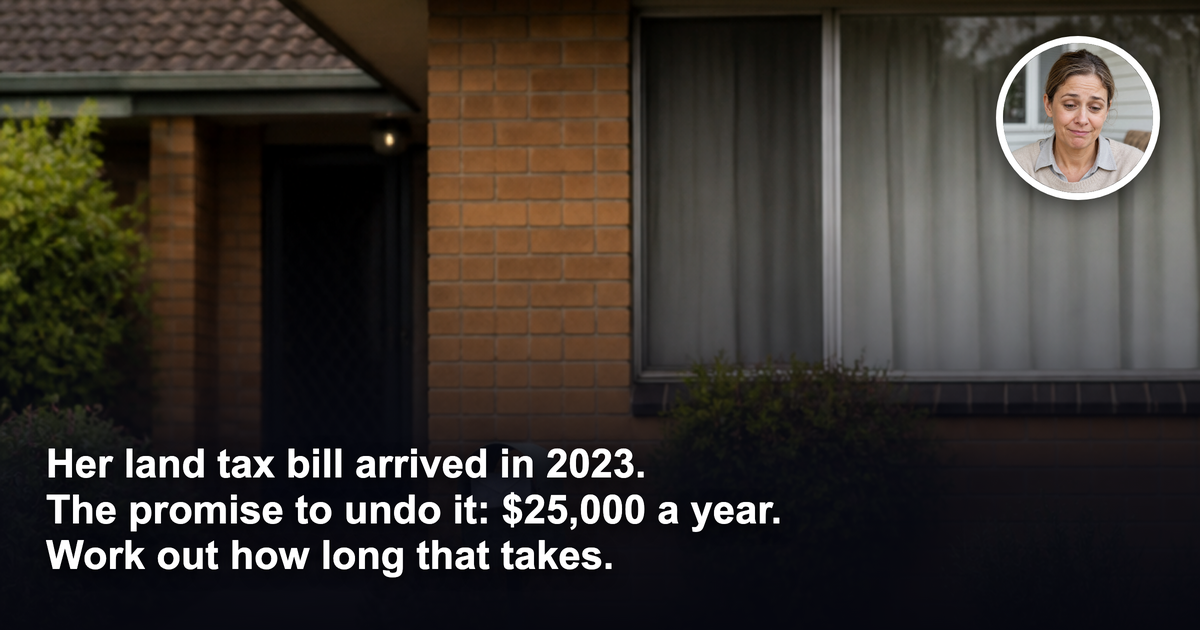
She is 41. She owns her home in Ballarat and one rental unit in Melbourne's north, bought in 2019. The land under it is valued at around $180,000.
She is 41. She owns her home in Ballarat and one rental unit in Melbourne's north, bought in 2019. The land under it is valued at around $180,000.
Until 2023 she had never paid a cent of land tax. The threshold was a site value of $300,000 and she sat well under it.
Then the threshold dropped to $50,000. She got a bill. So did about 250,000 other Victorians who had never been in the system before, according to the ABC's report on the government's own figures.
This weekend the Premier promised to put the threshold back. Her property manager sent her the headline with four words underneath: told you to hold.
She is a composite, drawn from the Victorian land tax questions we have received since 2023. The policy figures below are from the ABC's reporting of the announcement on 4 October 2026.
The question she sent us
"The government says it is scrapping the 2023 land tax changes. Does that mean my bill goes away next year? And should I be buying a second one in Victoria now, before everyone else works this out?"
The answer: read the pace, not the promise
This is what the announcement actually says, per the ABC.
The Carroll government has promised, if re-elected, to reverse the 2023 changes that lowered the land tax threshold from a site value of $300,000 to $50,000.
The reversal would be progressive, with the threshold rising by $25,000 a year. The cost is put at $230 million over five years, paid for by consolidating the government car fleet and delaying level crossing removals.
Now do the arithmetic the headline skips.
The threshold has to travel from $50,000 back to $300,000. That is $250,000 of ground. At $25,000 a year, that is ten years.
Her land is valued at $180,000. On the stated pace, the threshold does not pass her until it has climbed $130,000, which is a bit over five years from whenever the first step takes effect. She stays in the land tax system for all of that time. What each year's bill looks like along the way is a question for her accountant, and the answer will depend on her land value and how the schedule is legislated.
And that is the most favourable reading. It assumes the government is re-elected, the first $25,000 step lands promptly, and no future budget pauses the schedule. An election promise is an election promise. It is not legislation.
The Coalition and One Nation have also committed to reversing the 2023 changes, per the same report. So whoever wins, some form of reversal now looks likely to be on the table. The direction is shared across the parties. The pace, the start date and the funding are not settled by anyone.
What the $230 million tells you
$230 million over five years is the government's own costing. Spread across the 250,000 taxpayers the 2023 change captured, that works out to roughly $920 per taxpayer across five years, or under $200 a year on average.
That is a crude average and your own bill depends entirely on your land value. But it tells you the scale of the relief on offer: real, slow and modest. It is not a reason to buy a property.
The expensive mistake
This is the mistake we expect to see over the next few months.
Someone with equity reads "Victoria is back" and buys an investment property because the land tax is "going". They model the purchase with no land tax from year one. They pay a price that only works on that model.
Then the election goes a different way, or the schedule slips, or their land value sits above the threshold for seven years. The holding cost they never priced in arrives every year, on time.
The opposite mistake is just as real. Someone sells a decent Victorian asset in 2026 because they are sick of the bill, right before the threshold starts walking back toward them.
Both are decisions made on a headline about who might be in government. Neither is a decision about the asset.
What it means for you
If you are holding Victorian property: your land tax bill is not disappearing next year under any party's announced policy. If your land value is well above $300,000, this policy does not remove it at all.
If you are weighing Victoria against other states: run the purchase twice. Once with land tax at today's settings for the whole hold period. Once with the threshold rising $25,000 a year from, say, 2027. If the deal only works on the second run, you are betting on politics with your own money.
Then run the thing that actually moves the outcome. Rent, vacancy and growth on the specific street. Two streets in the same Melbourne suburb can be having completely different outcomes right now, and no land tax schedule changes that.
The Ripehouse reframe
Land tax is a holding cost. Holding costs matter, and in Victoria they have mattered more since 2023. They are still an input.
The output of a property investment is what the asset is worth and what it earns over ten years. That is decided by the street, the dwelling, the local supply pipeline and the price you paid. We have never seen a tax threshold turn a weak asset into a good one, or a strong one into a bad one.
Structure, not timing. The right asset on the right street, bought on numbers that survive both versions of the land tax schedule, beats any headline out of Spring Street.
This is general information only. For your own land tax position, speak to a qualified tax adviser.
Want to see how we stress-test a Victorian purchase with and without the promised land tax relief, street by street? Join Jacob's free live webinar.
General information only. It does not take your objectives, financial situation or needs into account, and nothing here is legal, financial, taxation or investment advice specific to your circumstances.