News · 4 October 2026 · 4 min read
He is paying $20,000 to escape a $1,000 land tax bill. Now both sides promise to wind it back
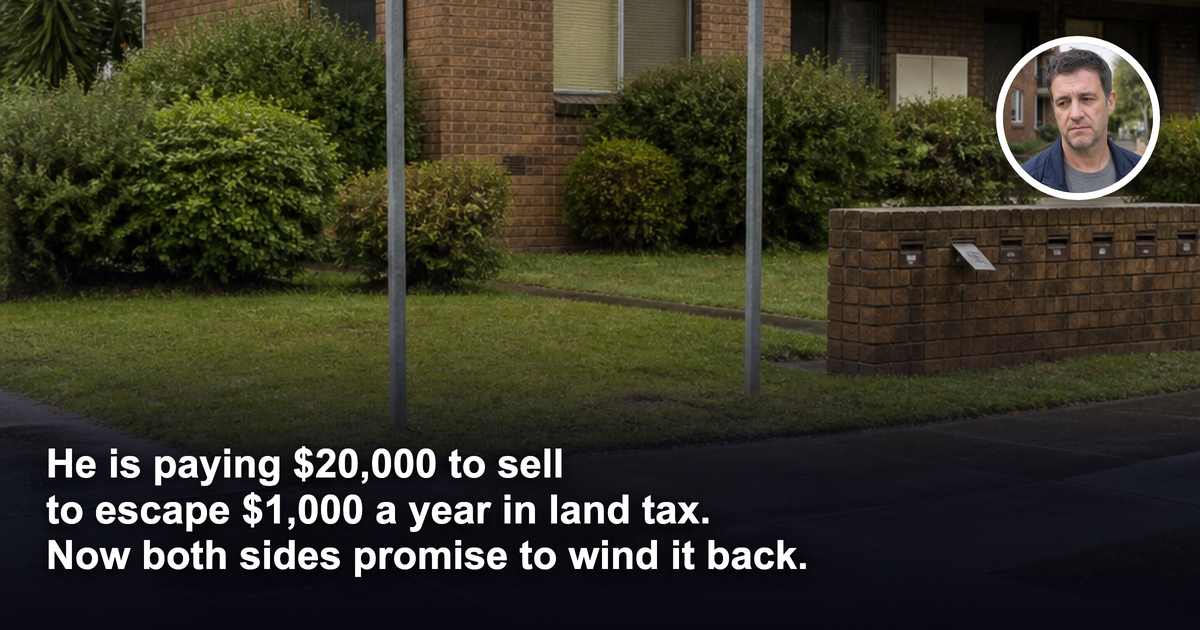
He is 44. He owns one investment property, a two-bedroom unit in Melbourne's inner west that he bought in 2017 and has rented out ever since. Until 2024 it had never cost him a cent in land tax.
He is 44. He owns one investment property, a two-bedroom unit in Melbourne's inner west that he bought in 2017 and has rented out ever since. Until 2024 it had never cost him a cent in land tax.
Then the threshold moved, and a bill arrived for a bit under $1,000.
It was the bill, more than the amount, that got to him. He had read every story about investors leaving Victoria. He rang an agent in September. The listing agreement is signed. The photographer is booked for next week.
Agent commission, marketing and conveyancing will come to about $20,000. He has made peace with that, because he sees it as the price of getting out of a tax he believes will only go up.
Then, on Saturday, he opened the ABC and read that the Victorian government will reverse its 2023 land tax changes if it is re-elected. The Coalition and One Nation have already committed to the same thing.
He is a composite illustration, not a real person.
The question
"I'm selling my unit mostly because of land tax. Now both sides say they'll undo the changes. Do I pull the listing? Have I just spent $20,000 to escape a tax that's about to disappear?"
The answer: read the schedule, not the headline
Start with what the ABC reported on 3 October.
In 2023 the Victorian government lowered the land tax threshold from a site value of $300,000 to $50,000. By the government's own count, that brought 250,000 more Victorians into the tax (ABC News, 3 October 2026).
Labor now says it will reverse that if re-elected. The Coalition and One Nation say the same.
So far, good news for him. Now the detail.
Labor's proposal lifts the threshold by $25,000 a year, "progressively over the course of several years", at a cost of $230 million over five years.
Do the arithmetic. From $50,000 back to $300,000 is a gap of $250,000. At $25,000 a year, that is ten years. The ABC report does not say ten years. It says "several". But the two figures in the report only add up one way.
For our composite, whose unit sits on land valued at around $200,000, the threshold would not climb past his site value until about the sixth year. Six more bills at roughly $1,000 each is about $6,000, assuming the rate and his land value stay where they are. If his land value rises, the threshold is chasing a moving target and he pays for longer.
Against that, his exit costs about $20,000 in cash, now, with certainty. Then capital gains tax on nine years of growth. Then stamp duty if he ever buys back in.
He is spending $20,000 to avoid something in the order of $6,000, spread over six years, to get ahead of a tax schedule that has not been legislated.
The rule nobody prices in: a promise is not a policy
Everything above is an election promise. None of it is law.
Labor's version is paid for by consolidating the government car fleet and delaying level crossing removals. The Coalition and One Nation have their own versions. All three are campaign commitments. Commitments change after costings, after the upper house, after the first budget update.
So the honest answer has two halves. Do not sell because of a tax that both sides promise to remove. And do not hold because of a promise either. Hold or sell on the merits of the asset.
What it means for you
If land tax is the reason you are selling in Victoria, write down the bill. Then write down the cost of selling. For many of the 250,000 owners pulled in by the $50,000 threshold, the first number is a fraction of the second.
If you are thinking about buying in Victoria because land tax is "going", slow down. Under the only schedule published, the threshold moves $25,000 a year. Run your numbers at the current settings. Then run them at the proposed settings. If the purchase only works under the second set, you are buying a promise.
Speak to your accountant about your own position. Land tax depends on your holdings and your structure, and nothing here is advice about yours.
The Ripehouse reframe: structure outlasts the election
Tax settings are inputs. They move with every budget, in every state. A portfolio that only works under one set of inputs is a bet on politics.
The decision that matters for our composite is the one nobody asked. Is this unit, on this street, worth holding for another decade? Two streets in the same suburb can be having completely different outcomes right now on days on market and vacancy. If his street is one of the strong ones, the land tax question answers itself. If it is one of the weak ones, he should sell for that reason, and the threshold was never the point.
That is how we would test it. The asset and the street first. The tax last.
Want to see how we test a decision like this street by street? Join Jacob's free live webinar, If I Were Buying an Investment Property in Australia Today.
General information only. It does not take your objectives, financial situation or needs into account, and nothing here is legal, financial, taxation or investment advice specific to your circumstances.