News · 3 October 2026 · 4 min read
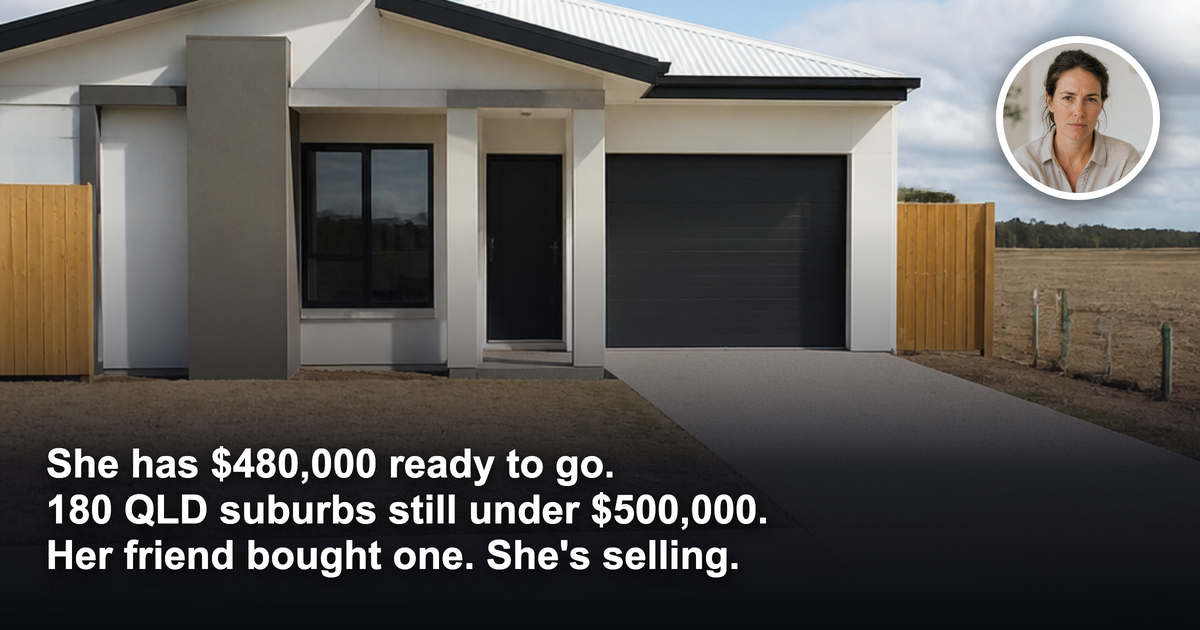
She has $480,000 and a list of 180 cheap Queensland suburbs. Why did her friend's pick already go wrong?
She is 39. She and her partner own their home in Melbourne's inner north, have about $120,000 of usable equity, and hold a pre-approval for $480,000 that expires in December.
She is 39. She and her partner own their home in Melbourne's inner north, have about $120,000 of usable equity, and hold a pre-approval for $480,000 that expires in December.
On Friday a friend sent her the realestate.com.au piece reporting that 180 Queensland suburbs are still priced under $500,000, and that buyers are crowding into them while they last. She read it on her phone in a supermarket car park and felt what a lot of people felt that day.
If I do not move now, I miss it.
She is a composite, drawn from the questions that arrived in our inbox over the weekend. The details are typical rather than taken from one file.
Two friends, one price bracket
What makes her hesitate is her phone contacts, more than anything in the article.
Two friends bought Queensland houses under $500,000 last year. One picked a brick house on an older street, ten minutes from a hospital, a university campus and a port. Her tenant renewed in August without being asked.
The other bought a newer house on a bigger block in a town where most of the work comes from one employer. Her tenant left in May. The next one took eleven weeks to sign. She has rung an agent about selling.
Same budget. Same state. Same year. Completely different outcomes.
The question she sent us
"There are 180 suburbs left under $500,000 and the article says they are disappearing. I have the money sitting there. Is it stupid not to buy one before they are gone?"
The answer: the headline counts suburbs. It does not grade them
The 180 figure is real and we credit realestate.com.au for it. The piece also, to its credit, warns about traps. Most readers will not get that far. They will see 180, see a shrinking list, and start scrolling listings.
A price cap is a filter. It tells you what you can afford. It tells you nothing about what you are buying.
The four things that separated her two friends are the four things a cheap-suburb list cannot show you.
Supply. Some suburbs are cheap because they are overlooked. Others are cheap because land there is close to unlimited and a developer can release another stage whenever prices twitch. The first kind can re-rate. The second kind is competing with a brand new house down the road every year, forever.
Job concentration. A town built on one mine, one plant or one government department has one point of failure. A town with a hospital, a campus, a port and a council has several reasons for people to stay when one of them wobbles. Rent follows people. People follow work.
Rental depth. A tenant today tells you little. Ask how many people are looking in that suburb on the week your tenant hands back the keys. Eleven weeks empty on a $480,000 house is roughly two and a half months of mortgage, rates and insurance with nothing coming in. That cost never shows up in the purchase price, and it is often the whole margin.
The asset itself. The cheapest house in the cheapest suburb is cheap for a reason. A sound brick house on an established street in a mid-priced suburb will usually outlast a newer, larger, thinner-built house on the edge of an estate. Buyers chasing a number tend to buy the second one.
What this means for you
If you are her, or close to her, three things follow.
The list is a starting point. Use it to find the bracket, then do the work the list cannot do. If a suburb survives the four tests above, the under-$500,000 price is a bonus. If it does not, the price is the trap.
The only deadline in her story is the pre-approval. That is a date set by a bank, and banks reissue pre-approvals every day. The market has not set her a deadline. Nobody knows what these suburbs will be worth next year, and the article does not claim to. The "closing window" is a description of how buyers are behaving, and behaving like the crowd is how her second friend ended up on the phone to an agent.
Fear of missing out is the most expensive emotion in property. It moves people to buy whatever is left rather than whatever is right, and the gap between those two can be a decade of flat growth and a vacant house.
The Ripehouse reframe
Two streets in the same suburb can be having completely different outcomes right now. One has owner-occupiers renovating and a waiting list for rentals. The other has a row of investor-owned houses all built in the same year, all hitting the market in the same month. The suburb median blends them together and calls it one number.
This is why we do not start with price. We start with structure: what the portfolio needs this purchase to do, which markets have the supply, employment and rental depth to do it, and then which streets and which houses within them.
Across 997 client portfolios since 2021, the median has grown at 19.0 per cent a year on a 5-year rolling basis, against roughly 6.3 per cent for the combined capitals over the same period. We publish the full spread, including the portfolios that underperformed, because the lesson in those is the same one her second friend is learning. The ones that lagged were almost never the ones that paid too much. They were the ones where the asset or the street was wrong.
Benchmark: CoreLogic/Cotality. Past performance is not a guarantee of future results.
The right asset, on the right street, chosen with data, beats a headline every time. Structure, not timing.
Want to see how we would test a sub-$500,000 Queensland purchase street by street before the pre-approval runs out? Join Jacob's free live webinar.
General information only. It does not take your objectives, financial situation or needs into account, and nothing here is legal, financial, taxation or investment advice specific to your circumstances.