News · 3 October 2026 · 4 min read
She paid $740,000 for a station that does not exist yet. Now a party has promised to scrap it
She is 41. In 2024 she bought a two-bedroom unit in Melbourne's south-east, a ten-minute walk from where a Suburban Rail Loop station is meant to open. She paid $740,000.
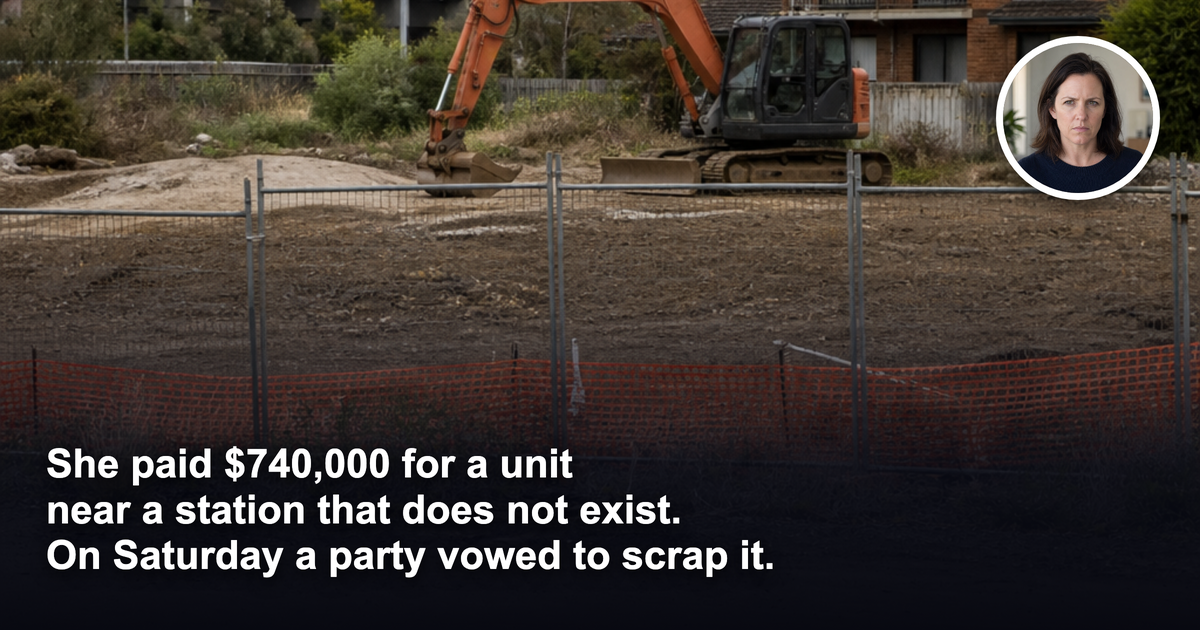
She is 41. In 2024 she bought a two-bedroom unit in Melbourne's south-east, a ten-minute walk from where a Suburban Rail Loop station is meant to open. She paid $740,000.
She did not pay that for the unit. She paid it for the station.
The brochure had the station render on the cover. The agent talked about the precinct, the towers, the "once in a generation" uplift. Units of the same size a few streets further out were going for less. She paid up for the walk.
She is a composite, drawn from the questions we receive from buyers along the SRL corridor. The details are blended. The situation is very real, and this week it got sharper.
The question she sent us
"I bought near a planned SRL station because everyone said the station would carry the value. Now One Nation says it will scrap the whole project if it wins. Do I sell before the election?"
What actually happened on Saturday
One Nation launched its Victorian election campaign at Crown Casino in front of roughly 750 supporters, according to the ABC. Law and order was the centrepiece. To pay for it, the party said it would scrap the Suburban Rail Loop and divert the money to Airport Rail and electrifying the Melton line.
That is a campaign pledge from one party. It is not a policy change. The project has not been cancelled. Nobody knows the election result, and we are not going to guess at it.
But the ABC also reports that polling suggests the party will seriously challenge both Labor and the Coalition. So the pledge is no longer something a buyer can wave away as noise.
Which brings us back to her unit.
The answer: she bought a promise, and promises are not fundamentals
The expensive mistake was made in 2024, not on Saturday.
She priced an announcement as if it had been built. The station was years from opening even on the official timetable. Every dollar she paid above the units a few streets out was a bet that a government project would be delivered on time, in full, by whoever holds office in the meantime.
That is a political position, not a property position. Saturday simply made the political position visible.
Here is the part nobody puts in the headline. Even if the line is built exactly as planned, a station precinct is a mixed blessing for someone who owns one unit in it. Precinct rezoning brings towers. Towers bring hundreds of new two-bedroom units competing with hers for the same tenants and the same buyers. The infrastructure that was supposed to lift her value can also flood her market.
So the honest question is not "will the station be built." The honest question is "does this unit work on this street today, with the station struck out of the spreadsheet."
How to run that test
Take the purchase case and delete the project.
- What are comparable units on the street actually renting for right now, and how long do they sit vacant between tenants?
- How many units are approved or under construction within a kilometre, regardless of the rail line?
- Who lives on the street today, and would they still want to live there if nothing changed for a decade?
- If the holding cost stays where it is for five years with no station, can you carry it without stress?
If the case survives those four questions, the station is upside. If the case collapses without the station, you were never buying property. You were buying an election.
For her, the answer to "do I sell before the election" is that selling into a headline crystallises every cost at once, agent fees, marketing, the stamp duty she will never see again, and it does so on the basis of a pledge that may never become policy. The decision should turn on what the street is doing, not on what a party said at Crown Casino.
That is a general observation about how we test a case. It is not personal financial advice, and her numbers are not your numbers.
What this means for you
If you are weighing a purchase anywhere along the SRL corridor, or any corridor sold on a project that has been announced but not delivered, do the subtraction first.
Strike the project out. Re-run the yield, the vacancy, the supply pipeline, the holding cost.
Two streets in the same suburb can be having completely different outcomes under exactly the same headline. One has tight rental demand, older owner-occupier stock and almost no new supply. The other has three cranes and a hundred identical units arriving in eighteen months. The station render on the brochure is the same for both.
The Ripehouse reframe
Infrastructure announcements are where highlight reels get made. Somebody bought near a project, the project landed, the price went up, the story gets told at a seminar.
We do the opposite. We stress-test every purchase for the project not arriving, and we publish the full spread of client results, including the portfolios that underperformed. Across our client portfolios the median growth has been +19.0 per cent a year on a 5-year rolling basis, against roughly 4.3 per cent nationally. Benchmark: CoreLogic/Cotality. Past performance is not a guarantee of future results.
The right asset on the right street, chosen on data that holds today, beats a headline every time. Structure, not timing.
Want to see how we strike a promised project out of a purchase case and test what is left, street by street? Join Jacob's free live webinar.
General information only. It does not take your objectives, financial situation or needs into account, and nothing here is legal, financial, taxation or investment advice specific to your circumstances.