News · 9 October 2026 · 4 min read
Up 40 per cent in Middle Park, 3.4 per cent across Melbourne: which rent number should your deposit follow?
Middle Park house rents rose almost 40 per cent in the year to September, to a median of $1,250 a week. That comes from Domain's September quarter Rent Report, as covered by the Sydney Morning Herald, and it is the largest house rent rise of any Melbourne suburb.
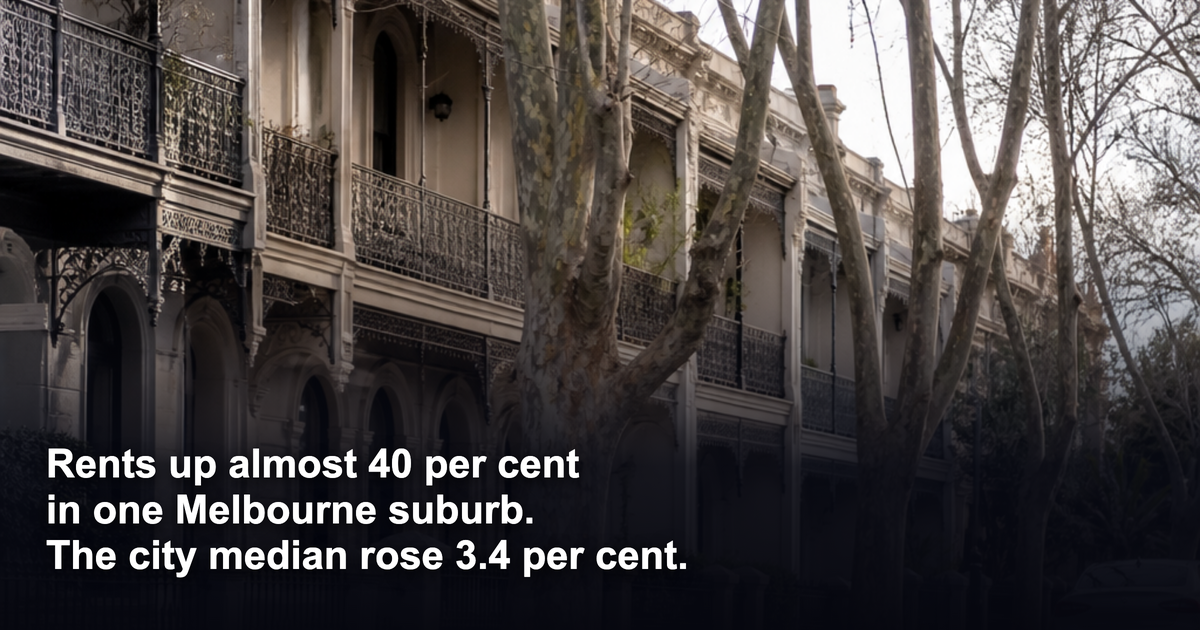
Middle Park house rents rose almost 40 per cent in the year to September, to a median of $1,250 a week. That comes from Domain's September quarter Rent Report, as covered by the Sydney Morning Herald, and it is the largest house rent rise of any Melbourne suburb.
Sixty-three homes were leased there over the whole year.
Hold those two facts next to each other. They explain most of what follows.
What changed
Melbourne's median asking rent for houses and units held at a record $600 a week in the September quarter. Over the year, the greater Melbourne house median rose 3.4 per cent.
That is the city-wide story. Record rents, modest growth, and a market Domain's chief economist described as reaching an "affordability ceiling", where landlords are finding it harder to push rent increases through to tenants who have already stretched.
Underneath that median, the suburb numbers scatter.
Glen Iris house rents rose 10.5 per cent. East Melbourne, Camberwell and Beaumaris were all in the top five for growth, each up 15 to 20 per cent, each with asking rents at least $500 a week above the Melbourne median. Eltham units rose 15 per cent to $575 a week and Eltham houses rose 13.6 per cent. Brunswick units rose 13.3 per cent.
So yes, some Melbourne suburbs posted double-digit rent growth. The headline is accurate.
Why the big numbers happened where they did
Look at the list. Middle Park, East Melbourne, Camberwell, Beaumaris, Albert Park, Safety Beach. Prestige suburbs with very few rentals and very few leases.
When a suburb leases 63 homes in a year, a handful of expensive family homes coming onto the market can move the median a long way. Domain's economist said these areas combine lifestyle appeal with clearly limited rental supply. A data analyst quoted in the same piece went further: these smaller markets can be volatile, and "you might find that next quarter they drop by 20 per cent".
Brunswick is the useful exception. It posted 13.3 per cent unit rent growth across more than 1,000 leases. That is a deep market with real tenant demand behind the number.
Middle Park's 40 per cent on 63 leases and Brunswick's 13.3 per cent on more than 1,000 are different kinds of evidence, even though one looks three times bigger.
What this means if you have equity to deploy
If you own a home with usable equity and had written Melbourne off, this report is a reason to put the city back on the shortlist and test it. On its own it is a weak reason to buy.
The trade-off, in the report's own numbers.
A $1,250-a-week house in Middle Park is a prestige asset. Rent growth of 40 per cent in a thin market tells you very little about what the next tenant will pay, and the purchase price in that suburb means the yield still has to be checked against the cost of the money.
Brunswick's 13.3 per cent came from a market with more than 1,000 leases. Deep rental demand lowers vacancy risk, which matters more to a leveraged owner than any one-year growth figure.
Greater Melbourne's 3.4 per cent is the number that applies to the average street. If you buy an average Melbourne house on an average street, that is closer to the rent growth you should underwrite. And at a record $600 a week median, the report's own economist says tenants are near the limit of what they can pay.
The expensive mistake is to read "Melbourne rents up double digits", buy a suburb-average property, and expect a suburb-top result.
Rent growth and investor outcomes are different things
A rent rise improves one line of a portfolio. It does not repair a purchase at the wrong price, a street with chronic vacancy, or a loan that costs more than the asset earns.
Rising rent in a suburb you do not own is research. Rising rent on a property you bought well, in a street where tenants compete for it, is an outcome. The suburb lists published this week are inputs. The outcome still has to be built.
The street, not the suburb
Two streets in the same Melbourne suburb can be having completely different years. One backs onto the train line and leases in nine days. The other has three for-lease boards and has not moved in a month. The suburb median averages them together and describes neither.
That is the Ripehouse reframe. Suburb lists are a starting point. The decision is made at the street: days on market, vacancy, who the tenants are and how many of them there are, and whether the asking rent clears at that price or sits.
Structure beats timing. The right asset on the right street, bought at a price the rent and the data support, is what carries a portfolio through a year when the median moves 3.4 per cent and the headlines say 40.
Want to see how we test a Melbourne suburb street by street before a dollar of equity goes in? Join Jacob's free live webinar, "If I Were Buying an Investment Property in Australia Today".
General information only. It does not take your objectives, financial situation or needs into account, and nothing here is legal, financial, taxation or investment advice specific to your circumstances.