News · 10 October 2026 · 5 min read
Melbourne house prices fell $39,000. Buyers lost 62 suburbs anyway. Why price was never the limit
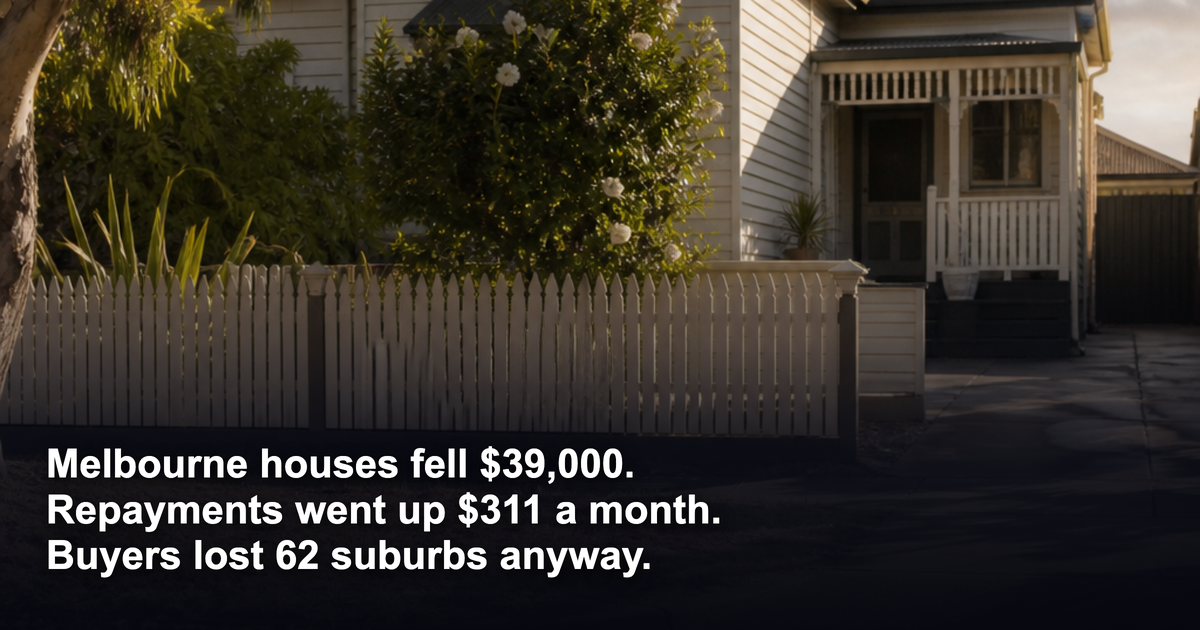
Melbourne's median house value has fallen from $999,000 to $960,000 in recent months, according to a Canstar report covered by realestate.com.au this week. That is $39,000 off the typical house.
The number
Melbourne's median house value has fallen from $999,000 to $960,000 in recent months, according to a Canstar report covered by realestate.com.au this week. That is $39,000 off the typical house.
The monthly repayment on that cheaper house went up by $311.46.
Read those two sentences again, because they are the whole story. The asset got cheaper and it costs more to hold. Everything else is detail.
What changed
Canstar modelled a two-person household on a 30-year mortgage with a 20 per cent deposit, $48,000 a year in other expenses and a 3 per cent serviceability buffer. In October 2025 that household could afford a median-priced house in 210 Melbourne suburbs. In October 2026 the same household can afford a median-priced house in 146.
Realestate.com.au reports that as 62 suburbs lost in a year.
The income needed to buy the median Melbourne house rose from $135,268 to $139,362 over the same period, an increase of more than $4,090, while the price of the house fell.
Canstar's research manager Josh Sale put it plainly: in markets where prices have fallen, the income required to buy has still gone up, because borrowing costs rose faster than prices dropped. His modelling has each 25 basis point rate rise cutting a buyer's maximum borrowing capacity by roughly 2 per cent, and adding about $100 to $165 a month on a $600,000 to $1 million loan.
Geelong went the other way on price and the same way on capacity. Its median house reached $1 million this year, and the income needed to buy it rose from $124,000 to $142,946.
Why the price fall did not help
Most people picture affordability as a seesaw. Prices down, buyers up.
Rates broke the seesaw. Capacity moves with the rate and the buffer, and both moved against buyers faster than the price moved for them. A price fall of under 4 per cent is small next to a borrowing ceiling that drops about 2 per cent for every quarter-point hike, with Westpac and ANZ flagging another hike as a live risk.
So the Melbourne buyer who sat out the year waiting for a cheaper entry got one. They also got a smaller loan, a higher repayment and fewer suburbs. On paper they won $39,000. In the bank's calculator they lost ground.
What this means if you hold equity
If you own a home with usable equity and household income in the $180,000 to $500,000 range, you are not the couple in Canstar's model. Your constraint looks different.
You still have a borrowing ceiling. It moved for the same reason. Every rate rise since last October has trimmed what the bank will lend against your equity, regardless of what the next headline says about prices.
That changes the decision.
Waiting for prices to fall further is a bet that the price line drops faster than your capacity line. In Melbourne over the past twelve months, it did not. The data in this report says the opposite happened.
The useful question has changed from "how low will it go" to "what can I actually borrow today, and which streets does that number buy well in".
The decision, with numbers
Call the two options what they are.
Option one: wait. If rates rise another 25 basis points, Canstar's model takes about 2 per cent off your maximum loan. On a $700,000 ceiling that is roughly $14,000 of buying power gone. For prices to compensate, the house you want has to fall by at least that much, in the suburb you want, before someone else buys it. Melbourne's median fell $39,000 over a stretch when the market lost 62 suburbs of affordability anyway.
Option two: buy on today's capacity and treat the rate risk as a holding cost you price in before you sign. On a $600,000 to $1 million loan, each quarter-point rise adds about $100 to $165 a month. That is a known number. You can model it, test it against rent, and decide whether the asset carries it.
The trade-off is honest. Buying now means paying a price that may dip further. Waiting means hoping a smaller loan buys a cheaper house in a market where fewer people can borrow, auction volumes are down 42 per cent on last year, and the cheapest medians are already in Melton at $570,000, Melton South at $580,000 and Wyndham Vale at $610,000.
The expensive mistake is treating the price as the only moving part. Price is the one thing you cannot control. Capacity, buffer, rent coverage and the street you choose are the things you can.
The street, not the median
A median is an average of a lot of different outcomes.
Two streets in the same suburb can be having completely different years. One has a tightening rental pool, short days on market and owners who are not selling. The other has a run of investor listings, longer campaigns and a vendor who just took a discount to get out. The suburb median blends them and tells you nothing about which one you are buying into.
That is the part the suburb count misses. Being locked out of 62 suburbs at the median says nothing about whether the right street in the 147th suburb is a better asset than the wrong street in one you can still afford.
Our client portfolios have grown at a median of +19.0 per cent a year on a 5-year rolling basis, against roughly 4.3 per cent nationally, and we publish the full distribution, including the portfolios that underperformed. Benchmark: CoreLogic/Cotality. Past performance is not a guarantee of future results. We cite it for the method. Those results came from structure, street selection and capacity planning done before the purchase. Headlines did not produce them.
The reframe
Melbourne got cheaper this year and harder to buy in. That will keep happening wherever rates move faster than prices.
If you have equity, the first job is to know your real borrowing number under today's rate and buffer. The second is to work out which streets that number buys well in, one by one, with data rather than a suburb list. The third is to decide whether the asset carries a rate rise, in dollars per month, before you sign.
Structure beats timing. The bottom is a date nobody can give you. Your capacity is a number you can get this week.
Want to see how we test a purchase like this street by street under today's borrowing limits? Join Jacob's free live webinar.
General information only. It does not take your objectives, financial situation or needs into account, and nothing here is legal, financial, taxation or investment advice specific to your circumstances.