News · 10 October 2026 · 5 min read
Norlane gave back $21,000 in three months. Highton rose $23,000. Which Geelong growth holds when rates rise?
Norlane houses rose $59,000 in the year to September. In the last three months they gave back $21,000 of it.
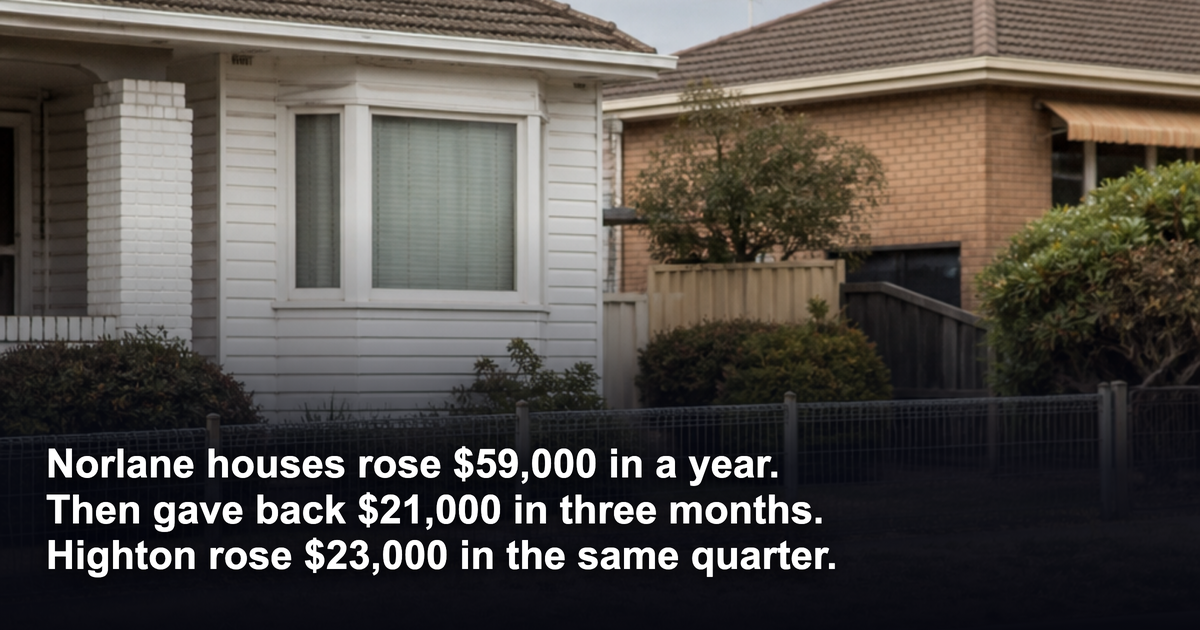
Norlane houses rose $59,000 in the year to September. In the last three months they gave back $21,000 of it.
That is the headline number from PropTrack's new quarterly suburb data for Geelong, published on 9 October. It matters to anyone with equity or cash who has been looking at a cheap, fast-rising suburb and thinking the hard part was getting in.
The hard part is picking growth that holds.
What the data says
PropTrack's automated valuation model gives a median house value for every Geelong suburb, with a quarterly and annual change. The pattern across the table is hard to miss.
The affordable northern and eastern suburbs had the best year. Corio houses rose 14 per cent, more than $70,000. Norlane rose 13 per cent, about $59,000. St Albans Park and Whittington both rose 10 per cent, around $62,000 and $51,000.
Every one of those suburbs went backwards in the September quarter. Norlane fell 4 per cent, Corio 2 per cent, Whittington and St Albans Park 1 per cent.
The suburbs that rose in the quarter were a different kind of place. Highton, with a median above $895,000, added 3 per cent, about $23,000. Wandana Heights added 2 per cent, about $19,000. Grovedale, Lara, Newcomb, Newtown and Leopold held flat.
The biggest quarterly falls were at the top end, in Manifold Heights (5 per cent, about $46,000) and central Geelong (4 per cent, about $34,000), along with the coast, where Lorne is down 14 per cent for the year.
Why the cheap suburbs turned first
The article quotes a local agent, Nick Lord of Maxwell Collins, explaining who had been buying in the sub-$700,000 bracket: investors and self-managed super funds. He says a surge of super fund buyers came through those suburbs, then rate rises cut borrowing capacity and the demand softened in the last quarter. PropTrack notes the figures landed as the Reserve Bank lifted rates for the fourth time this year.
A Geelong buyers agent, John O'Brien, describes the other half of the story. Interstate buyers agents from Sydney, Brisbane and Melbourne had been paying over the odds for houses sight unseen. He says those buyers have gone.
So the suburbs that ran hardest were running on borrowed demand. Investors chasing a cheap entry, super funds with a tax structure to fill, and interstate buyers who had never stood in the street. Take away borrowing capacity and that demand leaves faster than it arrived.
The suburbs that held were running on a different fuel. O'Brien says the buyer mix has shifted toward owner-occupiers heading for family suburbs like Highton, Belmont and Newtown, often with a particular primary school zone in mind. Families buying a home to live in do not stop wanting the school zone because the cash rate moved.
What it means if you have equity to deploy
If you own your home and have usable equity, Geelong is now a cleaner test than it was in March.
Six months ago the growth table rewarded whoever bought the cheapest suburb on the list. The quarterly numbers now split that list in two, and the split is about who else is buying, and why.
A 14 per cent annual gain in Corio looks very different once you know a chunk of it was interstate money paying overs. Some of that gain is real. Some of it was price discovery that ran ahead of the local market and is now being handed back.
A 3 per cent quarter in Highton looks modest until you ask who was bidding. Families with jobs in Geelong and kids at a specific school are the stickiest demand there is.
The decision, with the trade-offs
There are three ways a reader with equity could play this.
- Buy the dip in the north. Norlane's median is about $530,000, Corio's about $579,000. The article notes 4 per cent gross yields are still achievable at suburb medians across many Geelong markets, and many suburbs sit under the $950,000 cap on the federal 5 per cent deposit scheme, which keeps first home buyers in the pool. The risk is that you are buying into a market that just lost its marginal buyer and has not yet found the next one. Lord expects listing volumes to stay thin until February or March because it is an election year, which supports prices short term but tells you nothing about demand after that.
- Pay up for the family suburb. Highton at $895,000 or Belmont at $739,000 costs more and yields less. What you are paying for is depth of owner-occupier demand that does not switch off with the cash rate. Less growth in a boom, less give-back in a correction.
- Wait. The honest case for waiting is that stock may rise in autumn. The honest case against it is that the suburbs with the stickiest demand did not fall this quarter, so waiting for them to get cheaper may be waiting for something that does not happen.
None of these is personal advice. Each is a bet on a specific kind of buyer staying in a specific suburb, and that is a question you can actually research.
The street-level reframe
Suburb medians are a blunt tool. Norlane as a whole gave back 4 per cent, but two streets in the same suburb can be having completely different quarters. One street backs onto industrial land and was only ever bought by investors. Three streets over is a pocket of renovated weatherboards that owner-occupiers compete for.
The suburb table cannot tell you which street you are on. Days on market, vacancy, the owner-occupier share and the buyer mix at recent sales can.
That is the difference between a hotspot list and a portfolio. A hotspot list is an input. What counts is how the asset holds when the headline turns, which is why we publish our client results across the full distribution, including the portfolios that underperformed. Our clients' median portfolio growth has been 19.0 per cent a year on a 5-year rolling basis against about 4.3 per cent nationally (benchmark: CoreLogic/Cotality). Past performance is not a guarantee of future results.
The right asset on the right street, chosen on data about who buys there and why, beats the growth table. Structure, not timing.
If you are weighing a Geelong purchase and want to see how a street gets tested before the money goes in, join Jacob's free live webinar.
General information only. It does not take your objectives, financial situation or needs into account, and nothing here is legal, financial, taxation or investment advice specific to your circumstances.