News · 20 September 2026 · 5 min read
Twenty metres from cover: when a neighbour reprices your asset
Small businesses near Melbourne tobacconists are being denied fire cover because of a neighbour they cannot control — brokers put the threshold at about 20 metres. Insurers have already moved to pricing risk street by street; most investors are still shopping at the suburb level. What that means for how you value an address: R-Score, street-level heatmaps, achieved versus advertised rent, street-level vacancy, days on market for that exact stock type, approved-but-unbuilt competing supply and buyer depth on exit.
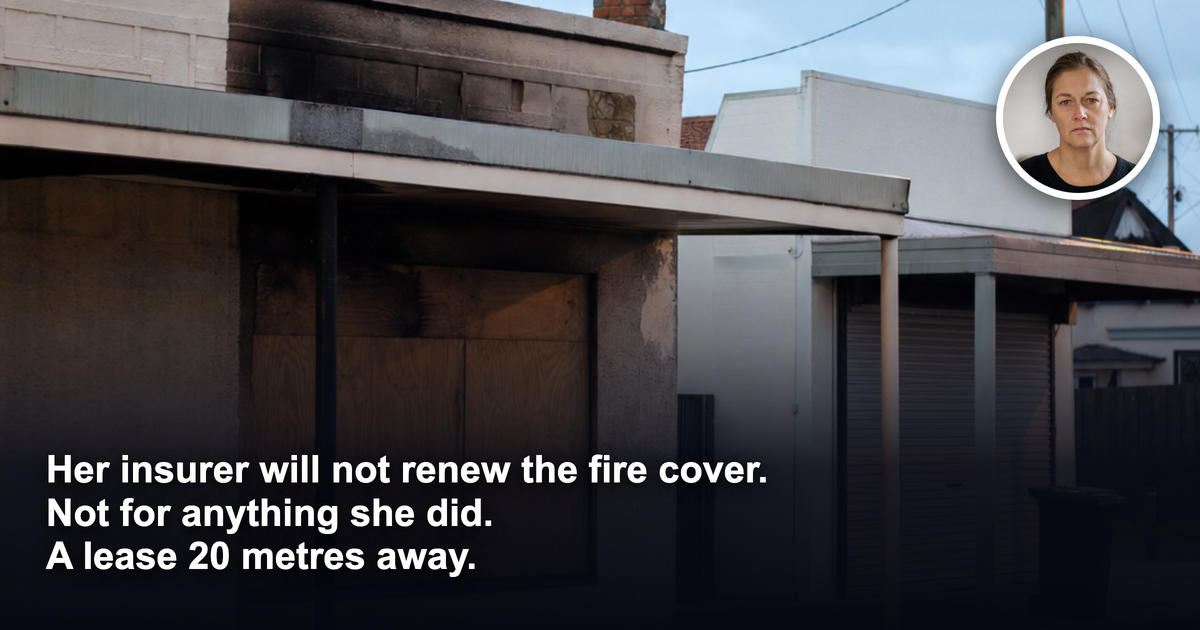
She did nothing wrong. Her building did not change. Her tenants did not change. But when the renewal notice arrived, the fire cover was gone — because of who signed a lease a few doors down.
That is the situation now facing small business owners across Melbourne, according to Guardian Australia reporting published on 20 September 2026. Businesses located near tobacconists are being denied insurance, or priced out of it, as arson attacks linked to the illicit tobacco trade turn neighbouring shops into collateral damage. One recent blaze destroyed a Richmond tobacco retailer and nearly a dozen neighbouring shops, and took 80 firefighters to contain. Government data cited in that reporting implicates crime syndicates in more than 200 firebombings of commercial and residential premises across Australia since 2023, as rival groups fight for control of the illicit tobacco market.
One Melbourne retailer, who asked not to be identified, told the Guardian their insurer refused to renew simply because they were a "few doors down" from a tobacconist. The quotes they received elsewhere excluded fire cover entirely. As they put it: "Even if we re-located, which is not really an option for us, who's to say a tobacconist doesn't move in next door?"
The chief executive of the Council of Small Business Organisations Australia, Skye Cappuccio, put the unfairness plainly: "Small businesses should not be left carrying the financial consequences of criminal activity that is beyond their control."
The owner who did everything right
Consider a woman who is a composite illustration — she is not a real person, and she is not connected to anyone named or described in the Guardian's reporting. She is 46. Years ago she and her family bought one small suburban investment: a modest shopfront with a flat above it, their main asset outside super. Call it worth about $740,000 — an illustrative figure only.
She has maintained the building. She has paid every premium on time. And in this illustration her insurer declines to renew the fire cover — not because of anything she did, and not because of anything about her property, but because of which business took a lease along the strip.
Her scenario is invented. The mechanism is not. Insurers have not disclosed what "close proximity" means, but brokers generally consider it to be within about 20 metres of a tobacconist, and tobacco retailers inside shopping complexes are seen as lower risk. Twenty metres. That is not a suburb. That is not a postcode. That is a handful of shopfronts.
The question every investor should be asking
If someone else can reprice your asset because of a neighbour you cannot control, what actually tells you what your property is worth?
Not the suburb median — a median does not know what leased next door. Not the listing page — it shows you the kitchen, not the tenancy mix fifteen metres away. Not the headline growth rate for the council area.
A Suncorp spokesperson told the Guardian the insurer no longer offers cover for tobacconist retailers, including renewals for existing customers, and that businesses located near tobacconists may still be eligible, with underwriting decisions based on a range of factors including the nature of the business and location-specific risks: "As with all commercial insurance, applications are considered on a case-by-case basis." A QBE spokesperson said decisions were assessed individually: "Where risk profiles change, this can influence the price, terms or availability of cover."
Read those two statements again. Location-specific risks. Case-by-case. The institutions that price risk for a living have already moved down to the street. Most investors are still shopping at the suburb level.
The answer is street-level data
This is Ripehouse Advisory's opinion, argued plainly: the suburb is the wrong unit of analysis, and this story is the sharpest illustration of it we have seen this year.
Our R-Score rates the investment quality of an individual street rather than a postcode. Our street-level heatmaps show how performance shifts block by block, because it does — and the reporting above suggests how a location can be repriced by something happening a few doors away rather than a few suburbs away.
We track achieved versus advertised rent, because what a landlord actually banks on a given street routinely differs from what the listing promised. We measure street-level vacancy, which is where a strip with a struggling retail frontage separates from the postcode average long before the median moves. We measure days on market for that exact stock type, because a two-bedroom flat above a shopfront behaves nothing like a freestanding house four streets away, and blending them hides the risk you carry.
We count approved-but-unbuilt competing supply within walking distance, because tomorrow's competition is already in the planning register today. And we test buyer depth on exit — how many genuine buyers actually compete for that exact property type on that exact street — because every risk discussed here only crystallises when you need to sell or refinance and discover who is still willing to transact.
Tie those together and you have what a median cannot: the specific street, not the average of three thousand homes around it.
What this means for you
Be careful with the read-across. The reporting concerns commercial insurance for small businesses near tobacconists. It does not say insurers are refusing residential cover, and we are not claiming that.
The transferable lesson is narrower and more useful. Serious risk is priced at street level, by parties with money at stake. The Australian Criminal Intelligence Commission notes that nearby small businesses are also affected by loss of foot traffic, revenue and reputation — effects that do not stop at a property boundary. The same government data records that those 200-plus firebombings have hit residential premises as well as commercial ones.
So if you own, or are about to buy, a property whose value depends on the strip it sits on — a flat above retail, a unit facing a shopping precinct, a house backing a commercial frontage — the composition of that strip is part of your asset. It belongs in your due diligence alongside rent, vacancy and days on market. And insurance terms should be confirmed directly with the insurer, in writing, before settlement rather than after.
The point
None of this is an argument against property. It is the argument for property done properly.
Headlines move on. Streets do not. The investors who do well through periods like this are not the ones who picked the loudest suburb; they are the ones who knew exactly which street they bought into, what competes with it, who rents it and who buys it on the way out.
The right asset, on the right street, chosen with data — that is what beats the headline every time.
General information only. It does not take account of your objectives, financial situation or needs, and it is not financial, legal or insurance advice. Insurance availability, pricing and terms change and are assessed individually; confirm cover directly with your insurer. All property investment carries risk, including loss of capital. Figures attributed to the persona above are illustrative.
If you own a property whose value can be altered by the strip around it, the webinar is a practical way to see how street-level data can help you test that risk before you buy, hold or refinance.
Frequently asked questions
Why are some Melbourne businesses near tobacconists being denied fire insurance cover?
According to the article, insurers are treating nearby tobacconists as a location-specific fire risk because of arson linked to the illicit tobacco trade. Some businesses have been refused renewal or offered quotes that exclude fire cover altogether.
How close does a property need to be for this insurance issue to matter?
Brokers generally consider the risk to be within about 20 metres of a tobacconist. The article says insurers have not disclosed an exact threshold, but the problem can arise from only a few shopfronts away.
What is the main property-investing lesson from this insurance story?
The article argues that risk is priced at street level, not suburb level. A neighbour, tenancy mix or nearby commercial use can affect the value, insurability and exit prospects of an address even if the broader suburb looks fine.
What street-level factors does the article say investors should check before buying?
It highlights R-Score, street-level heatmaps, achieved versus advertised rent, street-level vacancy, days on market for the exact stock type, approved-but-unbuilt competing supply and buyer depth on exit. These are meant to show how a specific street performs, not just the suburb average.
Does the article say residential properties are also being refused fire cover because of tobacconists?
No. The article says the reporting concerns commercial insurance for small businesses near tobacconists and does not claim residential cover is being refused. It does note that nearby businesses can still be affected by crime, foot traffic and reputation impacts.
General information only. It does not take your objectives, financial situation or needs into account, and nothing here is legal, financial, taxation or investment advice specific to your circumstances.