News · 20 September 2026 · 5 min read
He has to publish his reserve seven days before anyone bids
From 1 October Victorian sellers must disclose their reserve seven days before an auction or set-date sale, and release the achieved price within seven days on a mandatory document that does not exist yet, priced against comparable-sales criteria that has still not been finalised — with enforcement reaching back to campaigns listed before the law started. If your floor is public a week before bidding, only street-level evidence defends it: achieved versus advertised, days on market for that exact stock type, street-level vacancy, approved-but-unbuilt competing supply and buyer depth on exit, tied together by R-Score.
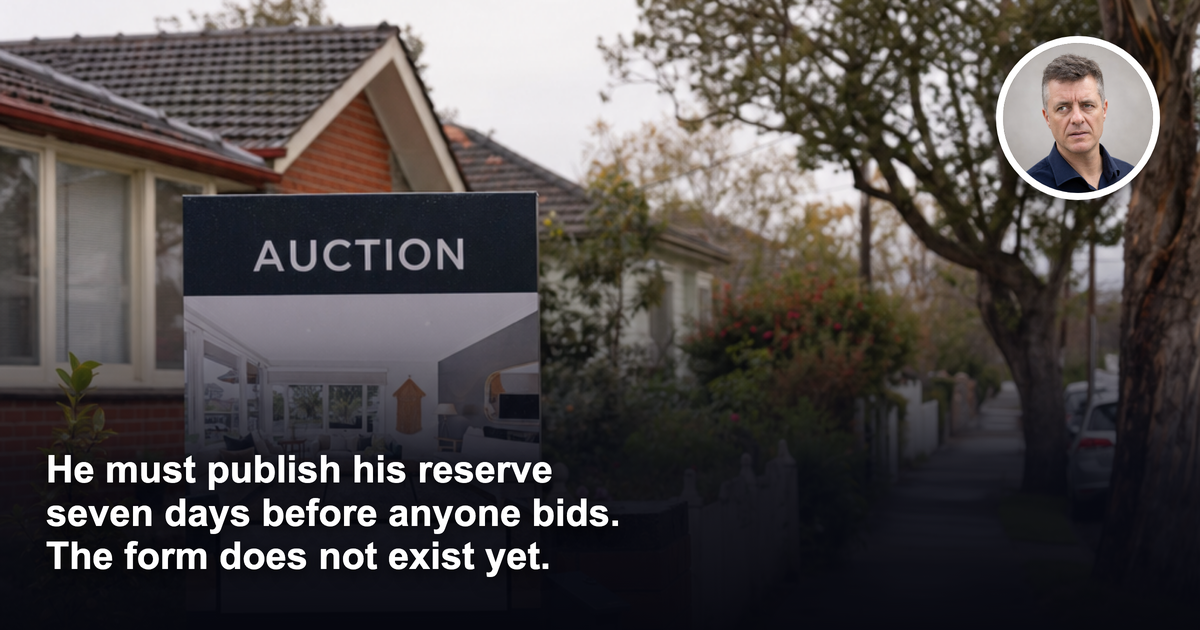
Consider a man in his early fifties selling the family home in Melbourne this spring. He is a composite — an illustration, not a real person, and not connected to anyone named in the reporting below. His campaign is booked, his auction falls in the second half of October, and he and his agent had settled on a reserve of about $920,000 before any of this landed.
Under Victoria's new auction and set-date laws, he must publish that figure seven days before anyone is allowed to bid.
Every buyer walking through his home will know his floor. He will know nothing about theirs.
What actually changed
From 1 October, Victorian sellers using an auction or another set-date method — expressions of interest, tender — must disclose their reserve price seven days before the sale. They then have seven days to release the achieved sale price after locking in a buyer, on a new mandatory document. According to the reporting, that document does not exist yet. When the agent prices the home, they must consider comparable local sales against criteria that has still not been finalised.
The rules bite harder than the start date suggests. Industry groups say the government will enforce the new requirements for all auction and set-date sales from 16 October — including homes that were listed before 1 October. A typical auction campaign runs four weeks. A seller listing this week cannot get to auction before the rules catch them without cutting their campaign short.
Consumer Affairs Victoria also clarified this week that where an agent invites offers by a certain time and date, "this could constitute a fixed-date sale and requires the seller's reserve price to be disclosed for seven days before the sale can proceed" — language that appears to reach into ordinary private treaty sales, not just auctions. REA Group data puts auctions attracting early offers at about 15 per cent of auctions across the state, and hundreds of sales a month.
Real Estate Institute of Victoria chief executive Toby Balazs said the legislation "doesn't suitably recognise that there's two sides of auctions", and that its timing "is particularly unfair for a property market that is typically resilient but is under significant challenges at the moment". He added that the changes leave things "more opaque for buyers, and for those who sell this is more onerous and involved in terms of them managing the sale in what is, for most people, their largest asset". Penalties for agents who breach the rules top out near $49,000 — a level Balazs called "disproportionate", the same exposure as dummy bidding, outlawed in 2004.
Not everyone reads it as a loss. Ray White Victoria chief auctioneer Luke Banitsiotis expects buyers will come to prefer disclosed reserves, though he concedes "it's going to be harder to start it off market", and sums the reform up as "the death of undisclosed sales results".
Be precise about what the law does not do. Gordon Legal lawyer Max Grech notes vendors are not liable for an agent's breach, and that reaching the reserve does not force anyone to sign: "In Victoria, the contract for the sale of land can only be finalised via the signing of a written contract."
The unfairness is the timing, not the transparency
Disclosed reserves are defensible. Buyers have wanted this for years, and the end of undisclosed results is a genuine gain for anyone working out what a street is really doing.
The injustice is narrower and harder to argue with. A class of ordinary people — Victorians selling what is, for most of them, the single largest asset they will ever own — are being held to rules whose mandatory form has not been written and whose pricing criteria have not been finalised, with enforcement reaching back over campaigns that started before the law did. One Cheltenham vendor quoted in the reporting, already selling because land tax increases made holding untenable, described the change as being kicked on the way out the door: "The only reason I'm selling is because the government has made it that difficult for us that I feel like I have to."
Meanwhile the market is thinning. Auction volumes are running about 40 per cent below a year ago, and auctions fell from 23 per cent of Victorian sales last year to 18 per cent this year. Melbourne has not recorded a single Super Saturday this spring, an event that had happened several times by this point last year.
So what decides his price now?
The question worth answering is not a legal one. If your floor is public a week before bidding, what defends it?
Only street-level evidence — the kind a reserve is supposed to be built on and too often is not.
- Achieved versus advertised. What comparable homes on and around his street actually sold for, not what they were quoted at. With disclosed results becoming mandatory, this gap is about to become visible to everyone. It should have been driving his reserve already.
- Days on market for that exact stock type. Not the suburb median. A four-bedroom house on 600sqm behaves nothing like a two-bedroom unit half a kilometre away.
- Street-level vacancy and rental depth. Our street heatmaps exist because vacancy and achieved rent vary street by street inside one postcode, and that variation sets the floor of investor demand.
- Approved-but-unbuilt competing supply. What comes out of the ground within walking distance over the next 24 months decides how many alternatives his buyers have.
- Buyer depth on exit. How many qualified buyers actually transact in his price band on his street each year. Thin depth is what turns a public reserve into a ceiling.
Tie those together and you get an R-Score: a defensible view of what a specific address is worth to the people most likely to buy it. A seller who has that can publish a reserve seven days early without flinching, because the number is evidence rather than hope. A seller who does not has just handed the market his guess, in writing, a week ahead of time.
What it means if you are buying or holding
The same logic runs in reverse. Disclosed reserves and mandatory price statements will, over the next 18 months, push a large amount of previously hidden Victorian sale data into public view. That is a gift to anyone doing genuine street-level work, and a problem for anyone whose strategy relied on others not knowing what things sold for.
None of this is an argument against property. It is an argument against buying and selling headlines. Rules change, campaigns get disrupted, governments legislate late and leave forms unwritten. The right asset on the right street, priced off what that street actually achieves, survives all of it. It is simply about to be much harder to pretend otherwise.
General information only, not legal or financial advice, and it does not consider your objectives or circumstances. Property values can fall as well as rise, and Victorian requirements are subject to change — confirm current obligations before acting.
If your floor is public a week before bidding, the real question is whether your reserve rests on street-level evidence or guesswork, and the Ripehouse Advisory webinar can help unpack that evidence before the market sees it.
Frequently asked questions
What do Victoria's new auction and set-date sale rules require sellers to disclose before bidding starts?
From 1 October, Victorian sellers using an auction or set-date method must disclose their reserve price seven days before the sale. They also have seven days after the property is sold to release the achieved sale price on a new mandatory document.
Do the new Victorian rules apply only to auctions?
No. The article says the rules apply to auction and set-date sales such as expressions of interest and tenders. Consumer Affairs Victoria also said that if an agent invites offers by a certain time and date, it may be treated as a fixed-date sale.
Can a seller still decide not to sell if the reserve is reached at auction in Victoria?
Yes. The article says reaching the reserve does not force anyone to sign, and a contract for the sale of land in Victoria can only be finalised by signing a written contract.
Why are some industry groups concerned about the timing of the new reserve disclosure rules?
Industry groups say the rules may be enforced from 16 October, including campaigns that began before 1 October. They argue this is unfair because a typical auction campaign runs four weeks, and sellers may have to shorten or disrupt campaigns already underway.
What kind of evidence does the article say should be used to set a reserve price in Victoria?
The article says a reserve should be based on street-level evidence, not broad suburb averages. It highlights achieved versus advertised prices, days on market for that stock type, street-level vacancy and rental depth, approved-but-unbuilt supply, and buyer depth in the price band.
General information only. It does not take your objectives, financial situation or needs into account, and nothing here is legal, financial, taxation or investment advice specific to your circumstances.