News · 19 September 2026 · 5 min read
She bought with a 5% deposit. Now she carries the downside
APRA data shows $15.6 billion in low-deposit loans written since the Home Guarantee scheme was uncapped, while 90-day arrears hit $25.9 billion and Australians pulled a record $8.6 billion out of offsets. For a buyer with 5% down, the deposit is not the decision — achieved rent, street-level vacancy, days on market, approved-but-unbuilt supply and buyer depth on that exact street decide whether the loan survives the cycle.
The invitation was clear. Skip the years of scrimping for a 20 per cent deposit, skip Lenders Mortgage Insurance, and get in with 5 per cent down, backed by the federal government's uncapped Home Guarantee scheme.
Australians took it. APRA data reported by realestate.com.au this week shows $15.6 billion in low-deposit loans written in the nine months since the scheme was uncapped.
Then the same environment delivered three cash rate hikes in 2026, with a fourth widely expected at the Reserve Bank's 28–29 September meeting. Values are sliding. The people holding the downside are the ones who accepted the invitation.
The buyer the policy was built for
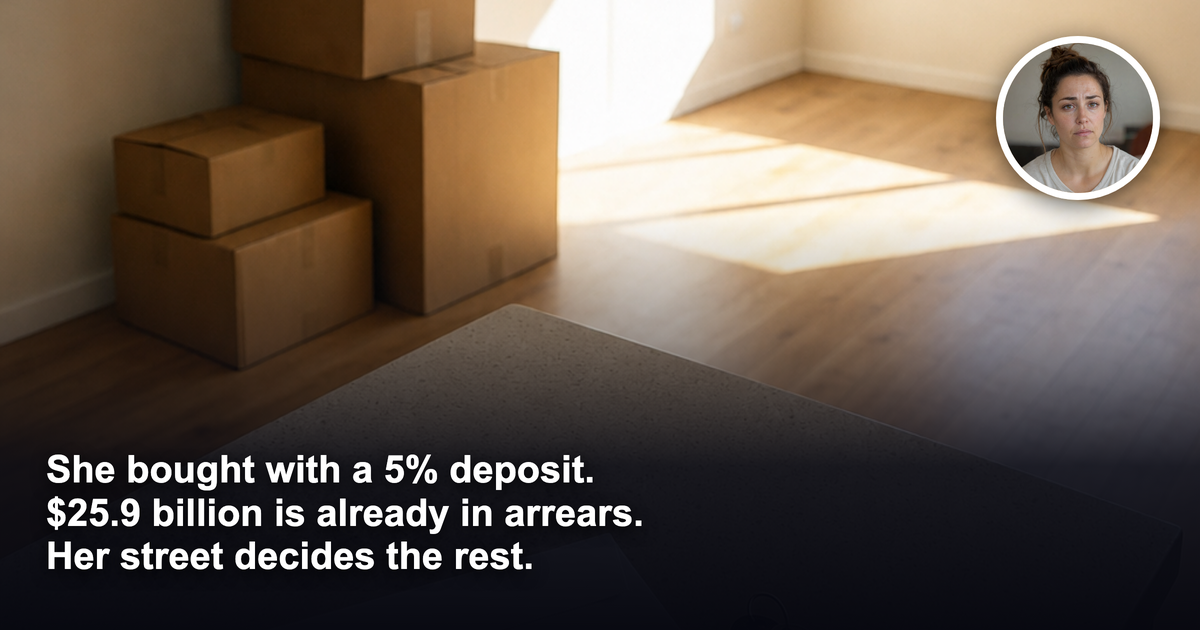
What follows is a composite illustration. She is not a real person, and not connected to anyone named in this article or its sources.
She is 29. She bought her first home this year through the uncapped Home Guarantee scheme with a 5 per cent deposit, saved thousands in Lenders Mortgage Insurance, and got through the front door years earlier than she otherwise could have.
Since settlement she has absorbed three rate rises with almost no equity between her loan balance and her home's value. She did not overreach or gamble. She did precisely what the policy invited her to do — bought at maximum leverage, near what may prove to have been the top of the cycle.
If her suburb slips even modestly, she owes more than the place is worth.
The question nobody answered before she signed
What happens to a 5 per cent deposit when prices fall and rates rise at the same time? The brochure never addressed it. The numbers now answer it.
Loans written with a 5 per cent deposit made up 4.31 per cent of all new owner-occupier lending in the quarter — a meaningful cohort sitting on wafer-thin equity as the market turns.
Canstar's data insights director Sally Tindall put it bluntly: "The number of borrowers getting into the property market with barely any skin in the game has surged yet again, at the same time the housing market is shifting into reverse."
The stress signals are no longer theoretical:
- Mortgages 90 or more days in arrears now total $25.9 billion — 1.01 per cent of all mortgages, a second consecutive quarterly rise, and above the post-2019 average of 0.93 per cent.
- Loans 30 to 89 days past due rose for a second straight quarter, to 0.54 per cent of credit outstanding.
- 24 per cent of new mortgages in the June quarter were interest-only, up from 21 per cent a year earlier.
- Australians pulled $8.6 billion out of offset accounts in the June quarter — the biggest quarterly fall on record. The buffers are being spent.
"Mortgage arrears are starting to flash amber," Tindall said, "with the share of loans behind by 90 days or more now sitting above its post-2019 average." Her sharper line: "Borrowers have been remarkably resilient through the rate cycle, but resilience isn't an infinite resource."
Nor is the RBA riding to the rescue. Economists widely expect the September meeting to lift the cash rate to 4.6 per cent; RBC forecasts a peak of 4.85 per cent, with some seeing another hike in November. Deputy governor Andrew Hauser told the House Standing Committee on Economics: "We're probably rather closer now to a more sensible level of long-term global real interest rates than we were a year or two ago."
That is the setting, not a blip waiting to be reversed.
The asymmetry, stated plainly
This does not require a villain, only that the asymmetry be stated honestly. A scheme encouraged first home buyers to enter at maximum leverage. The wider policy environment then produced three rate rises and falling values. The people who designed the invitation carry none of that risk. The people who accepted it carry all of it.
Tindall's own read is not a doom call: "While many of these borrowers, particularly in Sydney and Melbourne, are likely to be in negative equity, if they can keep their head down and their mortgage payments up, they should be able to rise out of what can potentially become a tricky financial position."
That is the real point. Negative equity is crystallised only when you sell or refinance. Everything between now and then is decided by whether the asset underneath the loan holds.
What actually decides whether her street holds
Here is where the national numbers stop being useful. A 5 per cent deposit is not one risk. It is a completely different risk on two streets four kilometres apart, and almost nobody checks which one they bought on.
This is the work we do at street level rather than suburb level:
- R-Score compresses a street's fundamentals into one comparable number, so a buyer compares like with like instead of a suburb median against a headline.
- Street-level heatmaps show where value actually sits inside a suburb. Two addresses can share a postcode and a median and behave nothing alike through a downturn.
- Achieved versus advertised rent is the gap between the yield in the brochure and the yield in the bank account. On a thin-equity loan, that gap is the buffer.
- Street-level vacancy and days on market for that exact stock type show how fast the street clears when conditions tighten — exactly when a high-leverage owner needs it to.
- Approved-but-unbuilt competing supply within walking distance is the most commonly missed risk. Stock not yet built still competes with you the day it lands.
- Buyer depth on exit answers the only question that matters if life forces a sale: is anyone there to buy it?
Our composite cannot change the cash rate, the scheme or the cycle. What the next buyer still can change is which street the leverage sits on. A 5 per cent deposit is far more survivable on a street with depth, real achieved rent and no wall of approved supply behind it.
What this means for you
If you are buying with a thin deposit, the deposit is not the decision. The street is. Test the address, not the postcode: achieved rent against advertised rent, real vacancy, how long that exact stock type takes to sell, what is approved but not yet built nearby, and who is buying on exit.
If you already own with thin equity, the same data tells you whether to hold, reduce or restructure — before your bank does.
Headlines describe the market. Data describes your asset. The right asset on the right street, bought on evidence, is what survives a cycle like this one — and that is a case for property investment done properly, not against it.
Want to know what the data says about your street? Talk to Ripehouse Advisory about a street-level assessment.
General information only. It does not consider your objectives, financial situation or needs, and is not financial, credit, tax or legal advice. Property is leveraged and illiquid: values can fall, rates can rise, losses are possible. Seek licensed advice before acting.
For buyers with thin equity, the real concern is whether their street has enough demand, rent and supply discipline to withstand a downturn, which is exactly what a Ripehouse Advisory webinar can help unpack before a forced sale or refinance becomes a problem.
Frequently asked questions
Why is buying with a 5% deposit riskier when property prices fall and interest rates rise?
With only 5% down, there is very little equity buffer. If values fall while repayments rise, a borrower can end up owing more than the property is worth.
What does the article say matters more than the deposit when you buy with thin equity in Australia?
The article says the street matters more than the deposit. It points to achieved rent, street-level vacancy, days on market, approved-but-unbuilt supply and buyer depth on that exact street as the real tests of whether the loan can survive.
What signs suggest mortgage stress is building in Australia?
The article points to $25.9 billion in mortgages 90 days or more in arrears, rising 30 to 89 day arrears, and Australians withdrawing a record $8.6 billion from offset accounts. It also notes more new loans are interest-only.
Can someone who bought with a 5% deposit avoid negative equity if prices fall?
Yes, but only if they keep making repayments and do not need to sell or refinance. The article says negative equity is only crystallised when the property is sold or refinanced.
What should a buyer check before taking a low-deposit loan under the Home Guarantee scheme?
The article says to test the address, not just the postcode. That means checking achieved rent versus advertised rent, vacancy, days on market for that stock type, nearby approved-but-unbuilt supply, and buyer depth on exit.
General information only. It does not take your objectives, financial situation or needs into account, and nothing here is legal, financial, taxation or investment advice specific to your circumstances.